When to Float in Poker: Board, Turn Card and the Math
Learn when to float in poker: which boards and turn cards to attack, which opponents to target, and the simple break-even fold math behind the turn bet.
Most flop continuation bets are not strong hands. A regular player opens, the board misses him, and he fires one small bet because the math tells him to. Fold every time and he prints money.
Floating answers that. Call his flop bet in position with a weak hand, then take the pot when he checks the turn. Four things decide when to float in poker: position, board texture, the turn card and your opponent’s habits. Price is the fifth, and you can work that out in big blinds before you put a chip in.
What floating means, and what it isn’t
Floating is calling a flop bet with a weak hand, little to no showdown value, and the plan to bluff a later street once your opponent slows down. That definition comes from PokerCoaching, and the plan for the turn is the whole reason for the call.
Two conditions keep the play from becoming a donation. You want a heads-up pot, and you want some backup equity such as a backdoor draw, an overcard or a gutshot, as Upswing Poker points out. A call with no plan for the next card is just a call. PokerCoaching puts it bluntly: calling two streets with no equity and no plan loses money in two installments.
Float versus calling with a real draw
With a flush draw or an open-ended straight draw, you call because the draw pays for itself. You expect to win at showdown when you hit. A float wins when your opponent’s range goes weak, and any draw is a bonus. The two plays split on the turn. A real draw can call a second barrel. A pure float usually folds there.
Float versus bluff-raise
A bluff-raise puts two bets in at once and ends the hand on the flop. It risks more chips to win the same pot, so it needs a high fold rate right now. A float costs one small bet and keeps the hand alive. The raise punishes players who fold to pressure. The float punishes players who give up on the turn.
Double float
Calling the turn as well, then betting the river when checked to, turns a float into a double float. This should usually be limited to hands that hold at least some equity and can make the nuts or near-nuts on a few river cards, or otherwise some strong read that tells you with high certainty you can bluff out your opponent.
When to float in poker: position comes first
In position is the baseline. Acting last on every street means you see the turn card and villain’s action before you commit more chips. Most tracking tools define a turn float as a flop call in position for that reason, according to Hand2Note.
Position also buys you a free card. When the turn helps his range, you check back and see the river for nothing. Out of position, a second barrel often arrives before you know where you stand.
The out-of-position float from the big blind
A float is a flop call with a hand that has little or no immediate showdown value, made with the explicit plan of taking the pot later—usually after the opponent checks the turn.
In position this is relatively straightforward: you see the opponent’s action first, then bet when they give up.
Out of position the same idea is much harder because you must act first on every subsequent street.
You therefore need several favorable conditions stacked together to float out of position:
- You are in the big blind (cheap call, closing the action preflop).
- The board is low and disconnected (or paired-low), so it connects poorly with a typical button/cutoff opening range that is heavy in Broadway cards, high pairs, and big suited aces.
- Your own defending range contains many suited connectors, small pairs, and suited gappers that can represent a wide variety of made hands and draws on that texture.
- The opponent is the type who continuation-bets frequently but gives up a meaningful percentage of the time on the turn when called.
- You hold a hand with at least some backdoor equity (backdoor flush draw, backdoor straight draw, or strong overcards) so you are not purely bluffing without outs.
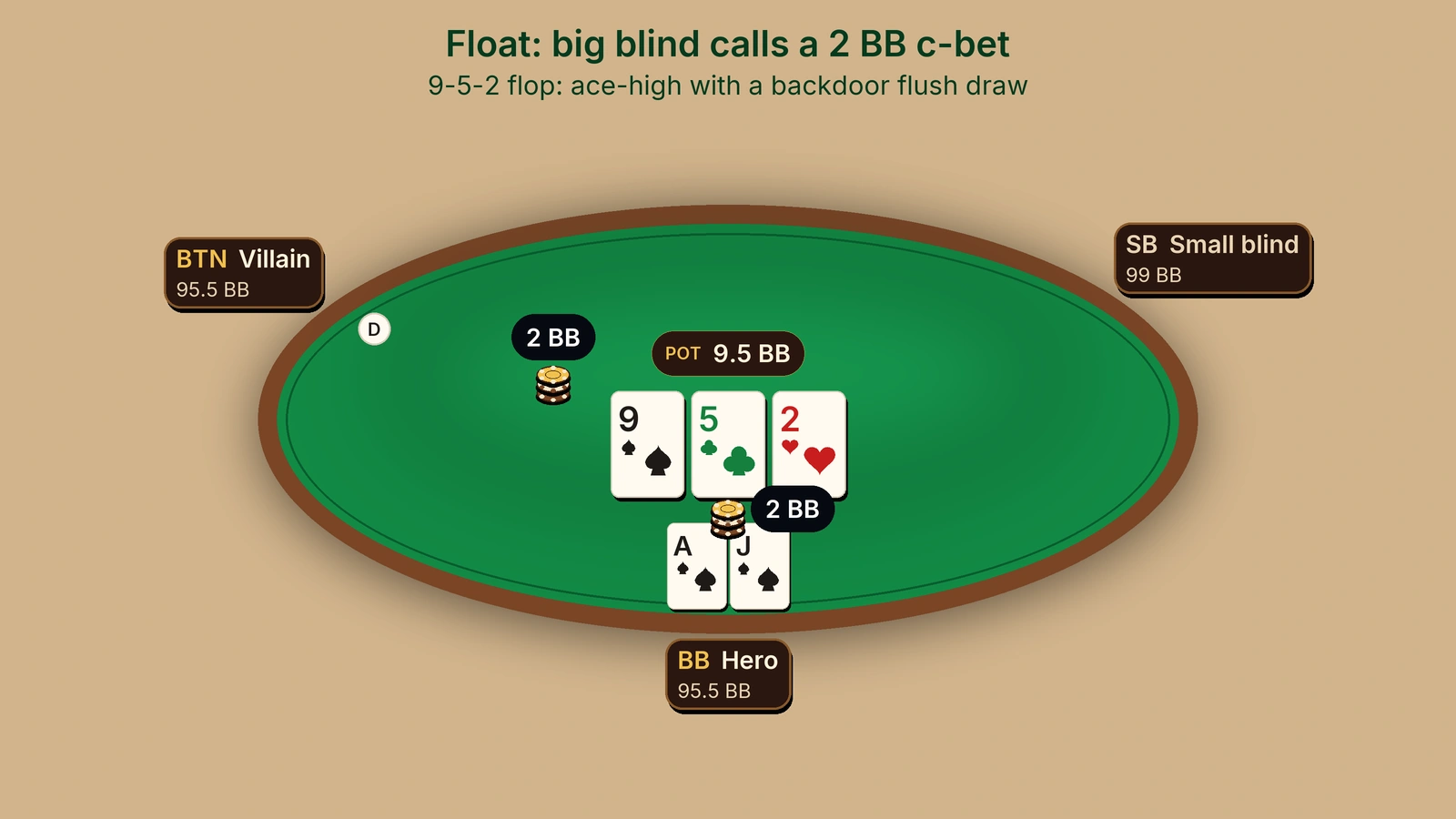
PokerCoaching (Jonathan Little) frames the play exactly this way: mostly from the big blind, on boards such as 7-6-3 or 9-5-2, and you check the turn rather than lead. The cheap preflop call plus the board missing the raiser’s range creates the equity and fold-equity window that makes the float viable. Upswing teaches the identical concept through board texture.
The drier the board, the wider the profitable float range. Their classic example is the big-blind float range on 8♠8♥4♥ versus a button open: mainly ace-high hands that also have a backdoor flush draw, plus the strongest king-high hands that have a backdoor flush draw. On wetter boards the float range shrinks sharply because the raiser’s range connects better and you have fewer scare cards that favor your perceived range.
Which hands you even reach the turn with depends on your preflop defence. A sound big blind defence plan versus a button open at 20 BB decides whether you have the right hands for this play.
Why check the turn instead of leading (donking)?
A donk bet splits your range into two visible piles. The in-position player can immediately read something from the fact that you chose to lead: either you are polar (strong value or pure bluff) or you are unbalanced - meaning the hands you lead with are skewed in strength or frequency, so the bet itself becomes readable and exploitable.
Checking keeps your entire range together: sets, two-pair, strong one-pair, weak one-pair, draws, and pure floats all take the same line. You also retain the option of a free river if the opponent checks behind, and you force them to decide whether to barrel or give up without the extra information a lead would have given them.
Only after they check do you decide whether to stab (usually 50-60% pot) or sometimes raise if you pick up a strong draw. Leading the turn with a donk bet is reserved for rare, highly specific textures where your range has a clear nut advantage and the opponent’s range is capped.
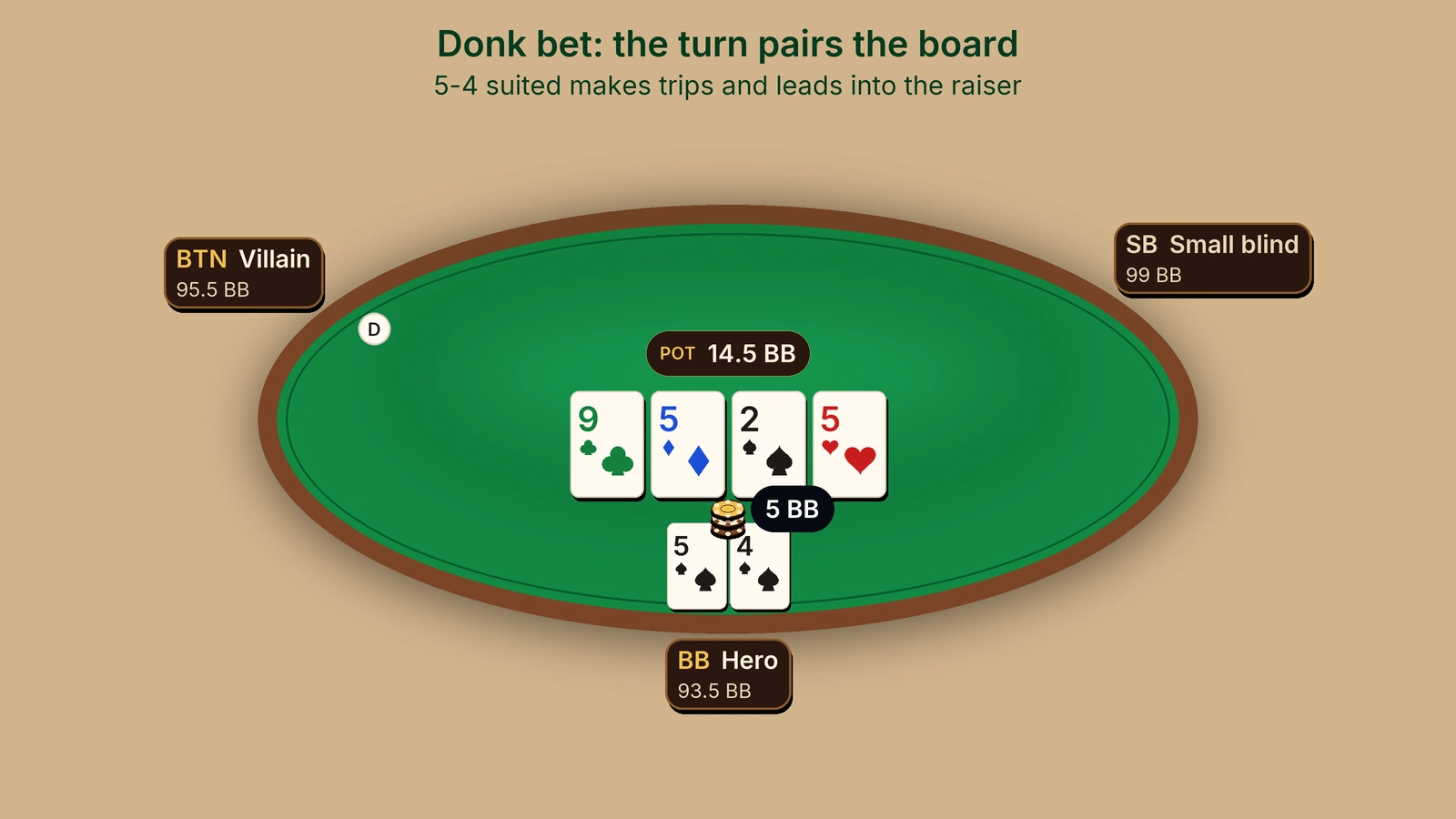
Donking makes sense when the board suddenly gives your range a clear edge in the strongest hands (the nuts), and the other guy’s range gets capped, meaning a lot of his strong preflop hands didn’t improve and are now just medium-strength.
Think of boards where a low or middle card pairs on the turn (like flop 9-5-2 and turn is another 5 or 2). Suddenly you have way more trips and full houses than he does, while a lot of his high cards and overpairs are stuck looking weaker.
In those cases you can lead out with a mix of strong hands and some bluffs, and it works.
But most of the time the turn doesn’t create that kind of imbalance for a donk bet. So the normal play stays the same: just check and keep your whole range together.
The board: float where the raiser is thin
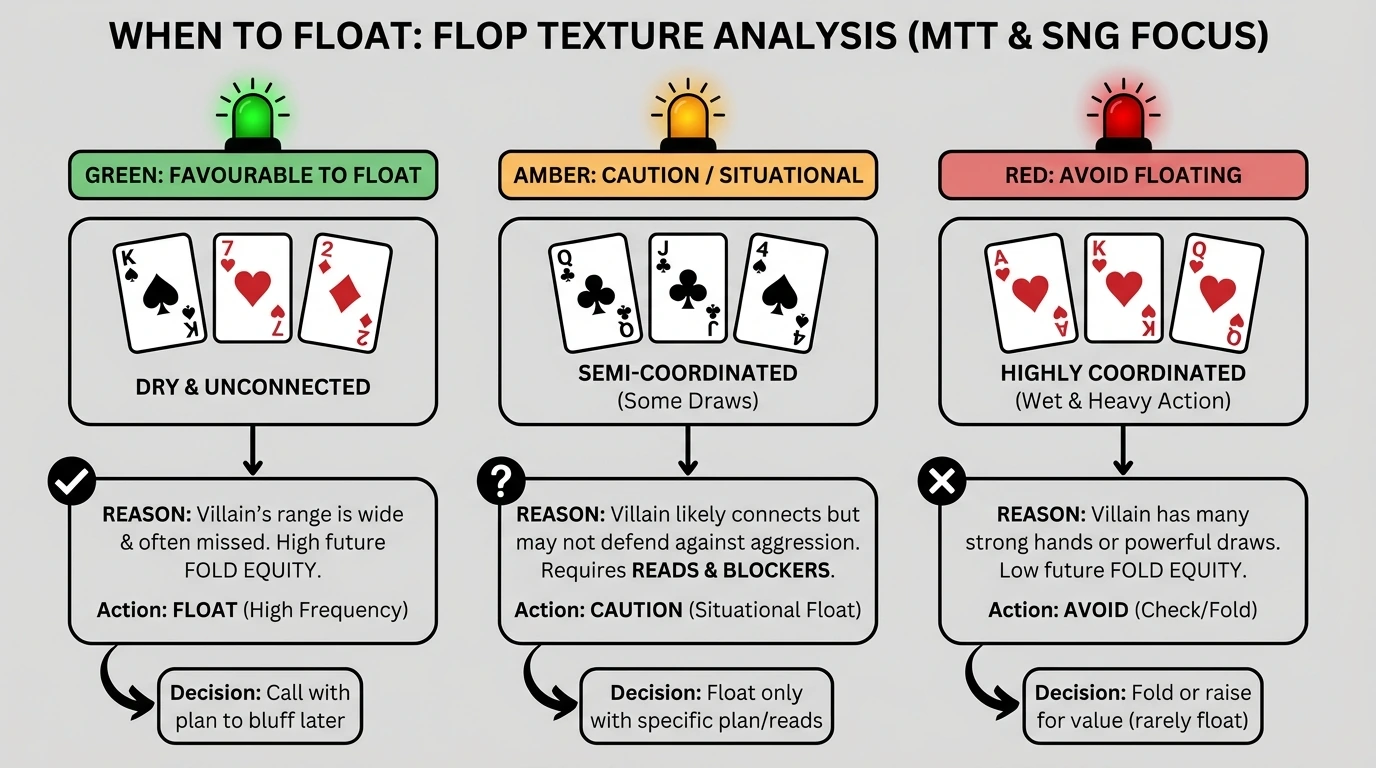
Float on low, disconnected flops that miss a raiser’s range and leave you with straights, two pair and trips. Fold on ace-high and Broadway boards that hit his range hard.
PokerCoaching names A♠K♥T♦ as a bad float board. The opener, and a three-bettor in particular, holds AA, KK, TT, QJ, AK, AT and KT on that flop. Your call has to dodge most of the deck. A flop like 8♣7♠4♦ runs the other way. He has overpairs and ace-high, and you have far more two pair, straights and sets.
| Flop | Example | Float? | Why |
|---|---|---|---|
| Low, disconnected rainbow | 8♣7♠4♦ | Yes | You hold more two pair, straights and sets |
| Low and connected | 7♥6♥5♣ | Rarely | His range has more made hands and big draws |
| Paired low board | 6♠6♦2♣ | Sometimes | Fewer combos for him, but trips stay in his range |
| Ace-high rainbow | A♠K♥T♦ | No | AK, AT, KT, AA, KK, TT and QJ all connect |
| Broadway two-tone | Q♥J♥T♠ | No | He holds the big pairs and the big draws |
| Dry king-high | K♠7♥2♦ | Yes, versus small bets | His edge is real but thin |
Range advantage decides how often you continue, and nut advantage decides how big you bet. A board where he holds all the sets and you hold none is a bad place to float, even when your raw equity looks fine.
The turn card decides the barrel
The turn card matters more than the flop. Some turns grow your equity and shrink his. Others do the opposite, and then you check behind or fold.
GTO Wizard ranked turn cards in a button-versus-big-blind pot on K♠7♥2♦, after a 33% c-bet and a call. The offsuit ten was the best of the four for the raiser’s range at 49.9% equity, because it improved his backdoor straight hands (AJ, QJ, 98). The ace came next at 45.9%, a brick five at 44.5%, and a paired king was the worst (GTO Wizard). Read that list from the floater’s side: a turn that helps his backdoor hands is the turn where your plan dies, and a card that leaves him near or below even is the one you can attack.
That gives you a simple triage for the turn.
- Blank that misses both ranges: bet. Small is fine, since he either has a pair or he does not.
- Card that improves your hand: bet. You now have outs when called.
- Card that completes a draw you can represent: bet, but size down if it also helps him.
- Card that fills in his range, like a ten that hits his backdoor straights: check behind and take the free card.
- Board pair: barrel only when your calling range holds more trips than his; otherwise check.
When he checks, PokerCoaching recommends a bet of 50% to 60% of the pot. Bigger bets cost more when you are wrong, and the small bet already does the job against a player who c-bet with air. Past 60%, your risk climbs faster than his fold rate does.
Your equity: pick hands with a path forward
Float with at least one route to a strong hand. Pure air gets expensive, because you pay twice and win once.
A backdoor flush draw is the cheapest route. Completing from the flop happens about 4% of the time, or once in 25 hands, per Card Player. That number alone never justifies a call. The real value shows up on the turn: one more spade turns your hand into a nine-out flush draw, which is a hand you can bet with confidence.
Backdoor straights and a single overcard add smaller slices of equity. A gutshot gives you a real draw right now. Two overcards with a backdoor flush draw make the classic in-position float. Upswing adds the suited broadway hands (KTs to KQs, ATs to AQs) to reach a healthy continue frequency on 9♥8♠5♦, lifting their in-position continue rate from 45.5% to 58%. A similar 3-bet spot on T♠8♦4♥ goes from 53.1% to 72.2%.
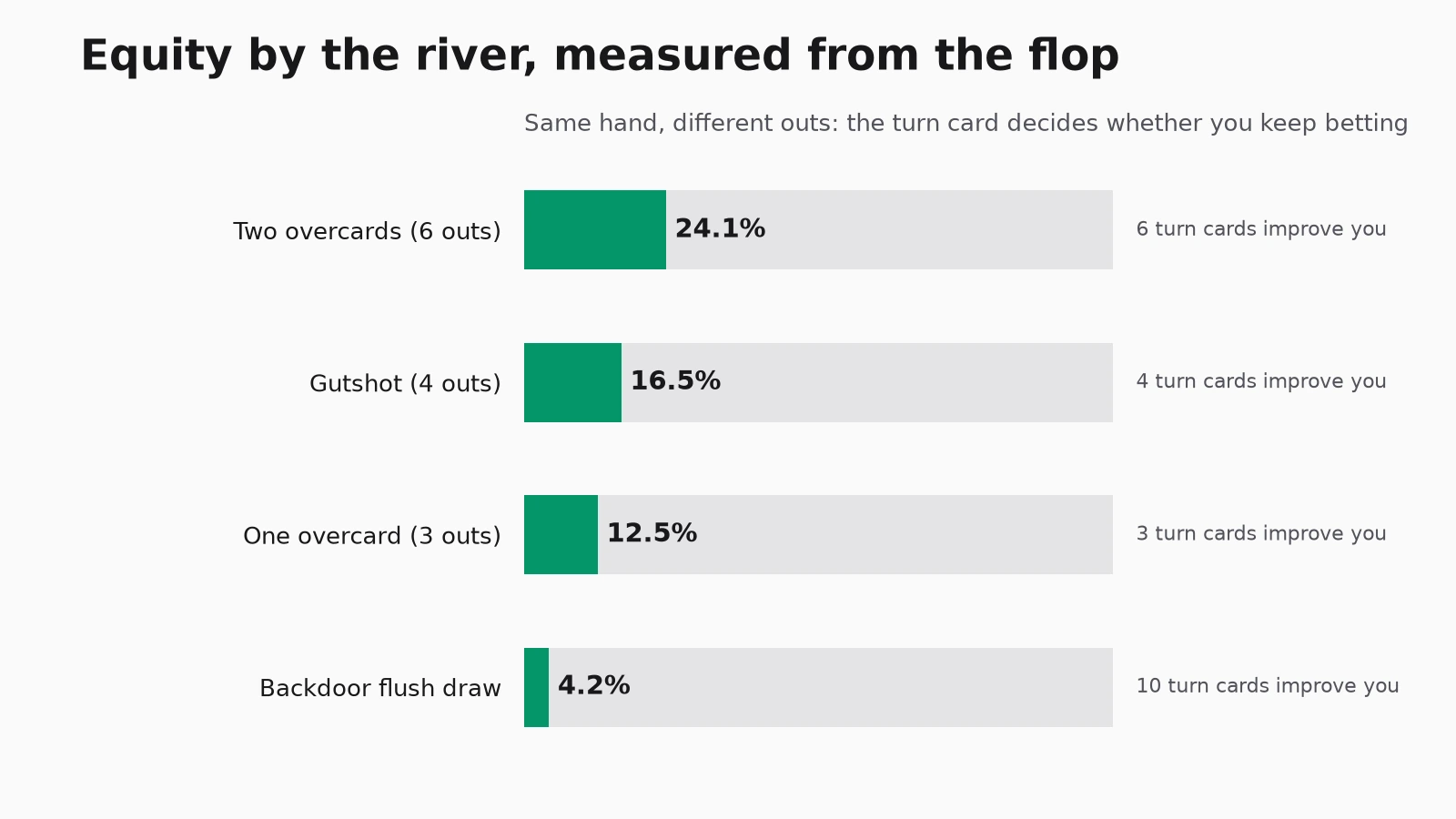
Count the turn cards that give you a real hand. If that count is close to zero, you’re guessing.
How often does he have to fold?
A 6 BB bet into a 10.5 BB pot breaks even at 36.4% folds when your hand has no equity. Give it 15% equity when called and the same bet needs about 20% folds to break even.
The no-equity figure is easy. Break-even fold rate equals bet divided by pot plus bet: f = B ÷ (P + B) = 6 ÷ 16.5 = 36.4%.
Equity changes the second half of the sum. You lose less when he calls, so you need fewer folds:
loss when called: L = B − e × (P + 2B)
break-even folds: f = L ÷ (P + L)
B is your bet, P the pot before it and e your equity when called. With B = 6, P = 10.5 and e = 0.15, L = 6 − 0.15 × 22.5 = 2.6 and f = 2.6 ÷ 13.1 = 19.8%.
| Turn bet into a 10.5 BB pot | Folds needed, no equity | Folds needed with 15% equity |
|---|---|---|
| 3 BB (29%) | 22% | 5% |
| 5 BB (48%) | 32% | 16% |
| 6 BB (57%) | 36% | 20% |
| 7.5 BB (71%) | 42% | 26% |
Smaller bets need far fewer folds, which is why the 50% to 60% pot sizing works so well as a default. A little equity goes a long way too, because it trims the required fold rate by a third or more.
The same spot in big blinds
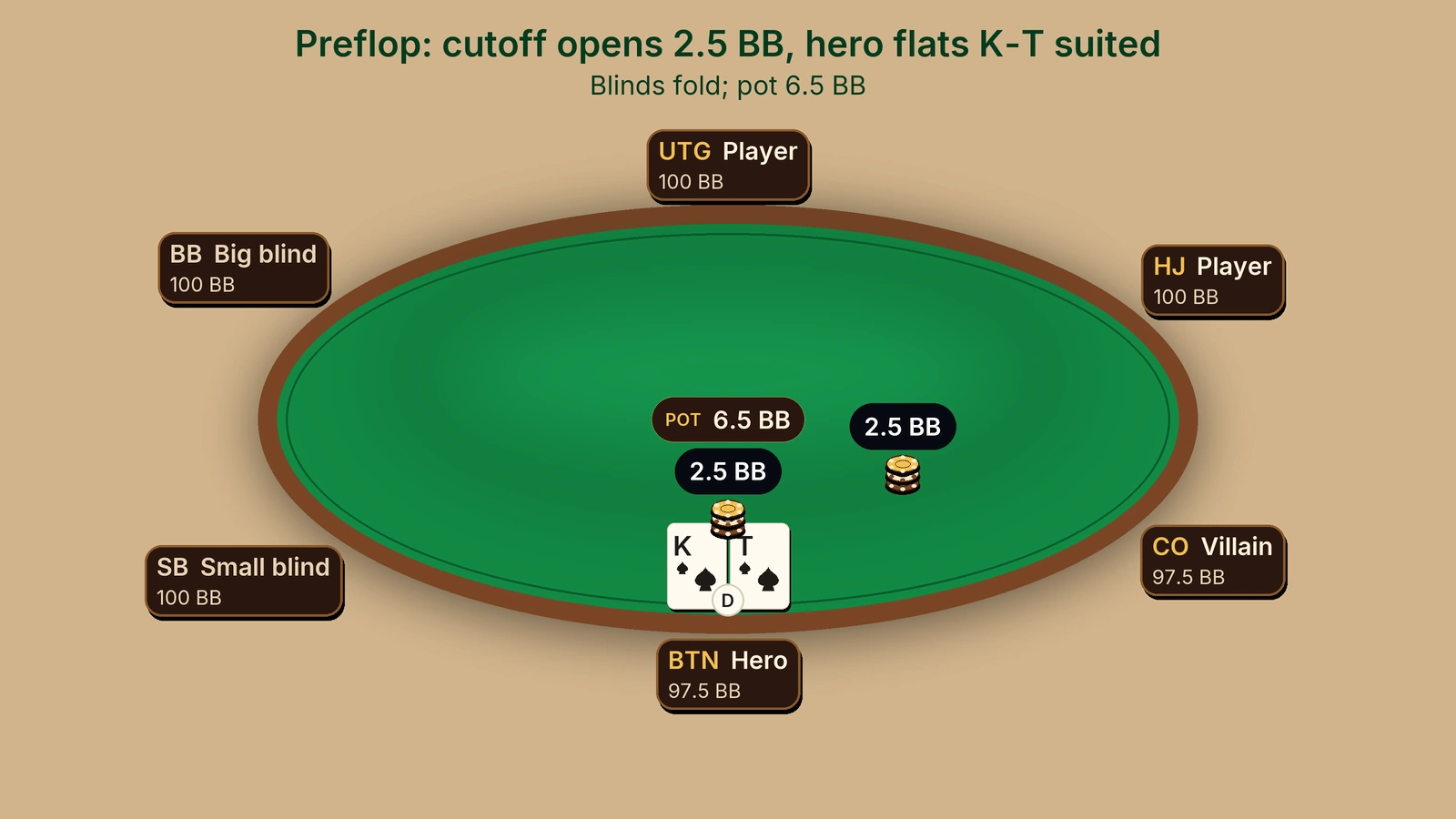
Here’s a representative setup at 100 BB effective. The cutoff opens to 2.5 BB, and you flat K♠T♠ on the button. The blinds fold. The pot is 6.5 BB.
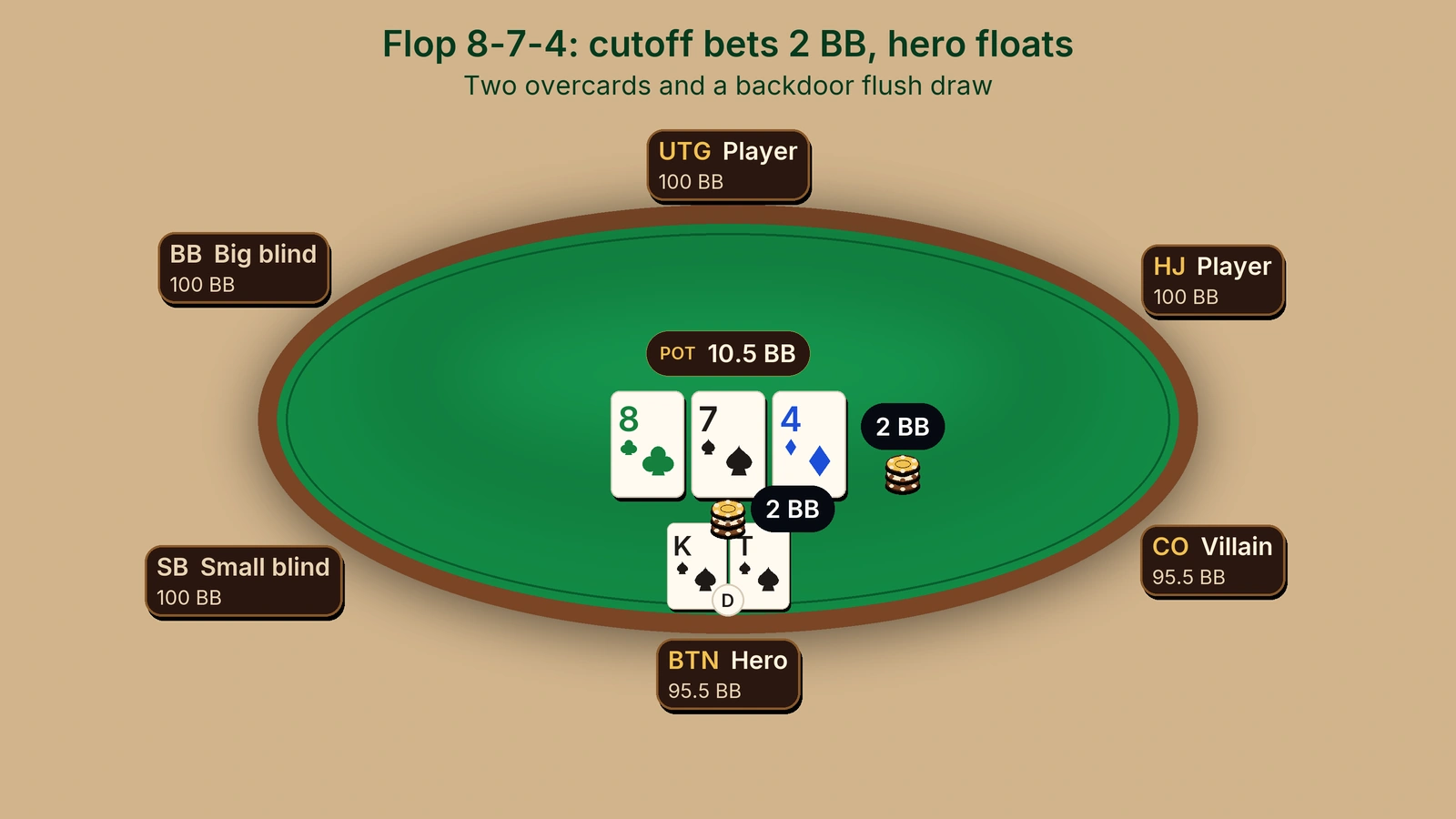
The flop comes 8♣7♠4♦ and he bets 2 BB, about 31% of the pot. Two overcards and a backdoor flush draw sit in your hand, plus a board that misses his range. Calling 2 BB brings the pot to 10.5 BB.
The turn is the 2♠. He checks. Four spades now sit in your hand, so any spade on the river makes a flush.
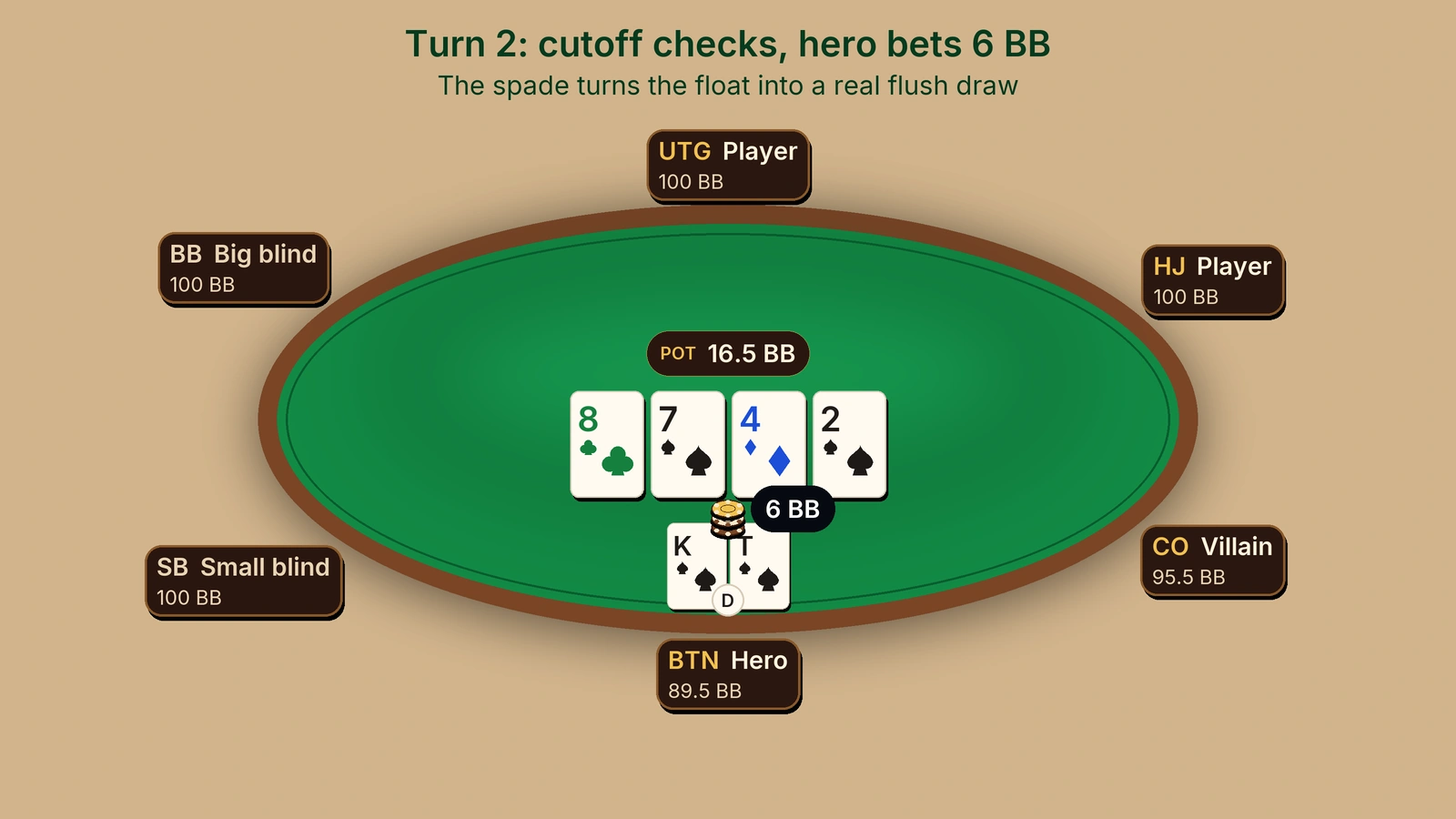
Betting 6 BB into 10.5 BB is roughly 57% of the pot. With no equity that bet needs 6 ÷ 16.5, or 36.4% folds. Against a calling range of 99+, A9s+, KTs+, QTs+, JTs, T9s, 98s, 87s, 76s, ATo+ and KQo, K♠T♠ holds 35.1% equity. With that much equity the bet does not need folds at all: when he calls, 35.1% of the 22.5 BB pot is 7.9 BB, more than the 6 BB risked. The float earned its money because the turn card gave you a real draw on top of the plan.
Blank the turn instead, say a 3♦, and two overcards are all you have left. Now the bet is a pure bluff: with no equity, 6 BB into 10.5 BB needs 36.4% folds, so the play depends entirely on how often he gives up.
Which opponents to float
Float the players who give up on the turn, and leave the rest alone. PokerCoaching’s rule of thumb is that any opponent who continues on the turn less than half the time after c-betting the flop is a profitable float target. That’s his rule of thumb from experience, with no stated sample size, so check the number yourself over a few hundred hands.
| Player type | Float? | Why |
|---|---|---|
| Fit-or-fold regular | Yes, often | C-bets wide, then surrenders when the flop bet fails |
| Tight-aggressive regular | Selectively | His c-bet range is stronger, but he also barrels turns |
| Calling station | No | He calls the turn and the river, so your bluff never lands |
| Maniac or aggro | Rarely | He fires the turn again, so you need real equity to continue |
| Weak-tight | Yes | He folds to pressure, and small bets do the job |
Against an unknown, float only the hands with a clear draw.
Heads-up or multiway
A float needs one fold, and that’s why it works heads-up. Add a third player and every opponent has to fold. Two opponents who each fold 60% of the time both fold only 36% of the time, because 0.6 × 0.6 = 0.36, as SplitSuit lays out when explaining multiway bluffs.
Losing that pot happens 64% of the time, and your turn bet would need a much better story or a much bigger size. Neither is reliable when two players hold cards.
A multiway call with a weak hand is a draw call. You call because you can make a strong hand and get paid by two players. The plan is to hit and build a pot.
The flop side tells the same story. Regulars with a VPIP of 25% or lower c-bet about 60% of the time heads-up and about 43% of the time in pots with three or more players, per Hand2Note. A multiway c-bet is a strong range, and a strong range doesn’t fold to one turn bet.
Stack depth, SPR and bet size
Stack-to-pot ratio is the effective stack divided by the pot. It tells you how much room you have left after the flop call.
At SPR 3 or lower, a float becomes a commitment play. Call, he checks, you bet, and you’re nearly all in with a weak hand. That needs real equity, so tighten up.
At SPR 10 and above, the float gets room to breathe. A 2 BB call on the flop leaves two more streets and plenty of stack behind, which is where backdoor draws earn their keep.
Shallow tournament stacks push the sizing down. GTO Wizard’s turn work shows the most common turn size at 20 BB dropping from an overbet to about 50% of the pot, and draws lose value with less money behind (GTO Wizard). If the turn bet commits a third of your stack, you need a hand that can call a raise.
When not to float
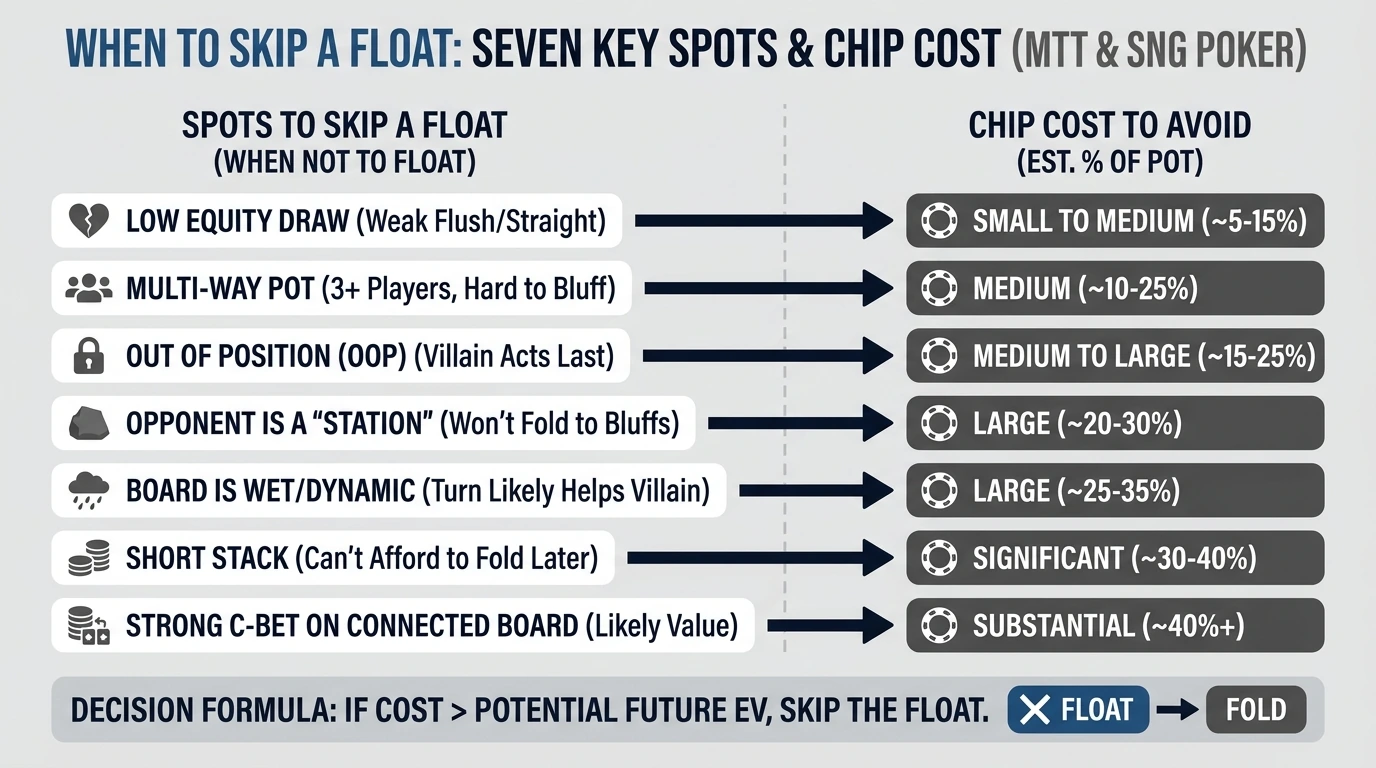
Some spots cost you money no matter how good the turn card looks.
- Out of position with no plan. You’ll face a second barrel with nothing.
- Multiway with players still to act. A squeeze ends the hand before your plan starts.
- Wet, connected boards where his range has the big hands and the big draws.
- Calling stations. They call the turn, so your float becomes a donation.
- Short stacks. At 20 BB or less, the flop call is a large slice of your stack, and one barrel commits you.
- Rake. The room takes a slice of every pot, so the smaller the pot you are fighting for, the thinner the margin on a pure float. The rake cost per 100 hands works through how it adds up.
- ICM pressure near a bubble. Chips you lose cost more tournament equity than chips you win, which changes the price of every call, as chip EV versus ICM explains.
A float checklist for the table
| Factor | Float when | Fold when |
|---|---|---|
| Position | You act last after the flop | You’re out of position with no turn plan |
| Board | Low, disconnected, misses his range | Ace-high, Broadway or two-tone |
| Your hand | Backdoor draw, overcard, gutshot | No route to a strong hand |
| Turn card | Blank, or a card that helps you | Ace, king, queen or a paired board |
| Opponent | Gives up on the turn under half the time | Calls down, or barrels again |
| Players in the pot | Heads-up | Three or more |
| Stacks | Deep enough to fold later | Short stack or low SPR |
Frequently asked questions
Is floating profitable at micro stakes?
Yes, when the opponent gives up on the turn. Break-even percentages depend on bet size and pot size, so they stay the same at every stake. What changes are the players and the rake. PokerCoaching notes that many players c-bet the flop automatically and then give up when called, and that habit is common in the cheapest games, which makes floating better than it looks. Rake still takes a bigger share of the small pots you win, so keep the float for spots where he really does surrender. The guide to beating micro-stakes no-limit cash games covers the wider adjustments.
Can you float in tournaments?
Yes, with two changes. Stacks are shorter, so the flop call takes a bigger share of your chips, and a turn bet commits you sooner. Near the money, tournament equity makes each chip you risk worth more than each chip you win, so a float that works in a cash game can lose money in a payout spot. In that spot, keep the floats that come with real draws.
What is a double float?
A double float means calling the flop and the turn, then betting the river when your opponent checks again. It needs at least some equity and a few cards that can make the nuts or near-nuts. Keep it for hands like a gutshot with an overcard.
Should you float out of position?
Only in a narrow form. PokerCoaching suggests doing it mainly from the big blind on low, disconnected boards and checking the turn rather than leading. Other coaches tell beginners to skip it entirely. Your position gives the raiser the last word on every street, which is a real cost.
How often should you float?
There’s no fixed rate. Build your continue range so it’s wide enough to punish his bet size, then add the hands with backdoors and overcards that can improve. Solver-based guides show a button continue frequency on 9♥8♠5♦ rising from 45.5% to 58% once suited broadway hands with backdoor draws go in.
Why does a backdoor flush draw matter?
Card Player puts it at about 4% equity from the flop, and more importantly it becomes a real flush draw on one turn card in five. That gives you a turn to bet with nine outs when called, which is what makes the float work. The 4% alone isn’t enough reason to call.
Should you float on turn scare cards such as an Ace or King?
On dry boards you can easily take a stab at the turn, as you can represent a hand like A8+ or K9+ that called the flop in position for the showdown value + overcard outs.
On a low-to-mid drawy flop (e.g. 6♥ 7♥ 9♠), it’s more iffy: on a A/K turn, if the villain doesn’t bet the turn after c-betting the flop, most likely the A/K didn’t hit him or he’d be doing a second barrel to protect his hand. And hands like 88, TT, JJ, QQ now want to control the pot and so would rather not second barrel either.
Here, provided you can represent that A/K and you do have some equity, a float from 40% to 50% of the pot is also fine. Keep in mind you might need to barrel the river though, as pocket pairs and 9x aren’t folding to a single float nor would draws (although these would tend to bet the turn rather than checking).
Otherwise, if the board hits the villain’s range too much, or if the A or K could have actually given a draw or easily improved villain’s range, then you’re better off checking back.

Written by
Jake Rivera
Founder and live poker player
Jake Rivera founded Rivera Poker and writes about No-Limit Hold'em: preflop ranges, ICM and bubble decisions, and the postflop lines that separate tournament play from cash games.