No-Limit Cash Game Micro Stakes: How to Beat $0.01/$0.02 and $0.02/$0.05
A practical guide to no-limit cash game micro stakes: rake in bb/100, open sizes, limpers, c-bets, multiway pots, bankroll and variance, with real numbers.
No-limit cash game micro stakes are the cheapest real-money tables a poker room offers. At $0.01/$0.02, the small blind is one cent and the big blind is two. At $0.05/$0.10, the big blind is ten cents. Rake takes a slice of nearly every pot, and at these blinds that slice is huge relative to the money on the table. This guide gives you the numbers to adjust, hand by hand.
What no-limit cash game micro stakes are
A cash game pays out each hand in chips with real value. You can leave whenever you want and take your chips with you. No-limit means you can bet any amount up to your whole stack. Micro stakes is slang for the smallest blinds a room runs.
The tables have short names. “2NL” means no-limit at $0.01/$0.02. “5NL” means $0.02/$0.05. “10NL” means $0.05/$0.10. The number is the big blind in cents. PokerSkill notes that a full 100 big blind stack costs $2 at 2NL, $5 at 5NL and $10 at 10NL.
A 100 big blind stack, or 100bb, is the standard buy-in. The big blind is the forced bet posted by one player before the cards are dealt. Multiply it by 100 to get your full buy-in.
At the table: Write your table’s big blind in cents. Multiply by 100. That is your full buy-in. Check it against your bankroll before you sit down.
Pick tables with a low rake and loose opponents
Table selection, choosing which room and which table to play, is the first decision that moves your win rate. Rake is the fee the room takes from each pot.
Small pots rarely reach the cap, so the percentage rate matters more than the cap. The cap is the most the room will take from a single pot. PrimeDope puts it plainly: “At microstakes, percentage drives the cost because pots rarely hit the cap.”
Rake is measured in big blinds per 100 hands, written bb/100. A win rate of 5 bb/100 means you collect 5 big blinds per 100 hands after rake.
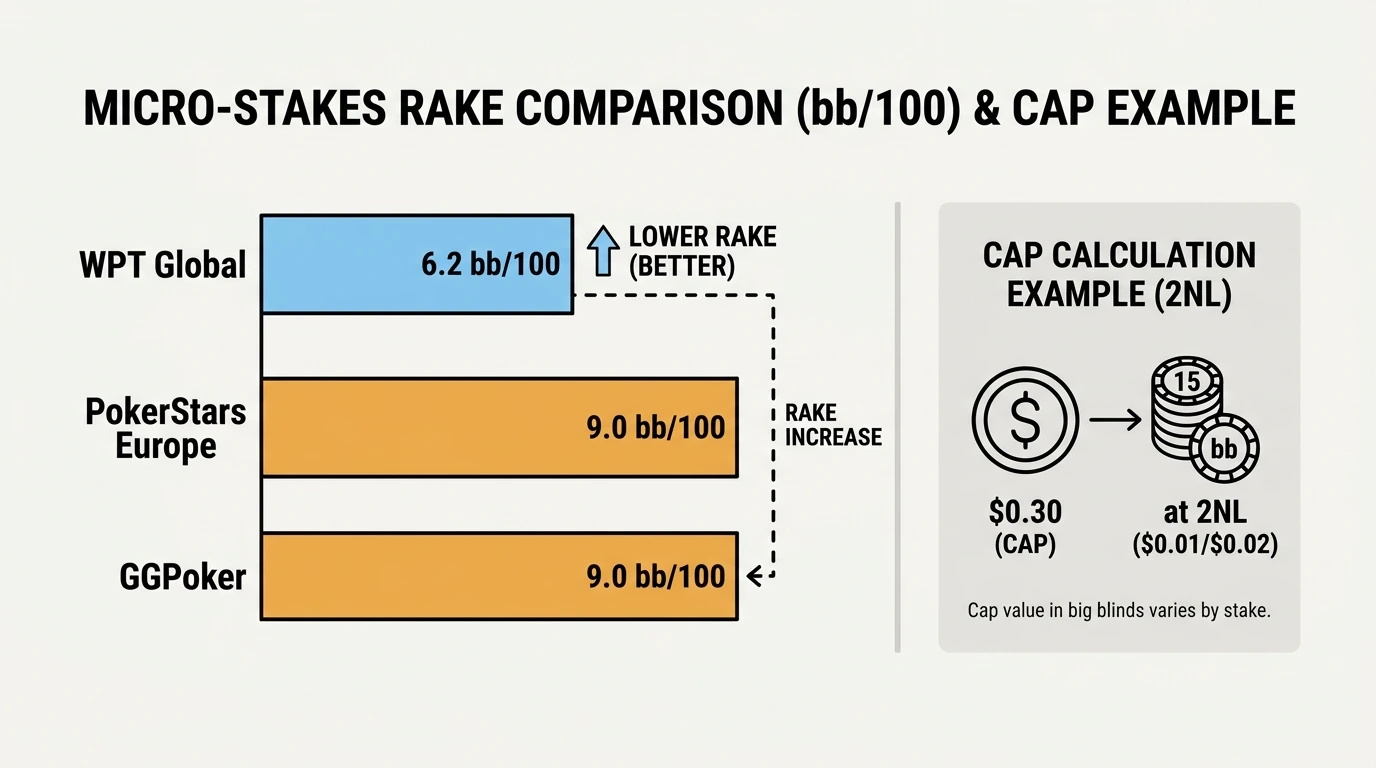
Room choice is worth real money. PrimeDope publishes its model inputs and method, and its 5NL-anchored model (updated March 2026) ranks WPT Global as the cheapest major room at 6.2 bb/100. GGPoker and PokerStars Europe come out most expensive at 9.0 bb/100. The same brand charges differently by region: 7.4 bb/100 globally, 8.7 in the US, 9.0 in Europe. Over 10,000 hands, that 2.8 bb/100 spread is 280 big blinds; at a $0.05 big blind it comes to $14.
Table makeup matters too. Loose players who call often give you more chances to win. Some coaches use rough cut-offs to spot them: players in more than 30% of hands, flops seen above 35%, average pot above 15bb (RiverOdds). These are rules of thumb from practitioners, not published studies.
At the table: Check the room’s rake page before you play. Compare the percentage and the cap in big blinds. Then sit where you see several loose players.
Rake decides which hands are worth playing
Rake takes a fixed bite out of every pot. A hand that breaks even before rake loses money after it. That is the main reason micro stakes players should fold marginal hands.
For a rough scale, one affiliate compilation, LegalUSPokerSites, lists 8 to 16 bb/100 as a typical 2NL rake burden, against under 1 bb/100 at $5/$10 tables. The page gives no method or date, so treat the range as a rough estimate only.
Run the numbers yourself. In an illustrative setup, a player who wins 15 bb/100 before rake and pays 8 to 12 bb/100 keeps 3 to 7 bb/100. Every marginal call costs more than it looks.
The cap hits harder in big blinds than in cents. At 2NL, PokerStars’ Zoom format takes 3.5% with a $0.30 cap (WorldPokerDeals). That cap equals 15 big blinds, almost one-sixth of a 100bb stack. WorldPokerDeals lists the standard schedule at 5% with a $1.00 cap from $0.01/$0.02 through $0.05/$0.10, with no flop, no drop. Schedules change, so check the room’s page.
One documented exception: GGPoker rakes preflop 3-bet pots. The idea that you can win those pots rake-free does not hold there.
At the table: Find your room’s rake percentage and cap. Divide the cap by the big blind to see it in big blinds. Use that number to decide how many weak hands to drop.
Open-raise sizes and limping
An open raise is the first voluntary bet before the flop. Position and the number of limpers decide the size.
Use bigger opens at $0.01/$0.02 than at higher stakes. BlackRain79 recommends 4x (8 cents) at $0.01/$0.02 and 3x at higher micro stakes. He drops to 3x when stealing from late position at $0.01/$0.02. His reasoning: micro games are full of loose calling stations who dislike folding.
Published charts disagree. Freebetrange’s preflop charts list 2.5 big blinds from every seat and 3 big blinds from the small blind, without naming a stake. Use the stake-specific sizing from BlackRain79 as your starting point and test it in your own games.
Add one big blind per limper. A limper is a player who calls the big blind before the flop instead of raising. BlackRain79’s example: 3x plus four limpers equals 7x.
Limping is debated. BlackRain79 says never limp. Poker Daze argues limping works short-handed and heads-up, and calls small pairs against three limpers at shallow stacks “one of the few defensible limp-calls.” Poker Daze also notes that “solvers assume an opponent who never limps in the first place.” That gap is why the edge survives.
At the table: Open 4x at $0.01/$0.02 and 3x at $0.02/$0.05 and above, dropping to 2.5x to 3x when stealing. Add one big blind per limper. Raise your normal hands.
Isolating limpers, three-bets and cold calls
To isolate a limper is to raise over one or more limpers so you play the pot against fewer players. A three-bet re-raises an open. A cold call is a call of a raise by a player who put nothing in before it.
Raising over limpers costs more than most players expect. Poker Daze’s example: two limpers, $7 in the pot, and you raise to $12. You risk $12 to win $7, so the raise needs folds about 63% of the time to break even. Poker Daze notes that “no limpy low-stakes table is going to give you” that. Raise over limpers with hands that play well after the flop.
Treat three-bets and cold calls with the same care. Against players who call too much, use a tighter range. Cold calls from early position cost extra because players behind you can still act. GTO Wizard notes that “cold-callers in front make you tighter, not wider, at equilibrium.”
At the table: Before isolating, count the limpers and the pot. Divide your raise by the pot after your raise: $12 into a $19 pot gives a 63% fold requirement. If that number sits well above 50%, make sure your hand plays well postflop.
Continuation bets and turn and river lines
A continuation bet, or c-bet, is a flop bet by the player who raised before the flop. It keeps the initiative and wins pots when players fold.
BlackRain79’s beginner guidance is to c-bet 50% to 60% of the time on a 6-max flop. Against two opponents, bet “50% of the time at the most.” Against three or more, bet less. His default flop size is about 60% of the pot.
Bet size sets the fold rate a bluff needs. BlackRain79 gives the arithmetic: “If you bet 1/3 of the pot, your opponent needs to fold only 25% of the time. If you bet a full pot, 50%.”
Turn and river play follows the same logic. Keep betting hands that are still strong. Slow down when the board brings cards that beat you. Sizing up with strong hands against players who call a lot pays well.
At the table: Consider c-betting about half the time after raising into one or two callers, at about 60% pot, and track how often your opponents fold.
Multiway pots need different frequencies
A multiway pot has three or more players after the flop. These pots play very differently from heads-up pots.
Solver data shows how sharply the frequencies shift. A GTO Wizard solver solution used a pot-sized c-bet 18% of the time heads-up. Multiway, that same bet dropped to 1.3%. PokerNews reports the solver “bets only ~11.7% of hands” in one multiway spot, and a turn barrel with a flush draw lost more than 5bb of expected value.
Hand strength shifts too. GTO Gecko simulations found that at least one opponent holds a pair or better 82.0% of the time four-way, against 35.8% heads-up. A pot-sized bluff into three opponents needs each one to fold 79.4% of the time. That target is very hard to hit.
At the table: When three or more players see the flop, bet less often. Use strong hands for value, check back medium hands, and save bluffs for heads-up spots.
Thin value bets and bluff frequency
Value betting means betting to get called by worse hands. A thin value bet is a bet where you expect to win only a little more than half the time when called. Upswing Poker defines it as a bet that wins “a little over 50%” of the time when your opponent calls.
Thin value bets pay against calling stations. BlackRain79 suggests betting about 75% of the pot or more against recreational players who call. He shows a hand with top pair and second kicker value-betting three streets on a board where both draws got there.
Bluffing needs fold equity, the share of the time a bet wins because your opponent folds. Against one opponent, a full-pot bluff needs a fold about 50% of the time. Against three, each player must fold 79.4% of the time. Bluff less in multiway pots and more against players who over-fold.
At the table: Against a player who calls too much, a 75% pot or larger bet with medium-strength hands gets paid; bluff the players who fold to pressure.
Stack depth and topping up
Stack depth is the number of big blinds you have behind. A deep stack gives you room to bet and room to win big pots. A short stack limits both.
Buy in for 100bb and top up between hands when your stack drops. Keep it near full so the big-pot lines stay open.
Do not add chips after a bad loss to chase it back. Plan the buy-in before you sit and stop when your stack drops below the level you set.
At the table: A common plan is a 100bb buy-in, a reload between hands when the stack drops, and a loss limit chosen before the session starts.
Bankroll, win rate and variance
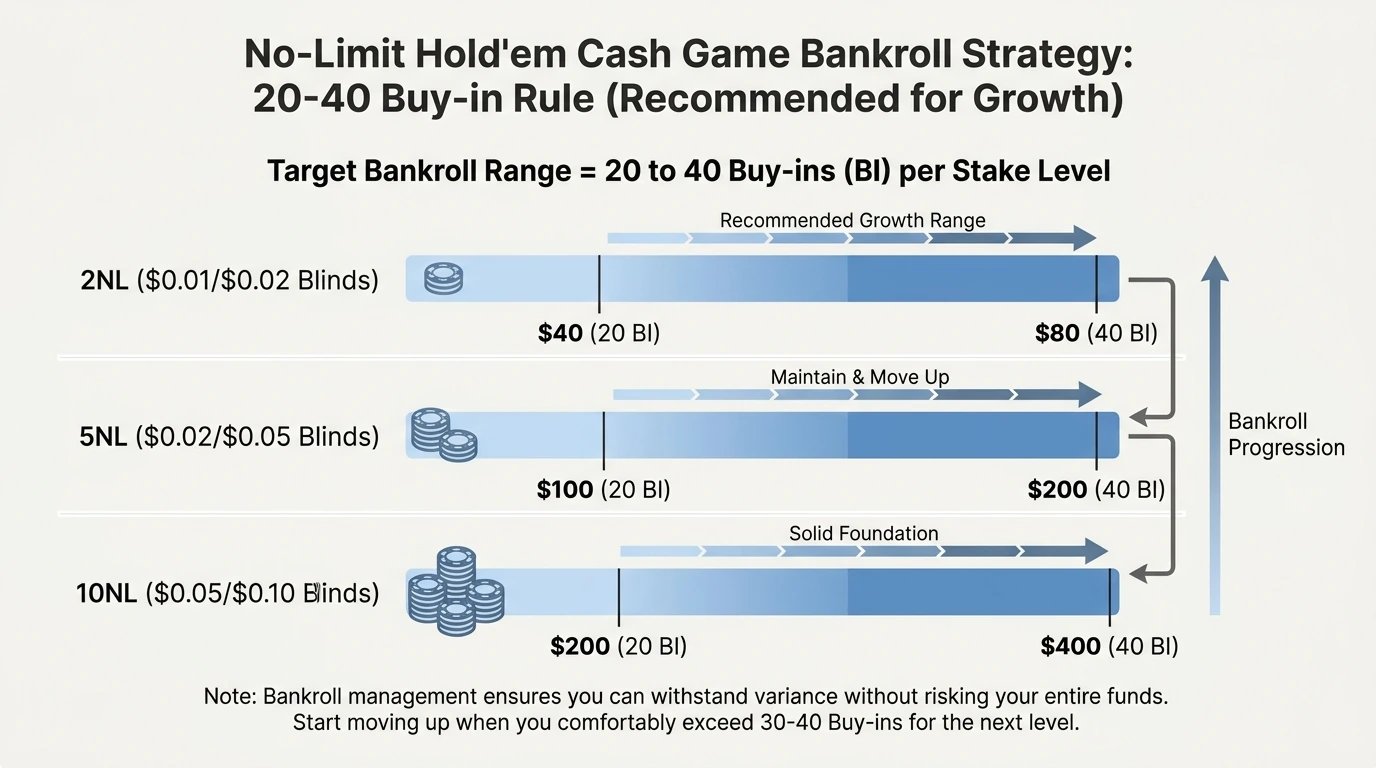
A bankroll is the money you set aside for poker. The usual rule is 20 to 40 buy-ins.
At micro stakes, that works out to concrete numbers. At $0.01/$0.02 a buy-in is $2, so 20 to 40 buy-ins is $40 to $80. At $0.02/$0.05 a buy-in is $5, so $100 to $200. At $0.05/$0.10 a buy-in is $10, so $200 to $400. SplitSuit gives 20 buy-ins as the common rule. ThinkGTO recommends 30 to 40 for a cautious plan. BlackRain79 suggests 30 buy-ins ($150) before moving from $0.01/$0.02 to $0.02/$0.05.
Variance is the swing of luck. In 6-max no-limit cash games, standard deviation runs about 75 to 95 bb/100, according to PrimeDope. Your results can swing far from your true win rate even when your play is sound.
Risk of ruin is the chance your bankroll hits zero before it grows. ThinkGTO’s formula is e^(−2·WR·B÷SD²), where WR is your win rate in bb/100, B is your bankroll in big blinds and SD is your standard deviation in bb/100. A 5 bb/100 winner with an 80 bb/100 standard deviation and a 20 buy-in bankroll (2,000bb) faces about 4.4% risk of ruin. That setup and the pre-rake arithmetic above are illustrative setups; they do not come from tracked results.
Sample size takes patience. PrimeDope estimates about 246,000 hands to prove a win rate within ±2 bb/100 at 95% confidence. GamblingCalc estimates that a 5 bb/100 winner has a 28.93% chance of being behind after 10,000 hands. PrimeDope also puts the chance of a 20+ buy-in downswing at 7% per 100,000 hands for that same player.
Win-rate bands for 2NL and 5NL published online come from affiliate pages with no stated method. Treat any single range as an industry guess and track your own results.
At the table: A common plan is 20 or more buy-ins for your stake, with the win rate tracked in bb/100 across tens of thousands of hands before you treat it as established.
The leaks that cost the most money
A leak is a repeated mistake that loses chips over time. These six show up constantly at micro stakes:
- Playing too many weak hands and paying rake on them.
- Limping with hands you should raise.
- C-betting too often in multiway pots.
- Calling too often against big river bets.
- Bluffing into several opponents.
- Rebuying right away to chase losses.
At the table: Pick one leak. Review your last 500 hands for it. Change one habit, then check results after the next session.
A four-week study plan
Study works best in small, repeated steps. Run this plan over four weeks.
- Week 1: Learn your room’s rake schedule and convert the cap into big blinds. Set your buy-in at 100bb and your bankroll at 20 or more buy-ins.
- Week 2: Practice open-raise sizes. Use 4x at $0.01/$0.02 and 3x above it, plus one big blind per limper. Track how often you open and how often you limp.
- Week 3: Work on flop c-bets. Track your bet frequency, how often players fold, and results by bet size.
- Week 4: Review multiway pots. Count how many hands reach three or more players after the flop. Bet less in those pots and keep bluffs for heads-up spots.
Frequently asked questions
How much money do I need to play $0.01/$0.02 and $0.02/$0.05?
Most players keep 20 to 40 buy-ins. At $0.01/$0.02 that is about $40 to $80. At $0.02/$0.05 it is about $100 to $200. SplitSuit gives 20 buy-ins as the common rule, and BlackRain79 suggests 30 buy-ins ($150) as the threshold for moving from $0.01/$0.02 to $0.02/$0.05.
How much rake do you pay at $0.01/$0.02?
Estimates cluster at 8 to 16 bb/100. LegalUSPokerSites lists this as a typical rake burden. A $0.30 cap equals 15 big blinds at a $0.02 big blind. Check your room’s own rake page before you play.
What size should I open-raise at micro stakes?
Open 4x at $0.01/$0.02 and 3x at higher micro stakes, according to BlackRain79. Add one big blind per limper. Freebetrange’s charts use 2.5 big blinds at every stake, so test both in your own sessions.
Should I ever limp at micro stakes?
BlackRain79 says never limp. Poker Daze allows small pairs against several limpers at shallow stacks. For most hands, raising beats limping.
How often should I continuation bet?
BlackRain79 suggests 50% to 60% of the time on a 6-max flop. Against two opponents, c-bet 50% at most. Against three or more, c-bet less.
How often should I bluff in a multiway pot?
Almost never. A pot-sized bluff into three opponents needs each one to fold 79.4% of the time, according to GTO Gecko. That figure comes from one simulated spot, so treat it as a direction rather than a rule. Save bluffs for heads-up pots.
How many hands before I know my win rate?
About 246,000 hands are needed to prove a win rate within ±2 bb/100 at 95% confidence, per PrimeDope. GamblingCalc shows a 5 bb/100 winner can still be behind after 10,000 hands.
Is GGPoker rake worse at micro stakes?
Yes. PrimeDope’s March 2026 model puts GGPoker among the most expensive majors at 9.0 bb/100, and GGPoker rakes preflop 3-bet pots.

Written by
Jake Rivera
Poker writer
Jake Rivera writes about poker strategy across No-Limit Hold'em, Pot-Limit Omaha and Short Deck. His work covers preflop ranges, ICM and bubble decisions, and postflop lines, along with the adjustments that separate tournament play from cash games.