Poker Rake Explained: What It Really Costs You Per 100 Hands
Poker rake in real money: what 5% with a 3 BB cap costs per 100 hands, how the two big rooms cap their tables, and how to pay less rake.
Every table has one opponent who cannot be bluffed, tilted or outplayed. The rake gets paid whether you win the pot or lose it, and it comes off the top before the money reaches your stack.
So the question worth asking at any limit is simple. How many big blinds per 100 hands does the room take, and what win rate does that force you to beat? Poker rake is the one cost at the table you can measure to the cent.
Moving up one stake can cost less than fighting the rake at the bottom. That only holds when your pre-rake edge clears the rake at your current stake by a wide margin, and when the field one stake up is not so much tougher that your edge disappears. The cap comparisons below show where the plan breaks down.
What is poker rake?
Poker rake is the fee a card room takes out of the pots it deals. It is a percentage of each pot up to a set maximum. The two biggest rooms both charge 5%, capped per hand (PokerStars, GGPoker).
Cash games use one of two charges. Pot rake comes out of each pot that qualifies. Time rake is a flat charge per seat, taken every half hour or hour. So you pay it whether you win a hand or fold every orbit. The site’s rake topic hub goes deeper on caps, rakeback and room schedules.
Tournament fees follow another set of rules. The room takes its cut off the buy-in before a card is dealt. So the prize pool never holds your full entry. Small fields carry the heaviest charge.
How much rake do you actually pay?
The cap decides most of it, and the cap is quoted in big blinds. So read the schedule in big blinds first and in dollars second.
Here is a representative setup, stated so you can swap in your own numbers. The game is six-max No-Limit Hold’em and the schedule takes 5% of the pot, capped at 3 BB. GGPoker publishes that for its fast-fold pool at every stake from $0.01/$0.02 to $1/$2 (GGPoker). Assume an average raked pot of 25 BB, 45 raked pots per 100 hands and 60 hands an hour. Those three inputs come from typical six-max play rather than from a room’s own figures, so treat them as a model you can replace.
Take one pot at a time. Five percent of 25 BB is 1.25 BB, which sits well under the 3 BB cap.
| Pot size | Rake at 5% | Capped at 3 BB | Effective rate |
|---|---|---|---|
| 10 BB | 0.5 BB | 0.5 BB | 5% |
| 25 BB | 1.25 BB | 1.25 BB | 5% |
| 60 BB | 3 BB | 3 BB | 5% |
| 100 BB | 5 BB | 3 BB | 3% |
| 200 BB | 10 BB | 3 BB | 1.5% |
The cap only starts to bite at 60 BB. Below that, the percentage sets the bill and the cap sits out of the way.
Now scale it up. Forty-five raked pots at 1.25 BB take 56 BB off the table every 100 hands, which is 9.4 BB for each of six seats.
| Stakes | Rake per 100 hands, whole table | Per seat per 100 hands | Per seat per hour |
|---|---|---|---|
| $0.01/$0.02 | 56 BB ($1.13) | 9.4 BB ($0.19) | 5.6 BB ($0.11) |
| $0.05/$0.10 | 56 BB ($5.63) | 9.4 BB ($0.94) | 5.6 BB ($0.56) |
| $0.25/$0.50 | 56 BB ($28.13) | 9.4 BB ($4.69) | 5.6 BB ($2.81) |
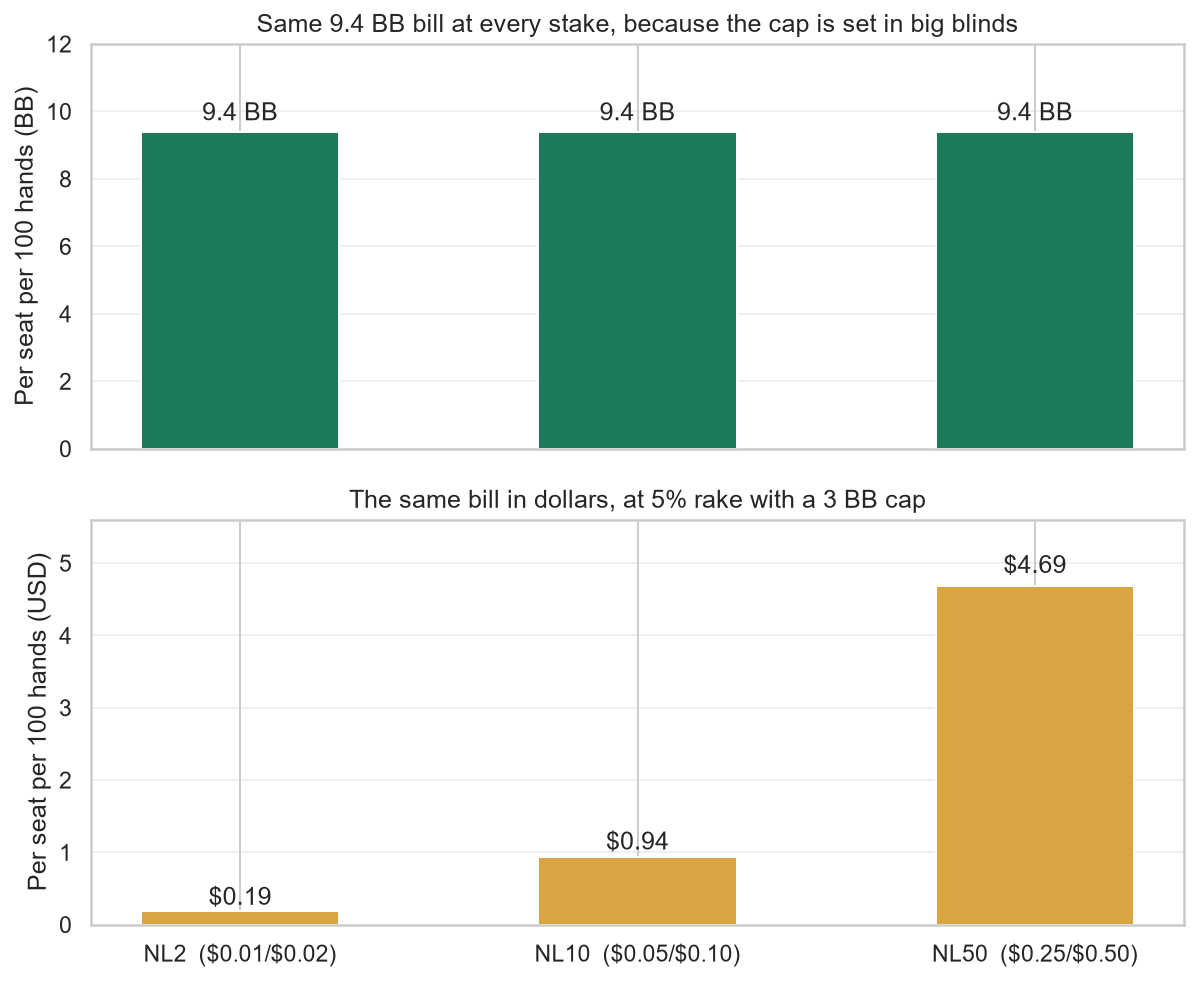
The big-blind figure stays flat because the cap is set in big blinds and never arrives at a 25 BB pot. The dollar figure climbs with the blinds, and that is the number your bankroll actually feels.
The win rate you need to beat rake
You break even when your win rate before rake matches your rake per 100 hands. On the table above, that line sits near 9.4 bb/100.
GTO Wizard puts the subtraction in one line. Win 7 bb/100 while paying 5 bb/100 in rake and your net rate is 2 bb/100 (GTO Wizard). Loose play pushes your line higher, tight play pulls it down, so treat 9.4 bb/100 as a starting point rather than a law.
The top of the range is wide. Nathan Williams reported winning close to 30 bb/100 at $0.01/$0.02 before rakeback (BlackRain79), which clears a 9.4 bb/100 bill with room to spare. The damage lands in the middle. A regular winning 10 bb/100 before rake at $0.25/$0.50 hands most of it back to a 9.4 bb/100 bill, and finishes near break-even.
Rake models compared
The model changes the bill by several big blinds per 100 hands, and the cap in big blinds changes it the most. Cash tables (cash game format) run these versions.
| Model | How it charges | On a 25 BB pot | What it does to your cost |
|---|---|---|---|
| Contributed | Your share follows what you put in | 1.25 BB, split by contribution | Loose players pay more |
| Dealt | Every player dealt in pays equally | 1.25 BB, so about 0.21 BB a seat | Shifts cost onto tight players |
| No flop, no drop | Nothing taken if the hand ends preflop | 0 if the hand ends early | Saves the preflop pots |
| Cap in big blinds | Rake stops growing at a set number of BB | 1.25 BB at a 3 BB cap, 0.6 BB at a 0.6 BB cap | Decides the rate once pots get large |
| Time rake | A flat hourly charge per seat | Nothing from this pot | $11 an hour is 22 BB an hour at $0.25/$0.50 |
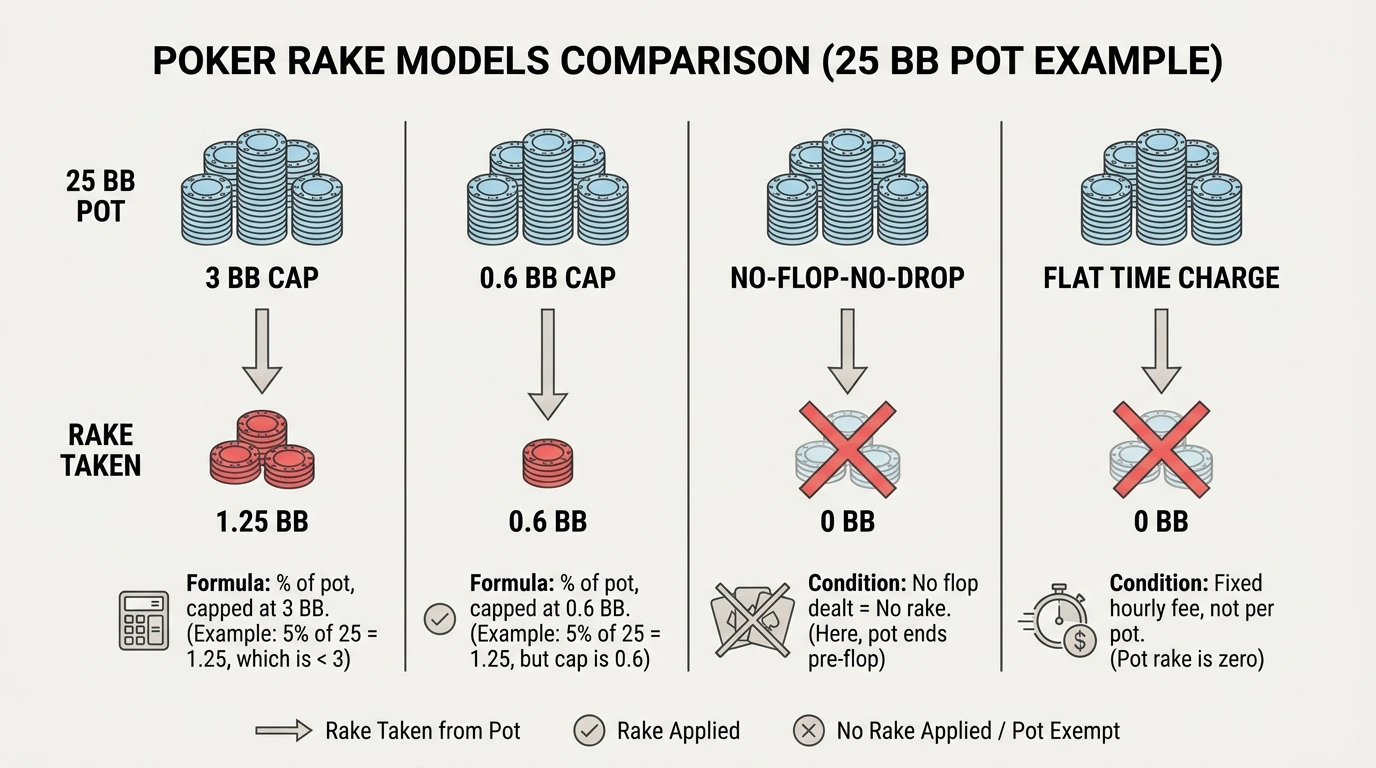
The cap does the heavy lifting once pots get large. The GTO Wizard blog reports a 4 BB cap at NL50 and a 0.6 BB cap at NL500 on the same 5% rate. Drop our 3 BB cap to 0.6 BB and 45 pots cost the table 27 BB, or 4.5 BB per seat. One number in the schedule swings the required win rate by about 5 bb/100.
No-flop-no-drop saves less than people hope. Every hand that ends preflop carries no charge at all, and that shifts opening ranges, because the pots you win without a flop are free.
Time rake cuts the link to pot size. A flat hourly charge does not move when the pot does, so a tight player pays the same as a loose one. Regulators set ceilings too. Nevada allows no more than 10% of the money wagered in the hand (Nevada Gaming Control Board).
Rake by room: what two rooms actually publish
The percentage is the same almost everywhere. The cap is not, and the cap is where your money goes.
These are the two schedules, read from the operators’ own pages on 11 Nov 2026. PokerStars quotes its cap in euros and sets it by stake. GGPoker quotes 3 BB at every stake, at both Low and Middle levels (GGPoker).
| Stakes | PokerStars cap, 5+ players | In big blinds | GGPoker cap | In big blinds |
|---|---|---|---|---|
| €0.01/€0.02 | €1.50 | 75 BB | 3 BB | 3 BB |
| €0.05/€0.10 | €1.50 | 15 BB | 3 BB | 3 BB |
| €0.25/€0.50 | €2.60 | 5.2 BB | 3 BB | 3 BB |
| €1/€2 | €2.85 | 1.4 BB | 3 BB | 3 BB |
| €2.50/€5 | €3.00 | 0.6 BB | 3 BB | 3 BB |
Read the big-blind column, because that is the number your win rate is quoted in. A 75 BB cap never arrives in a normal session, so the full 5% applies to every pot. A 0.6 BB cap arrives at 12 BB, so almost every pot is capped.
That changes which room is cheaper, and the answer depends on the pot. At €0.01/€0.02 the two schedules charge the same on any pot up to 60 BB, where both take 3 BB. Above 60 BB GGPoker’s cap holds it at 3 BB while PokerStars keeps taking 5%, so GGPoker is cheaper. At €2.50/€5 the flip happens at 12 BB instead, and PokerStars is cheaper on everything above that.
One practical detail sits in the small print. PokerStars counts players dealt into the hand, not players seated, so a six-handed table that folds to three players pays the 3-to-4 player cap.
Cash games, tournaments and the fee you pay
Cash games take a slice of each pot as it happens. Tournaments charge a fee on the buy-in before the first hand, and that fee sets a floor under your return.
A $100 + $10 tournament sends $100 to the pool and $10 to the room. That is 9.1% of the $110 you paid. Online fees usually land under 10%, and small live events charge more. A $305 + $45 buy-in comes to 13% (Jonathan Little).
Small fields feel it most, because the fee comes off the top before the prize pool is built. Field size and payout structure change how you play those events (SNG vs MTT strategy), and the fee is taken either way.
How to pay less poker rake
The numbers below are the ones to compare when you read a schedule.
- Compare the cap in big blinds. A 5% schedule with a 3 BB cap costs our table 9.4 bb/100. The same 5% with a 0.6 BB cap costs it 4.5.
- Read the extra drops. GGPoker takes 0.5 BB from pots of 30 BB or more for its Cash Drop pool. A 30 BB pot pays 1.5 BB rake plus 0.5 BB, so 2 BB in total, which is 6.7% of the pot.
- Check the rewards. Rakeback returns a share of what you paid, and the share changes by room, stake and volume, so check your own rate before you treat the bill above as final.
- Count the hands. One fast-fold table dealing 200 hands an hour doubles the bill to about 19 BB an hour per seat, against 5.6 BB at 60 hands.
- See what rake does to a call. In raked pots a call has to clear the fee. Upswing’s example at $1/$2 has the big blind needing 50% raw equity to call an $8 raise, against 35% with no rake (Upswing Poker).
- Notice thin calls. Rake turns thin calls into long-run losers, so the winning micro preflop charts fold more than a tournament chart would.
Why micro stakes rake is the worst deal in poker
The bill is the same 9.4 bb/100 at every stake in our model, so the difference is not the rate. It is what the bill is measured against.
First, the bankroll. A 5.6 BB hourly bill is $0.11 at $0.01/$0.02 and $2.81 at $0.25/$0.50. The smaller number is the one that comes out of a smaller bankroll, so the same rate costs a micro player a bigger share of their roll.
Second, the cap. Where a room scales its cap with the stake, the micro player pays the full percentage on nearly every pot and the high-stakes player does not. The room table above shows the whole ladder: 75 BB at €0.01/€0.02, then 0.6 BB at €2.50/€5.
Moving up can work once your pre-rake win rate clears the rake at your current stake by a wide margin. The field gets tougher with every step, so the plan fails when the edge does (beating micro stakes). A pre-rake edge of 3 bb/100 at $0.05/$0.10 will not survive the jump up a stake, because the regulars punish the same leaks harder.
Rake mistakes that cost the most
- Comparing rooms by percentage. Two rooms at 5% with caps of 3 BB and 0.6 BB cost our table 9.4 and 4.5 bb/100 respectively.
- Ignoring the extra drop. The 0.5 BB Cash Drop turns a 30 BB pot into a 6.7% charge.
- Playing fast-fold for volume without pricing the hour. At 200 hands an hour the same schedule doubles the bill to about 19 BB an hour per seat, against 5.6 BB at 60 hands.
- Leaving rewards unclaimed. Rakeback returns a share of that bill, so claim it. It is the only part of the cost you can cut without playing better.
- Calling preflop as if the pot were unraked. Upswing’s spot asks the big blind for 50% raw equity instead of 35%, and the extra 15 points is the fee talking.
Frequently asked questions
What is rake in poker?
Think of it as the room renting you a seat one pot at a time. It takes a share of each pot until the cap stops it. A room that charges by the clock prices the same rent in hours. Either way the cash is gone before you stack it.
How does poker rake work?
Two things set your bill. One is how big the pots run. The other is the cap, which is quoted in big blinds, so it protects a deep-stack player far more than a micro player. Switch the room to hourly charging and both drop out.
How much rake do you pay per hour?
Speed decides it. Our six-max numbers give 5.6 BB an hour per seat, which is $0.56 at $0.05/$0.10 and $2.81 at $0.25/$0.50. Live play takes more per hand and deals fewer. Four dollars a hand across 30 hands comes to $120 an hour for a $1/$2 table, about $13 for each player.
Is rake the same in every poker room?
Every room writes its own schedule, and some stack a second charge on top. GGPoker’s fast-fold pool runs 5% with a cap at 3 BB, then takes 0.5 BB more once a pot reaches 30 BB. Regulators add their own limits, and Nevada caps the charge at 10% of the money wagered in a hand.
Do you pay rake if you fold preflop?
Under contributed rake, only the players who put money in get charged, so folding costs you nothing. Dealt rake divides each raked pot across everyone at the table, folded hands included. A no-flop-no-drop rule removes the charge from any hand that ends before the flop, and opening ranges widen where preflop pots go unraked.
Is rake worse in cash games or tournaments?
By the hour, cash usually costs more. A tournament fee is taken once and the entry is finished, while cash keeps taking a slice for as long as you sit there. The two charges are priced on different bases, so compare them at the stake you actually play rather than on one headline number.

Written by
Jake Rivera
Founder and No-Limit Hold'em writer
Jake Rivera founded Rivera Poker and writes about No-Limit Hold'em: preflop ranges, ICM and bubble decisions, and the postflop lines that separate tournament play from cash games. He also follows the major series and reports on results, schedules and new formats.