Big Blind Defense vs Button Open at 20 BB: Calling with 8♥7♥
Big blind defense vs button open at 20 BB: why 8♥7♥ calls, how the flop plays, and how the ante, opener size and bubble ICM change the price.
At 20 BB in an MTT, the big blind is where small leaks add up. The button opens to 2 BB, the small blind folds, and you look down at 8♥7♥. Folding gives up a cheap chance to see a flop with a hand that makes straights and flushes. Big blind defense vs button open starts with one question: what price does the call need?
The spot
- Format: No-Limit Hold’em MTT, middle stage, nine players dealt.
- Stacks: hero 20 BB, button 20 BB, so the effective stack is 20 BB.
- Blinds and ante: 0.5/1 BB with a 1 BB big blind ante, posted by hero.
- Action: the button opens to 2 BB, the small blind folds, hero holds 8♥7♥.
Hero starts with 20 BB, posts the 1 BB big blind and the 1 BB ante, and has 18 BB behind. The button’s 2 BB and the small blind’s 0.5 BB make the pot 4.5 BB before hero calls.
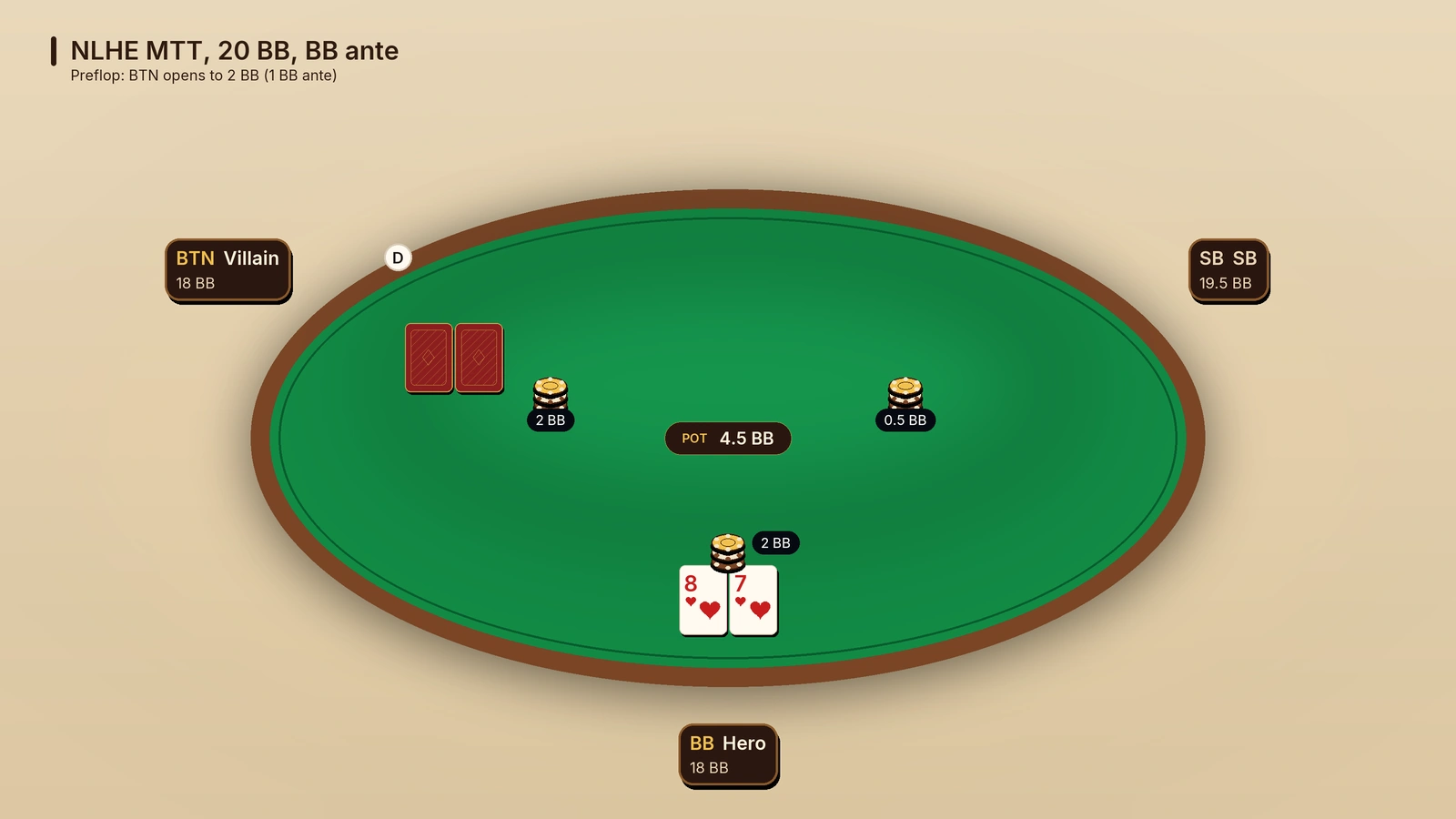
A call costs 1 BB. The pot becomes 5.5 BB and hero has 17 BB behind. Break-even equity is the call divided by the final pot: 1 divided by 5.5, or 18.2%.
Why 8♥7♥ calls
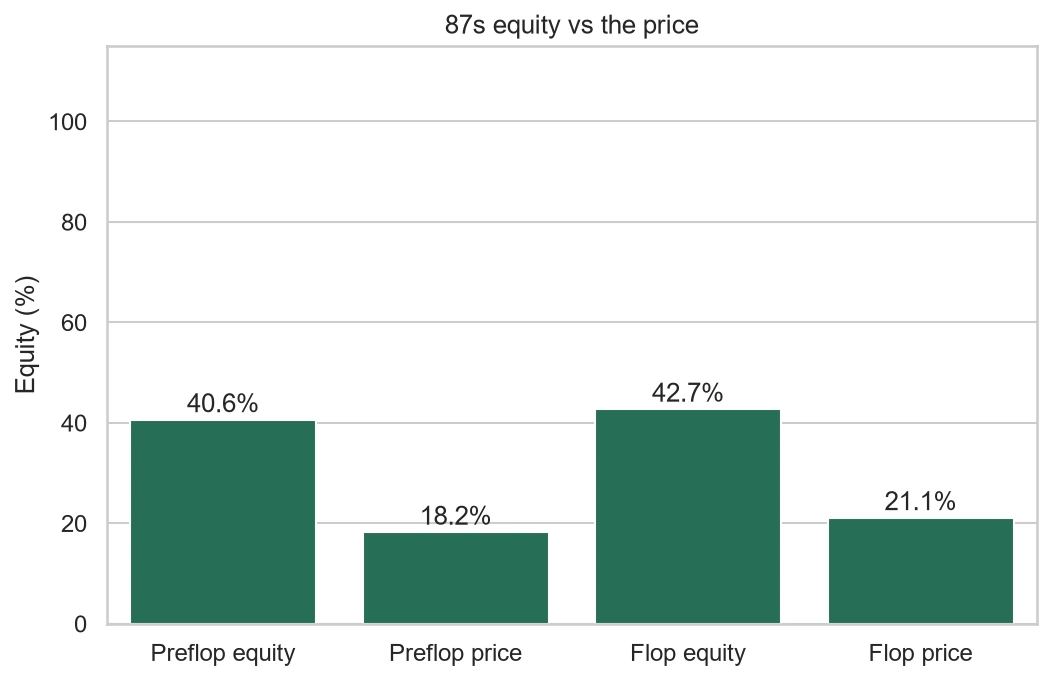
The button’s range is wide: 22+, A2s+, K2s+, Q4s+, J6s+, T6s+, 96s+, 85s+, 75s+, 64s+, 54s, A2o+, K8o+, Q9o+, J9o+ and T9o. That is 526 combos. Against that range, 8♥7♥ has 40.6% equity over 50,000 simulations.
A tight 110-combo range of 77+, ATs+, KQs, AJo+ and KQo cuts the equity to 32.85%. Both numbers sit above the 18.2% price.
Raw equity is not the whole story. Hero acts first after the flop, so the button can bet and apply pressure. The gap between 40.6% and 18.2% is wide enough to absorb some loss of realization.
Why not 3-bet or fold
A 3-bet at 20 BB commits a large part of the stack. A raise to 5 BB leaves 14 BB behind, and a button who calls or 4-bets puts hero in a difficult spot. 8♥7♥ makes its money on later streets, so seeing a flop is more valuable than turning the hand into a bluff. Hands with an ace or king blocker, such as A5s, make better 3-bet bluffs.
Folding gives up a 1 BB call with a hand that has 40.6% equity against the button’s range. The ante already in the pot improves the price.
The flop: K♣ 6♠ 5♦
Hero checks. The button bets 2 BB into the 5.5 BB pot, making it 7.5 BB. A call costs 2 BB, makes the pot 9.5 BB, and leaves hero 15 BB behind. The break-even price is 2 divided by 9.5, or 21.1%.
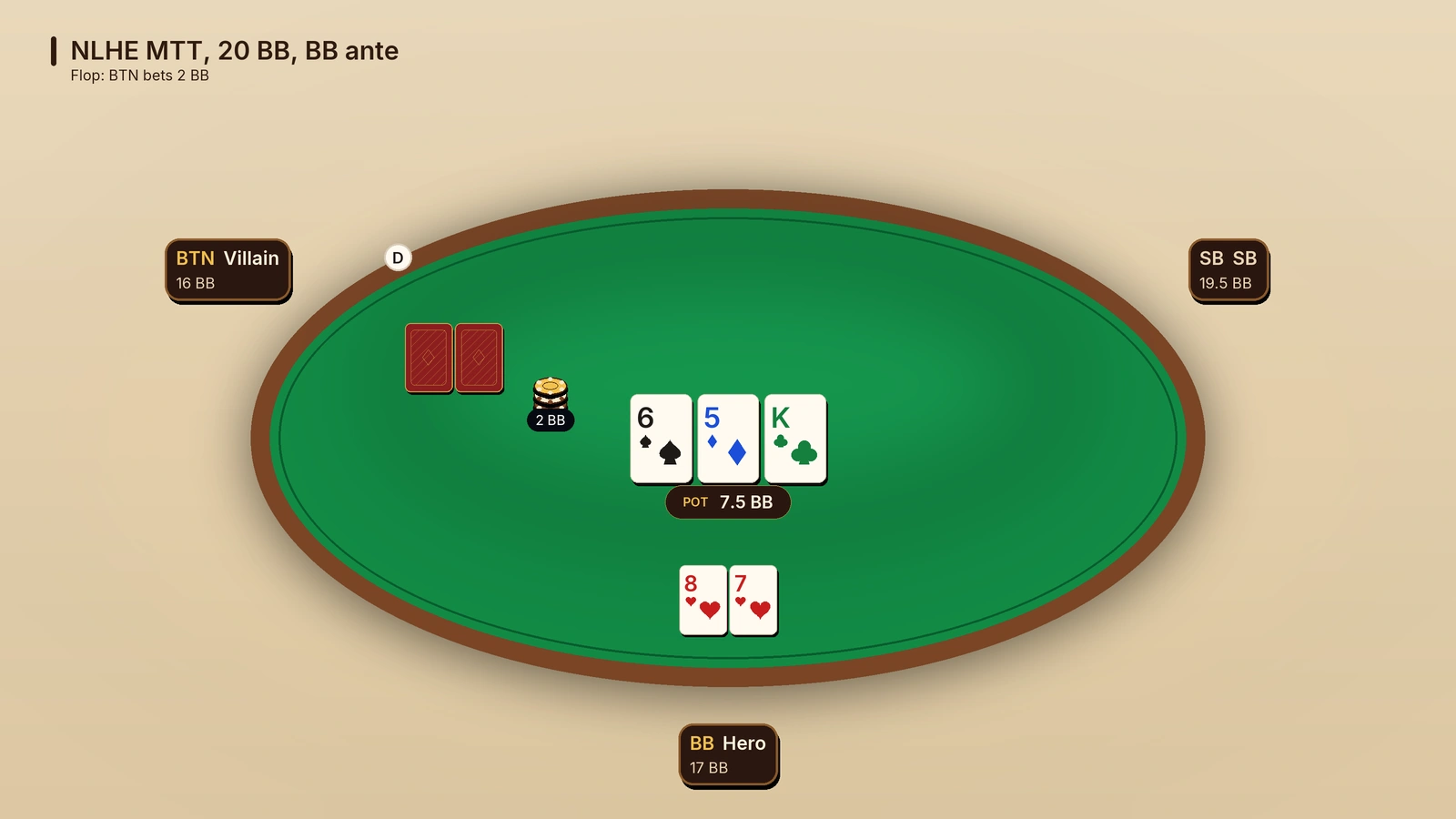
8♥7♥ has an open-ended straight draw: any 4 or 9 makes a straight, eight outs. Against the same button range, it has 42.7% equity on this flop. That is well above the 21.1% price.
A TexasSolver flop solve used the 5.5 BB pot, 17 BB behind, the button range above, and a big blind calling range of pairs through 99, suited connectors and broadway hands. The tree gave the big blind one bet size (50% of the pot) and the button one bet size (36%), with all-in as the only raise. The results describe this setup:
- Hero’s range checks 99.95% of the time.
- Facing a 2 BB bet, hero’s range calls 43%, raises all-in 57% and folds 0%.
Those frequencies are range-wide, not specific to 8♥7♥. The hand’s own equity and the price make the call clear. Calling keeps the pot smaller and keeps the button’s bluffs in. An all-in raise can fold out worse hands and get called by better ones, so calling is the simpler line at a mid buy-in.
If the turn brings a 4 or 9, hero can bet for value or shove. If it is a blank, hero can give up cheaply or take a stab.
What changes the line
The ante. Without the 1 BB big blind ante, the pot before the call would be 3.5 BB, the call would make it 4.5 BB, and the break-even price would rise to 1 divided by 4.5, or 22.2%. The ante lowers the bar to 18.2%.
Opener size. A 2.5 BB open makes the call 1.5 BB. The final pot is 6.5 BB, so the break-even price is 1.5 divided by 6.5, or 23.1%. The weakest offsuit hands lose the most at that price.
Opponent range. A wider button range gives 8♥7♥ more equity. The loose 526-combo range gives 40.6%; the tight 110-combo range gives 32.85%. A frequent stealer makes the call more profitable.
Stack depth. At 20 BB, hero has 17 BB behind after the preflop call and 15 BB after calling the 2 BB flop bet. The hand needs room to hit a draw and get paid; shallower stacks reduce that room.
Bubble ICM. Near a pay jump, chips won are worth less prize money than chips lost, so the equity bar rises. For a 1 BB call the effect is small. For a shove that risks the whole stack it is much larger. ICM pricing depends on the stacks and payouts, so the number moves with the tournament situation.
The line
Call preflop. On K♣ 6♠ 5♦, check and call the 2 BB bet. The price is 18.2% preflop and 21.1% on the flop; 8♥7♥ has 40.6% and 42.7% equity against the wide button range. The ante, the opener’s size, the button’s range, stack depth and bubble pressure all move those numbers, but the call clears the bar with room to spare.
For the tournament-equity side of the same decision, see SNG vs MTT strategy.
Frequently asked questions
How often should you defend the big blind against a button open at 20 BB?
With a 1 BB ante and a 2 BB open, the call needs about 18% equity. Most suited hands, connected hands, pocket pairs and many offsuit broadways clear that price. A tighter range or a larger open raises the bar.
Should you 3-bet or call with 8♥7♥ at 20 BB?
Call. A 3-bet commits much of the stack and 8♥7♥ has no blocker value. It makes straights and flushes after the flop, so seeing a flop is more valuable.
How much does the big blind ante change the price?
The ante adds 1 BB to the pot and lowers the break-even price for a 1 BB call from 22.2% to 18.2% against a 2 BB open.
Does ICM change the decision?
It can. Near a pay jump, chips won are worth less than chips lost, so the required equity rises. A 1 BB call is only slightly affected; a shove that risks the whole stack is affected much more.
What should you do on the flop with an open-ended straight draw?
Check, then call a small bet. On K♣ 6♠ 5♦, 8♥7♥ has eight straight outs and 42.7% equity against the button’s range, well above the 21.1% price of a 2 BB call. A raise is a valid mix in the solver, but calling is the simpler line.

Written by
Jake Rivera
Poker writer
Jake Rivera writes about poker strategy across No-Limit Hold'em, Pot-Limit Omaha and Short Deck. His work covers preflop ranges, ICM and bubble decisions, and postflop lines, along with the adjustments that separate tournament play from cash games.