Chip EV vs ICM: The Same Hand, Two Different Correct Answers
Chip EV vs ICM on one PLO hand: the same call is +500 chips and −$0.81 in ICM dollars. See the full break-even math and the exact dollar ICM calculation.
Chip EV vs ICM comes down to one question: are you counting chips or counting dollars? Chip EV adds up chips. ICM (the Independent Chip Model) turns your stack into a share of the prize pool. Near a pay jump, the two models give different answers to the same hand. Here is one, run twice.
Chip EV vs ICM in one paragraph
Chip EV treats every chip as equal. Doubling your stack is worth exactly what losing your stack costs. ICM is the model that converts stacks into expected prize money, and that conversion bends. Wikipedia’s entry on the model traces it to David Harville’s 1973 statistics paper, which Malmuth later applied to poker. It assumes all players have comparable skill, so stack sizes alone set each player’s finishing odds.
The example below uses Pot-Limit Omaha (PLO) in a three-player tournament. In PLO each player gets four hole cards and must use exactly two of them. A bet can never be larger than the pot. PLO hands often run close in equity, so a few extra points of required equity change many calls. That is the short version of ICM poker explained; the rest of this page shows where the numbers come from.
Same hand, two answers: the three-player PLO example
Hero should call under chip EV and fold under ICM. The hand is the same. The stacks are the same. Only the unit changes.
Three players remain in a PLO MTT, each with 6,000 chips and blinds of 100/200. The prizes are $50, $30 and $20, a $100 pool. Scale the dollars to any buy-in you like, because the ratios carry over.
The button folded before the flop and put nothing in. Hero and Villain each put in 2,000 total before the flop, including their blinds, so the pot holds 4,000 by the turn. Each has 4,000 left behind. The board is 8♦ 7♣ 2♥ K♦. Hero holds J♥ T♠ 9♠ 6♥. Villain jams the pot, 4,000 into 4,000.
Hero holds no made hand and draws to a straight on the river. Against Villain’s A♣ A♦ 7♠ 5♥, an overpair, Hero wins 37.5% of the time, counting every one of the 40 unseen river cards. Fifteen of those cards make a straight. The other twenty-five leave Villain ahead. Hero cannot see that hand, so treat the number as the typical result against a jamming range.
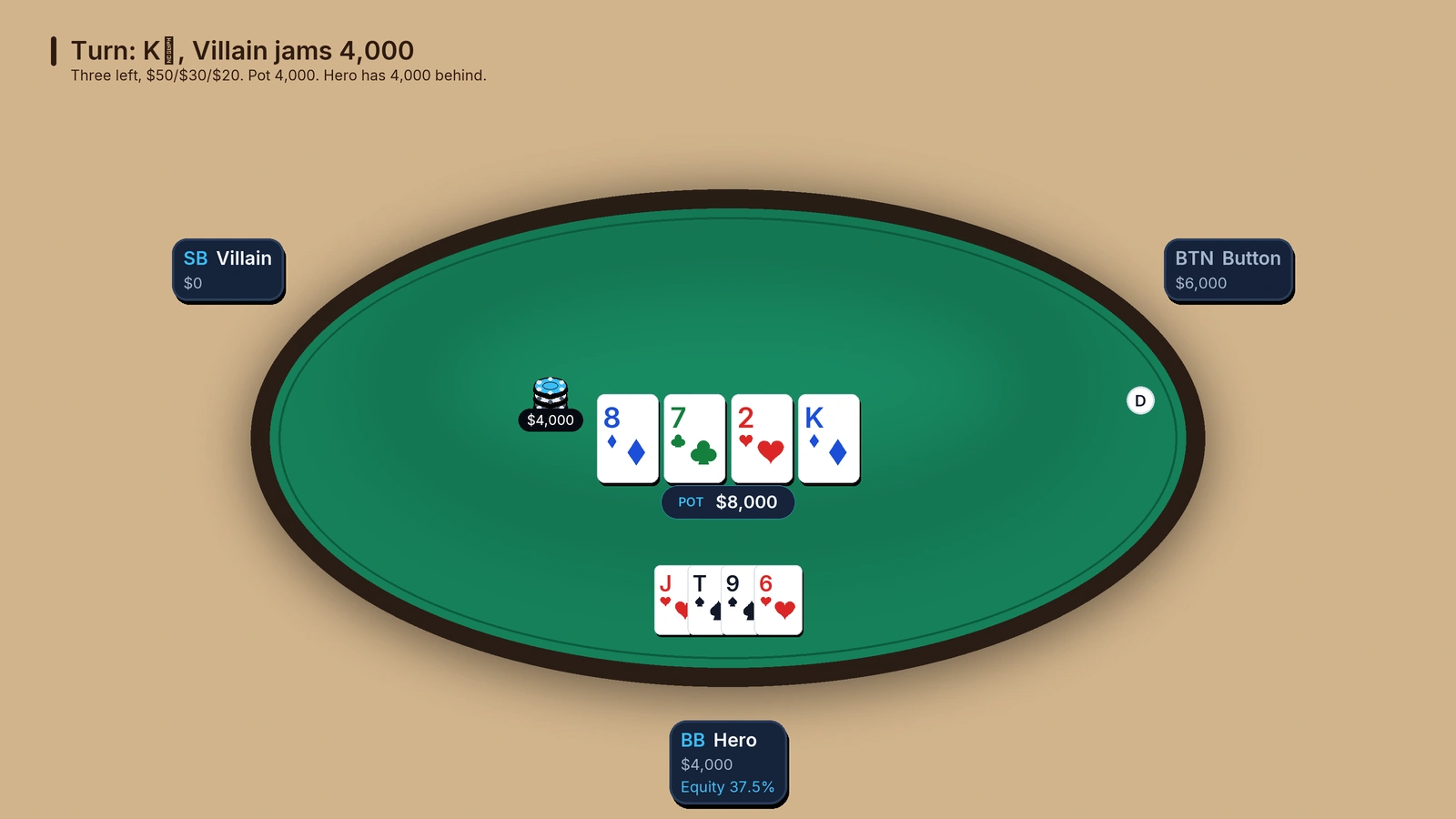
After the jam the pot is 8,000. Hero pays 4,000 to call, and the final pot is 12,000.
The chip EV answer: call
Hero risks 4,000 to win the 8,000 already in the middle. The final pot is 12,000, so the price is 2-to-1. A 2-to-1 price needs 4,000 ÷ 12,000 = 33.3% equity. Hero has 37.5%.
Calling is worth 0.375 × 12,000 − 4,000 = 4,500 − 4,000 = +500 chips. The 12,000 is the final pot, so it includes the 4,000 Hero calls with. Chip EV calls.
The ICM answer: fold
Now convert each outcome into dollars. Here is the full chip ledger, so every stack and the pot add up at each step:
| Step | Hero | Villain | Button | Pot | Total |
|---|---|---|---|---|---|
| Start | 6,000 | 6,000 | 6,000 | 0 | 18,000 |
| After preflop | 4,000 | 4,000 | 6,000 | 4,000 | 18,000 |
| Villain jams | 4,000 | 0 | 6,000 | 8,000 | 18,000 |
| Hero calls | 0 | 0 | 6,000 | 12,000 | 18,000 |
If Hero folds, Villain takes the 4,000 pot and his stack becomes 8,000. If Hero calls and wins, Hero takes the 12,000 pot. The stacks after each choice:
| Outcome | Hero / Villain / Button stacks | Hero’s prize equity |
|---|---|---|
| Fold | 4,000 / 8,000 / 6,000 | $29.56 |
| Call and win | 12,000 / 0 / 6,000 | $43.33 |
| Call and lose | 0 / 12,000 / 6,000 | $20.00 (locked in third) |
The call-and-win row has Villain out in third. Hero then holds two-thirds of the chips against the button, so Hero’s share is $50 × 2/3 + $30 × 1/3 = $43.33. The 12,000 is the whole pot, so it includes the 4,000 Hero called with. Hero started with 6,000, put in 2,000 before the flop, and called the last 4,000. A win returns the full 12,000.
The call-and-lose row leaves Hero with zero chips, which pays third place.
Here is how to calculate ICM in poker for the fold row. Start with each player’s chip share. Hero holds 4,000 of the 18,000 chips in play (the rest are in the pot and the other stacks), so the chance of first place is 22.2%. For second place, add up the chances that each opponent wins first and Hero then wins the rest. Villain first (8/18) then Hero (4/10) gives 17.8%. Button first (6/18) then Hero (4/12) gives 11.1%. Second place is 28.89% and third is 48.89%. Hero’s equity is $50 × 0.2222 + $30 × 0.2889 + $20 × 0.4889 = $11.11 + $8.67 + $9.78 = $29.56. The same steps work for any stack list, and PrimeDope’s ICM explainer walks through the doubling example.
Calling is worth 0.375 × $43.33 + 0.625 × $20.00 = $28.75. Folding is worth $29.56. Calling costs Hero $0.81, so ICM folds.
Where the line sits
Hero needs 40.95% equity to call under ICM. The algebra is short. Hero’s call is worth p × $43.33 + (1 − p) × $20.00, and that must beat $29.56. Solving gives p = 43/105, or 40.95%. That is 7.6 points above the 33.3% chip EV price.
Here is the same hand in dollars. Calling and losing costs Hero $9.56 compared with folding. Calling and winning gains only $13.77. In chips the call risks 4,000 to win 8,000, a 1-to-2 ratio. In dollars it risks $9.56 to win $13.77, a ratio near 1.44 to 1.
Smaller bets are easier calls. Less of Hero’s stack goes in, so the ICM premium shrinks. The full 4,000 jam is the hardest version of this decision.
Why a lost chip costs more: the payout ladder
The gap comes from the payout ladder, which bends. It has nothing to do with feelings. Psychologists use the term “loss aversion” for a bias where people feel losses more than gains (Wikipedia). ICM contains no bias. It is arithmetic on a payout ladder where the bottom rung is worth zero.
Take four players with 5,000 chips each and prizes of $50, $30, $20 and $0. Everyone’s equity is $25.00. Now compare two changes:
| Change to one player | New equity | Dollar change |
|---|---|---|
| Lose 1,000 chips (to 4,000) | $21.59 | −$3.41 |
| Win 1,000 chips (to 6,000) | $28.07 | +$3.07 |
Losing 1,000 chips costs $3.41, while winning 1,000 earns $3.07. The payout ladder is why. Chips at the bottom protect you from the zero.
The gap grows near a pay jump. Four players hold 4,000, 3,000, 2,000 and 1,000 chips, with $50, $30, $20 and $0 prizes. Equities are $33.60, $29.49, $23.59 and $13.32. When the 1,000 stack busts, the other three have 4,000, 3,000 and 3,000, worth $35.43, $32.29 and $32.29. The 4,000 stack gains $1.83 and the 3,000 stack gains $2.80 without playing a hand. That free gain is why mid stacks avoid fights with each other near a jump and let the short stack bust first.
When chip EV and ICM agree
Both models match when the ladder is flat or there is only one prize. Use this table to pick:
| Situation | Which model? | Why |
|---|---|---|
| Winner-take-all | Chip EV | Bubble factor is exactly 1 (GTO Wizard) |
| Heads-up, one prize | Chip EV | Equity equals chip share |
| Heads-up, two prizes | Chip EV for decisions | Totals shift, but a lost chip and a won chip are worth the same |
| Cash game | Chip EV | No payout ladder |
| Early levels, many players left | Mostly chip EV | The ladder is far away, but not zero |
| Final table of a standard MTT | ICM | Pay jumps are large and close |
| Money bubble | ICM | One bust changes a rung |
| Satellite bubble | ICM, at its strongest | Equal seats, so winning adds nothing past the cutoff |
| Progressive knockout early levels | Chip EV plus bounty value | Add the bounty value to the chip EV calculation |
The heads-up rows need a note. ICMIZER writes that “there is no ICM heads-up, it is the only stage of a tournament where that is the case”. Both players have locked up second-place money and are playing only for the difference between first and second, so the remaining decision is linear.
At $60/$40, a 7,000 vs 3,000 chip split is worth $54 and $46, not $70 and $30, which is $16 short of chip-proportional. Each chip still gains and loses the same $0.002, so the bubble factor is 1.0 and decisions follow chip EV.
Deal making at a final table runs on the same math. Players use ICM equity to split the money, then either stop there or keep playing for the title (ICMIZER).
Big stacks against big stacks barely feel ICM at all. In the four-player state above (4,000/3,000/2,000/1,000 at $50/$30/$20), the 4,000 stack facing the 3,000 has a bubble factor of 1.004, essentially 1.
Early in a tournament, ICM is small but present. GTO Wizard’s simulation of 500,000 tournaments found it had a statistically significant effect when 50% to 37% of the field remained, well ahead of the 15% bubble.
How big is the gap? A spectrum from satellite to winner-take-all
The gap is largest in a satellite and zero in a winner-take-all event. Here is the same hand, same stacks and same 37.5% equity, across three payout ladders:
| Payout ladder ($100 pool) | Chip EV break-even | ICM break-even | Call result vs fold |
|---|---|---|---|
| Winner-take-all ($100 / $0 / $0) | 33.3% | 33.3% | +$2.78 (call) |
| Final three ($50 / $30 / $20) | 33.3% | 40.95% | −$0.81 (fold) |
| Satellite, two equal seats ($50 / $50 / $0) | 33.3% | 51.1% | −$6.81 (fold) |
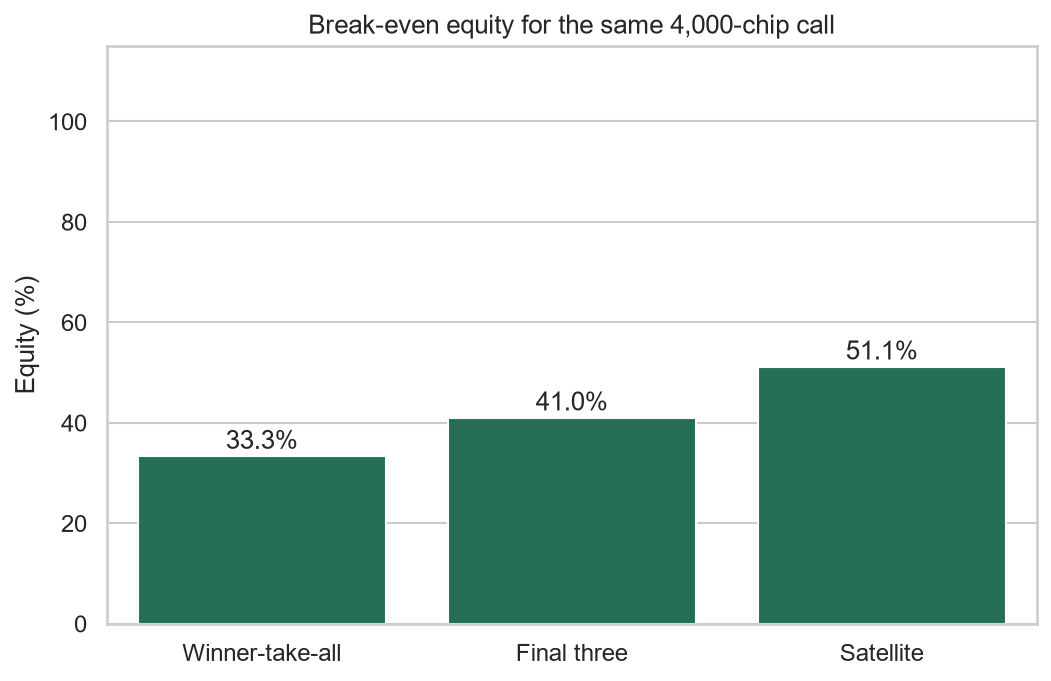
A standard MTT final table tends to sit between the first two rows. The WSOP and WPT publish different payout schedules (WSOP, WPT), so treat this placement as a reasoning aid rather than a measured average. The 2025 WSOP Main Event paid $10 million to first out of a $90.5 million pool, about 11%. The top prize is large, but the ladder still has steps. ICM poker strategy at a final table means a real but moderate premium. GTO Wizard’s bubble factor article shows the Sunday Million average (2009 structure, 10,000 runners) peaking at 1.6 on the money bubble.
The satellite end
A PLO satellite fits the third row. Say the prize is two seats worth $50 each, and three players remain with the same stacks as above. Hero holds 4,000 of 18,000 chips, a 22.2% share. Two seats pay and one player misses out. If Hero folds, Villain has 8,000 and the button 6,000, and Hero’s stack is worth $25.56. Call and win locks a seat, worth $50. Call and lose pays zero. Hero needs 51.1% equity to call, against 33.3% by chip count.
Satellites with equal prizes run on all-or-nothing pressure. Once a seat is nearly secure, extra chips add nothing, so the cost of busting outweighs everything else. That narrow equity margin makes loose calls expensive in a satellite. It is also why satellites produce spots where folding aces can be correct (ICMIZER). Shoves are often fine, since the pressure falls on the caller.
The three spots where this costs the most money
Most of the dollars leak in three places.
Calling off on the bubble. A medium stack that calls a covering stack with pot odds but not ICM odds loses the most. In a four-player test with $50/$30/$20, a 3,000 stack facing a 2,000 jam needs 41.67% by chip EV and 53.11% by ICM. Calling at 40% costs $3.24 of a $100 pool. The ICM bar is 11.45 percentage points above the chip-EV bar.
Folding too much as a big stack. The covering stack has little to lose, so it can raise and call wider. A big stack that folds hands with good pot odds gives away value it could take for free.
Mis-adjusting at a pay jump. ICM pressure on a short stack depends on who covers whom. A short stack jamming into another short stack faces a smaller multiplier than the same stack jamming into a big stack.
GTO Wizard’s analysis of 225 flops found that playing chip EV when ICM applied cost as much as 30% of the buy-in in EV. The study covered flops only, so the full cost, including turn and river play, is likely higher.
Using both models at the table
Start with the pot odds, then ask what a bust costs. Near a pay jump, raise your calling bar if the opponent covers you and lower it if you cover the opponent. In a satellite, raise it the most. The same pot-odds-first approach works for every tournament format. For a progressive knockout, the same chip EV logic runs with a bounty added on top.
Frequently asked questions
Is ICM only relevant at the final table?
No. GTO Wizard’s simulation found a significant ICM effect from 50% to 37% of the field remaining, and ICMIZER calls the belief that ICM matters only on the bubble and at final tables “a common myth”. The effect is small early and grows as pay jumps get closer.
Does ICM matter heads-up?
With one prize left, no. Equity equals chip share, so chip EV is correct. With two prizes, the split of money changes ($54/$46 for a 7,000 vs 3,000 stack at $60/$40), but each chip is still worth the same $0.002 to win or lose, so the bubble factor sits at 1.0 and decisions follow chip EV.
Why do solvers give two different answers for the same hand?
They optimize different things. Chip EV maximizes chips, and ICM maximizes dollars. In the example above, the same hand is a +500 chip call and a −$0.81 call. Both numbers are correct for their own goal.
How is a chip’s value calculated in ICM?
Your chance of first place is your share of all chips. Your chance of second is the sum, over each opponent finishing first, of your share of the remaining chips, and so on. Multiply each finishing chance by its prize and add. The three-player example above shows every step.
Why is ICM more important near the bubble?
One bust moves the field up a rung of the ladder by a large amount. On a satellite-style bubble, losing costs everything and winning gains nothing extra (PrimeDope). GTO Wizard’s bubble factor article shows the Sunday Million average (2009 structure, 10,000 runners) peaking at 1.6.
Does ICM apply to cash games?
No. A cash game has no payout ladder, so each chip is worth its face value and chip EV is the right objective.

Written by
Jake Rivera
Poker writer
Jake Rivera writes about poker strategy across No-Limit Hold'em, Pot-Limit Omaha and Short Deck. His work covers preflop ranges, ICM and bubble decisions, and postflop lines, along with the adjustments that separate tournament play from cash games.