Preflop Strategy at Micro Stakes No-Limit Hold'em: Opens, Blinds, 3-Bets and Shoves
A practical preflop strategy for micro-stakes no-limit hold'em: open sizes by seat, big blind defense rates, small blind 3-bets, limping spots and push/fold at 12bb.
Preflop strategy covers every choice you make before the flop: whether to raise, call, limp or fold, and how many chips to put in. Those choices set the pot size and decide who sees a flop. Micro-stakes tables repeat the same few preflop errors, so fixing them pays quickly. This guide walks through six decisions in no-limit hold’em: open raising, limping, calling a raise from the big blind, calling a raise in position, stealing blinds with a three-bet, and shoving a short stack. Every hand below comes with equity numbers from the site’s own calculator, run over 100,000 simulated boards with the ranges named in each spot.
A big blind (bb) is the forced bet posted by the player in the big blind seat. Charts measure bet sizes in bb, so a 2.5bb open is two and a half times the big blind.
Preflop strategy: open wider as your seat moves later
Open raising means betting first after everyone ahead of you folds. The later your seat, the wider you open. Poker Skill lists six-max opening frequencies of 14.3% from under the gun (UTG), 18.9% from hijack, 25.5% from cutoff, 43.3% from the button and 33.0% from the small blind.
Percentages mean more once they are counted in hands. Poker Skill’s 14.3% UTG range (22+, ATs+, A5s-A2s, KTs+, QTs+, JTs, T9s, 98s, AJo+, KQo) is 190 of the 1,326 starting combos. A button range of about 43% (22+, A2s+, K5s+, Q7s+, J8s+, T6s+, 95s+, 85s+, 75s+, 64s+, 54s, A2o+, K8o+, Q8o+, J8o+, T8o+, 98o) is 582 combos. You play roughly three times as many hands on the button as under the gun.
K♥9♥ on the button at 100bb, everyone folds to you. Open to 2.5bb. If both blinds fold you win the 1.5bb they posted: the 4bb pot includes your own 2.5bb, so the pot is not profit. Risking 2.5bb to win 1.5bb sets a fold-equity requirement of 2.5 / 4.0 = 62.5%, meaning both blinds must fold that often for the open to break even before any postflop play. That 62.5% is a fold rate, called alpha, and it is separate from the equity the hand needs once a blind calls.
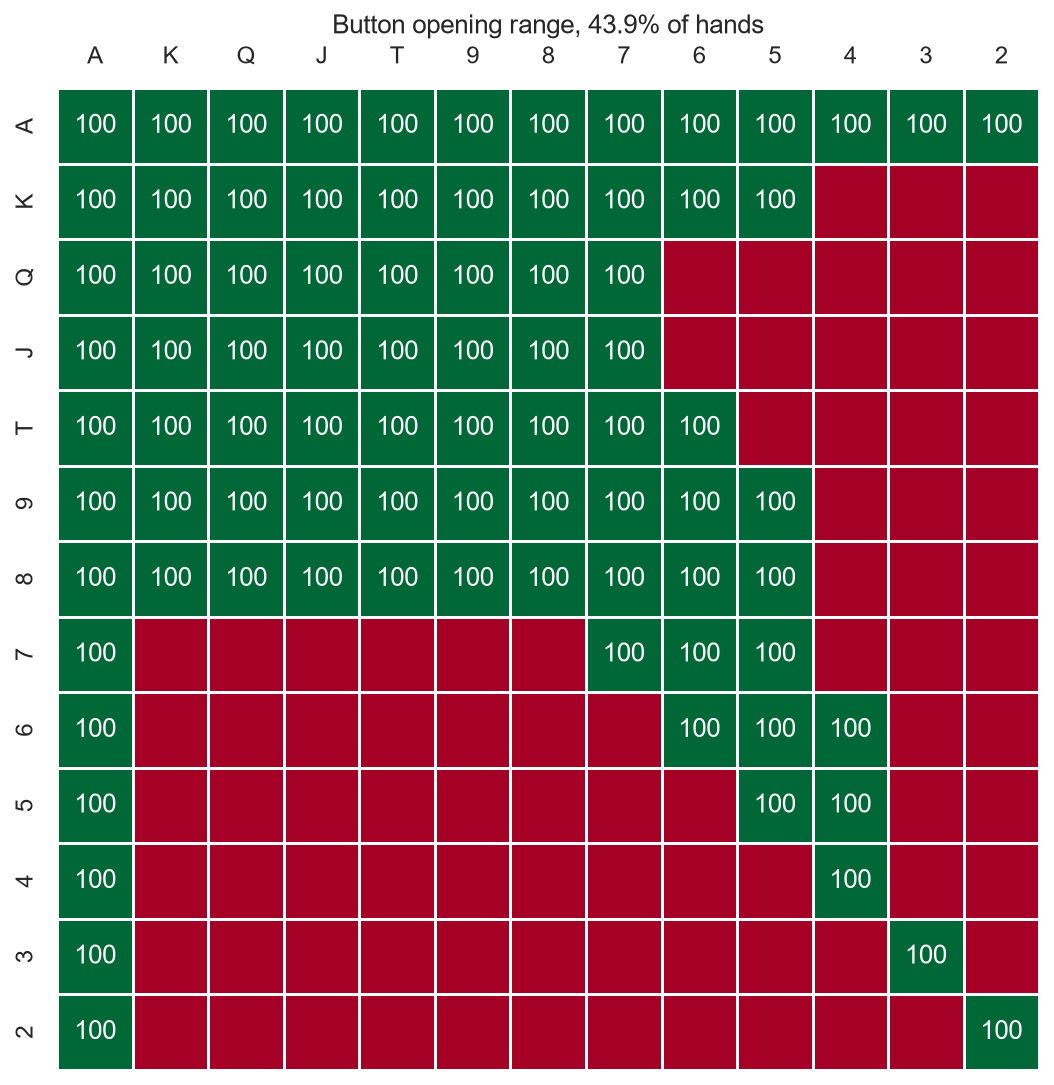
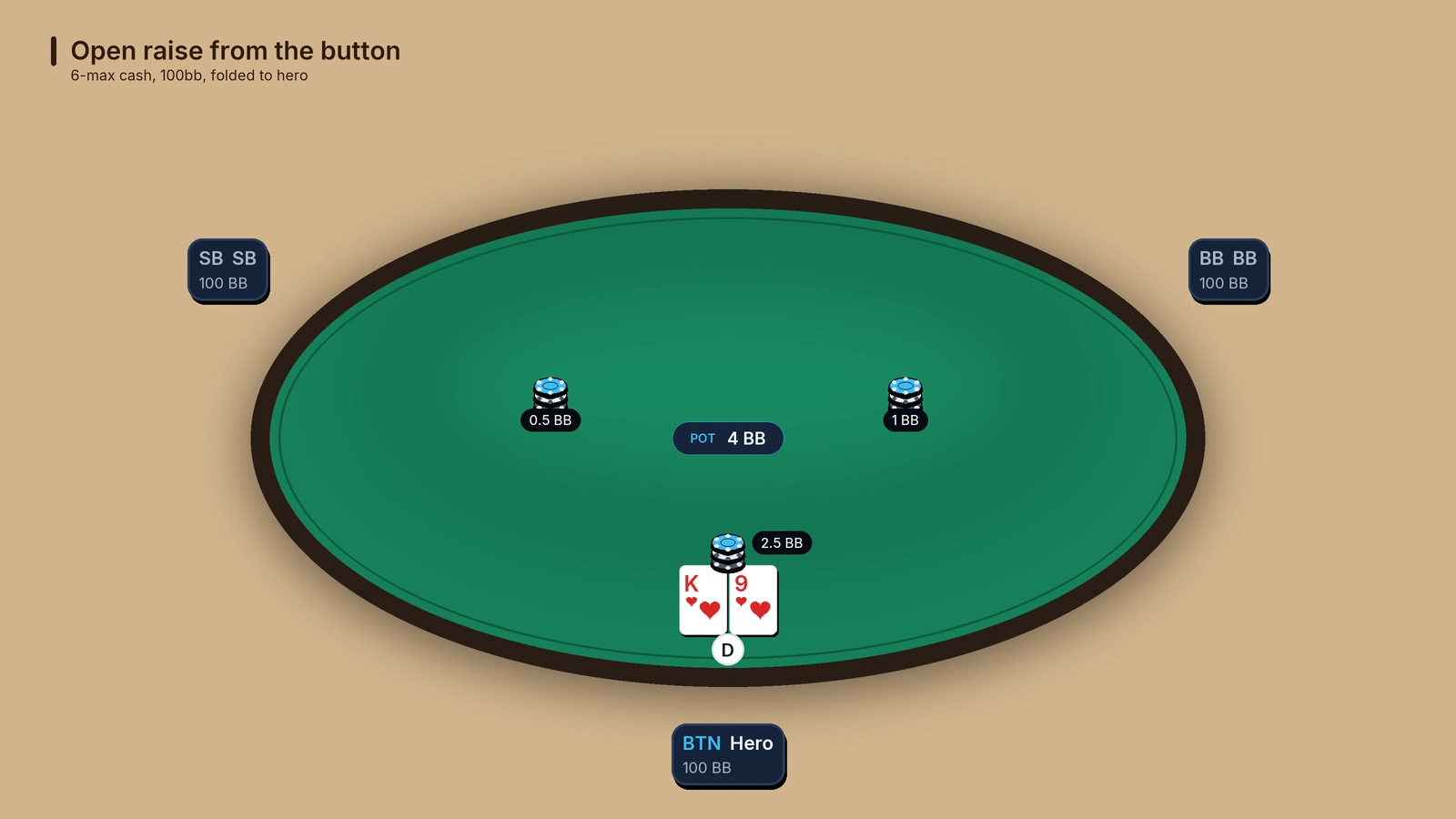
Fold equity is half of the story. When the big blind calls, K♥9♥ keeps 48.9% equity against the range a big blind usually flats (22-99, A2s-A9s, K9s-KTs, QTs+, JTs, T9s, 98s, 87s, A2o-A9o, K9o+, Q9o+, J9o+, T9o, 328 combos or 24.7%). That equity turns into a second barrel when you flop a pair or pick up a flush draw.
Early seats stay tight because so many players act behind them. The wheel aces (A5s through A2s) earn a place in the UTG range because they make straights and nut flushes, and they block the aces a caller behind you may hold.
Sizing: 2.5bb from most seats
Most current sources open to 2.5bb. Poker Skill uses 2.5bb from every seat except the small blind, where 3bb is standard. Freebetrange makes the same choice, so the big blind does not get too cheap a price to call.
Coaches disagree for loose low-stakes tables. GipsyTeam suggests 3x or 4x at low-stakes cash games because players call too much. Jonathan Little of PokerCoaching keeps opens at 2 to 2.5bb and sizes up slightly from early position, with one size per seat so your bet never gives away your hand.
A workable default for micro cash: 2.5bb from every seat, 3bb from the small blind, and one fixed size per seat.
The small blind is the one seat where good sources still disagree. Poker Skill opens 33.0%, Freebetrange 39% to 47%. Part of the gap comes from raise-or-fold lists against lists that also mix in limps. Use either approach, and stay consistent.
Limping belongs to two narrow spots
Limping means matching the big blind instead of raising. At 100bb in a cash game, raise or fold covers nearly every seat. Two spots are the exception.
The first is the small blind when everyone folds to you. GTO Wizard’s Matt Hunt says a limping range “almost always” belongs in the small blind when the action folds around, with exceptions for very shallow stacks and big ICM pressure. ICM measures what chips are worth in tournament payouts, where busting costs you a cash finish. Hunt’s video covers the details.
The second is short-stacked button play. GTO Wizard’s Andrew Brokos found short-stacked button limping works in polar ranges and drops out of play around 8bb. Brokos notes that an open-limp gets you heads up with the big blind nearly as often as a raise, at half the cost. Brokos’s article walks through the math.
Limping costs 0.5bb to see a flop. Raising to 3bb puts in 2.5bb more to win the 1.5bb the blinds posted, so it needs folds 62.5% of the time to break even on fold equity.
5♥4♥ in the small blind at 100bb, folded to you. A limp sees a flop for 0.5bb, but 5♥4♥ holds only 38.9% against the big blind flatting range used above, and the rest of the hand is played out of position. Raising to 3bb adds fold equity and risks 2.5bb for the same 38.9% when called. The limp keeps the pot small; the raise needs the big blind to fold often. At micro cash, raise to 3bb or fold stays the default, and a limp only makes sense when you are happy to defend 5♥4♥ after a big blind raise.
Jonathan Little treats limpers as a leak to punish, so build your isolation raises against them.
Calling a raise from the big blind: defend about half your hands against a button open
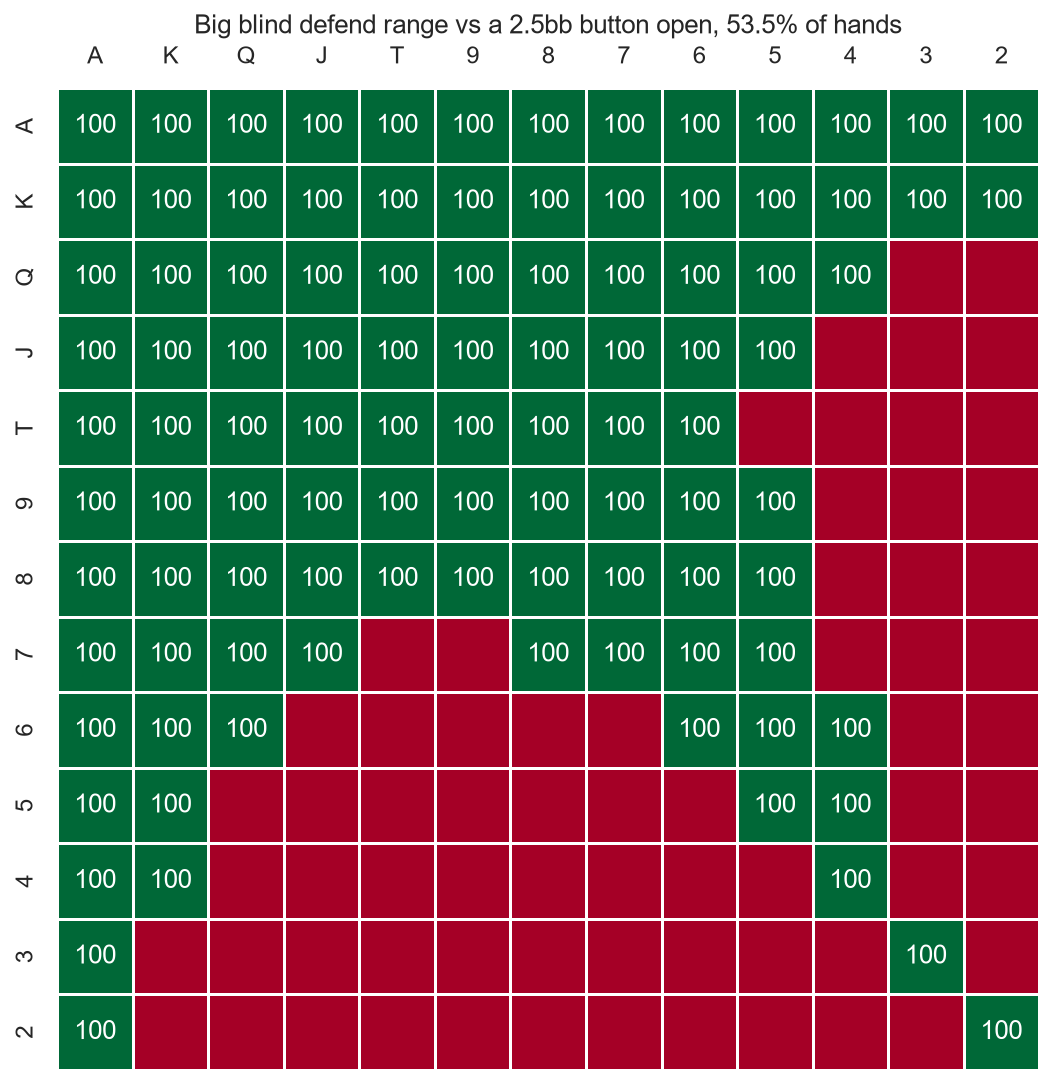
Big blind defense means calling an open with the blind you already posted. Against a button open to 2.5bb, defend a little over half your hands. vip-grinders lists 52% to 58% versus a 2.5x button open, 40% to 48% versus cutoff, and 25% to 30% versus under the gun.
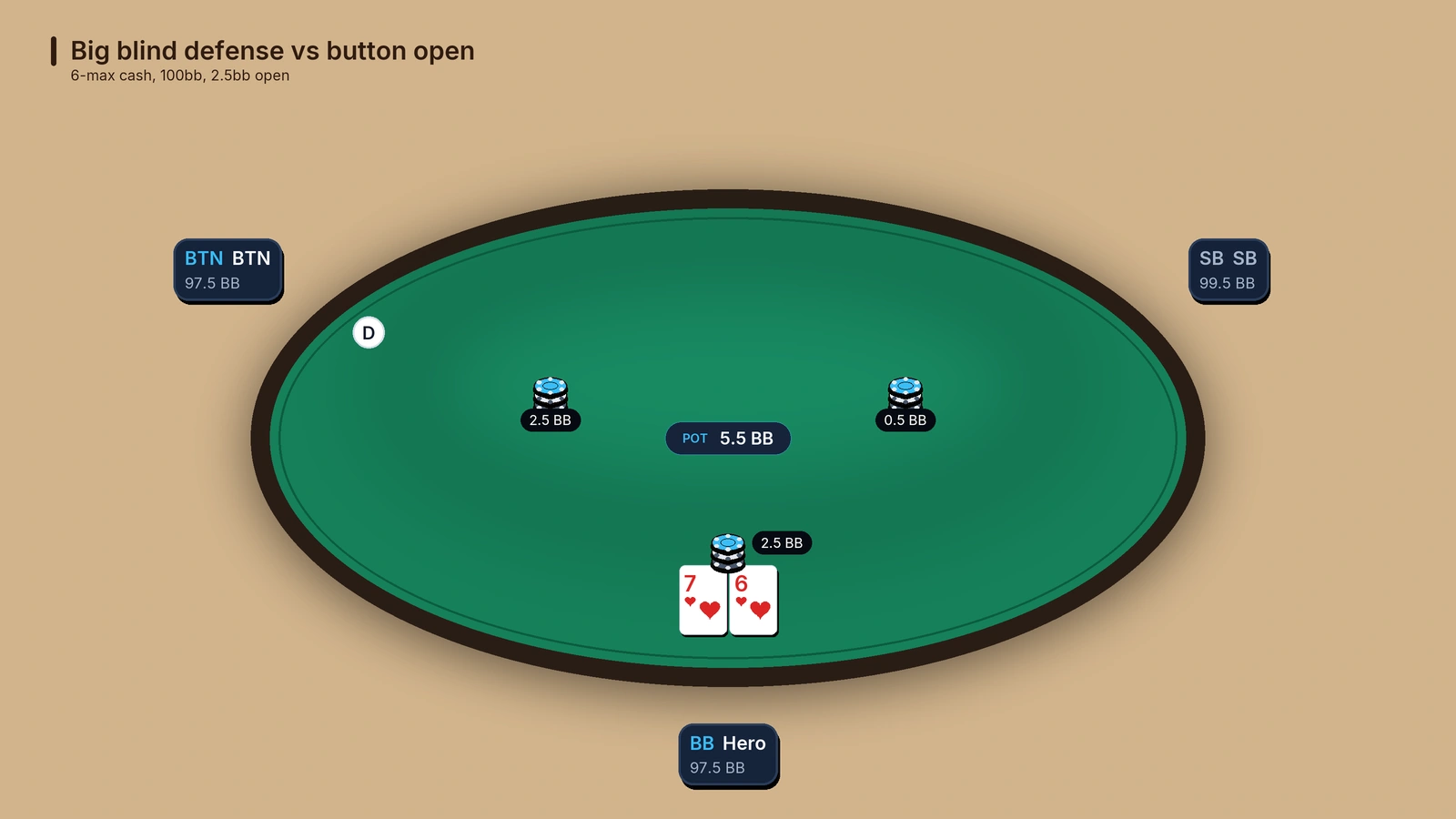
Pot odds explain why that number is so high. A 2.5bb button open, the 0.5bb small blind and your 1bb big blind put 4bb in the middle before you act. Calling 1.5bb makes the pot 5.5bb, so the call needs 1.5 / 5.5 = 27.3% equity to break even.
7♥6♥ in the big blind at 100bb. The button opens to 2.5bb, the small blind folds, and you call 1.5bb. Against the button’s 43.9% opening range, 7♥6♥ has 39.7% equity, well clear of the 27.3% break-even price.
A defend range that reaches 53.5% against a 2.5bb button open is 22+, A2s+, K2s+, Q4s+, J5s+, T6s+, 95s+, 85s+, 75s+, 64s+, 54s, A2o+, K4o+, Q6o+, J7o+, T8o+, 98o and 87o, which is 710 of the 1,326 combos.
Raw equity overstates the call, because the big blind acts first on every later street. Solvers defend 52% to 58% instead of every hand holding 27.3% equity, and preflopwizard calls a 30% to 40% defense against a 3x open a leak. Raise size matters: against a 3x button open, vip-grinders puts defense at 33% to 38%.
Three-betting from the big blind belongs in the same range. Choose the strongest hands and some suited hands that block the opener, then flat with the rest of your calling range.
Calling a raise in position
Calling in position costs more chips and buys the last action on every street. A cutoff open to 2.5bb leaves 4bb in the middle and asks 2.5bb from the button, so the price is 2.5 / 6.5 = 38.5%. Against a 22.8% cutoff range, 9♦8♦ has 39.2% equity, which is only just enough to call with position behind it. 4♠3♠ has 34.6% and is a fold at the same price.
Blind steals and three-betting
A blind steal is an open from the button or cutoff that tries to take the blinds with no showdown. Steals pay only when the blinds fold often enough. A 2.5bb button open with 1.5bb in the blinds needs folds 62.5% of the time to break even, which works out to roughly 79% per blind, since 0.79 x 0.79 = 0.62. Poker Skill’s glossary works the same sum. That fold rate is why any-two-cards stealing relies on tight opponents.
From the small blind facing a raise, pick three-bet or fold. Jonathan Little writes that “calling is rarely optimal” because it “invites the big blind in, creates multiway pots, and commits you out of position with a capped range.” He calls frequent small blind flatting “a red flag that their preflop discipline needs tightening.” Little’s small blind guide covers the reasoning.
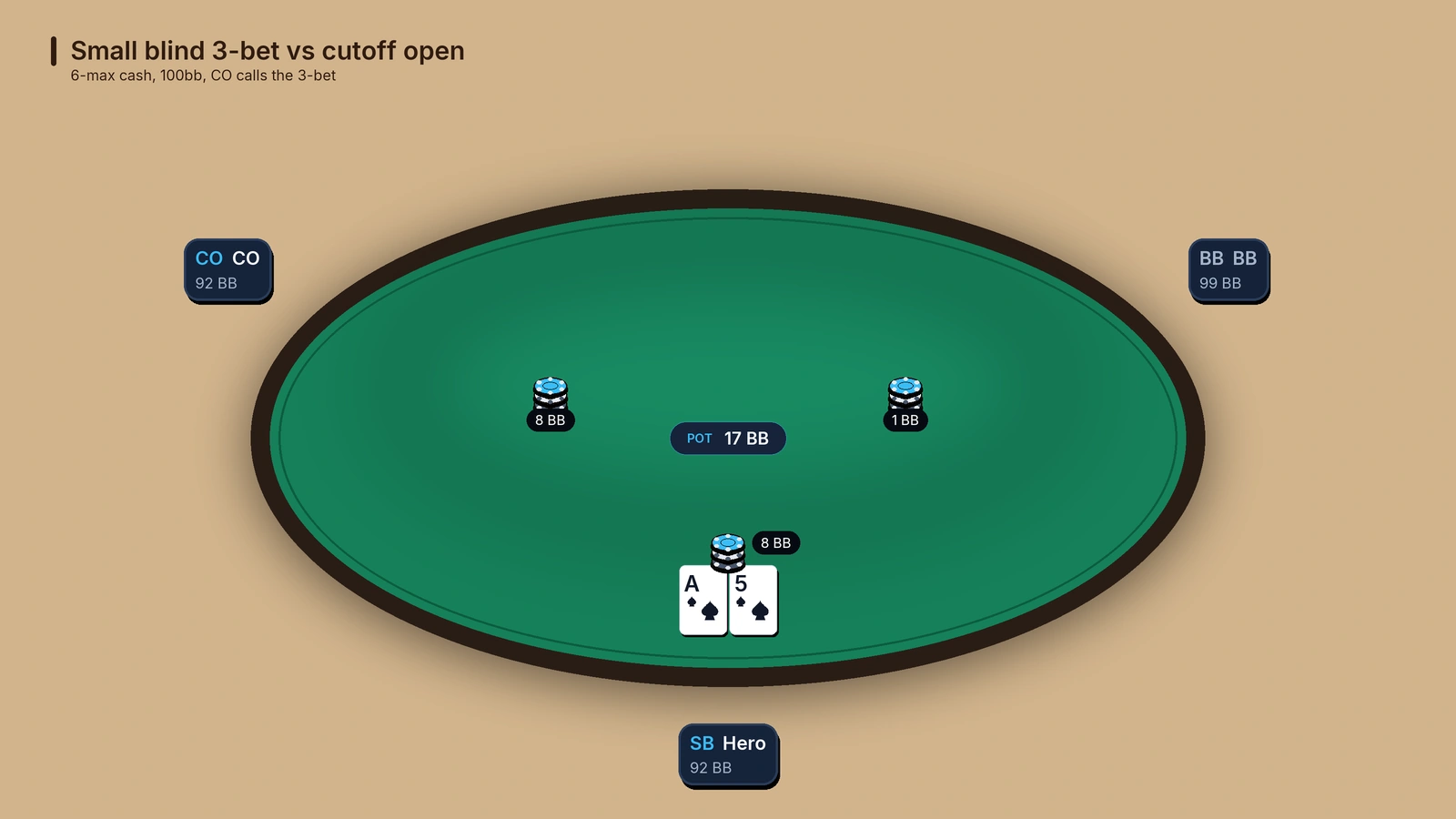
The sizes in the next two spots are the sizes used for the arithmetic here, set at 8bb from the small blind against a 2.5bb open and three times the open in position. They are not a published standard, and the equity numbers hold for any size you pick as long as the pot figures change with it.
A♠5♠ in the small blind. The cutoff opens to 2.5bb and the button folds. Make it 8bb. If the cutoff calls, the pot reaches 17bb (8bb from each player plus the big blind’s 1.0bb), and A♠5♠ has 46.5% against the cutoff’s 22.8% opening range. The ace blocks AA, AK and AQ, and the five gives a wheel draw as backup.
Three-betting in position keeps the same reasoning at a smaller size. K♠Q♠ on the button against a 2.5bb cutoff open: make it 7.5bb. When the cutoff calls, the pot reaches 16.5bb (7.5bb each plus 0.5bb and 1.0bb from the blinds), and K♠Q♠ has 52.4% against the cutoff range. A♦Q♦, the top of the same group, sits at 59.2%.
Every number in those spots comes from the site’s equity calculator: one exact hand against the stated range, 100,000 simulated boards. The output is equity for that matchup. It shows which hands have enough equity to continue, and it does not settle a mixed strategy on its own.
Short stacks: shove or fold near 12bb
A short stack here means roughly 15bb or less. At that depth the choice is usually all-in or fold. PokerCoaching says that between 12 and 15 big blinds some hands still want an open-raise, and at 12bb or less, “moving all-in or folding is almost always the highest-EV option.” PokerCoaching’s push-fold charts give the breakdown hand by hand.
When the shove gets called, the price decides the hand. Q♠J♠ on the button at 12bb with two folds: shoving 12bb into a 1.5bb pot puts 25.5bb in the middle when called (12bb + 12bb + 1.5bb), so the all-in needs 47.1% equity against the calling range. Against the range that calls a 12bb shove (22+, A7s+, KTs+, QTs+, JTs, A9o+, KJo+), Q♠J♠ has 40.5%. Fold equity covers the gap whenever both blinds give up the 1.5bb.
Preflopwizard sets its default push/fold range around 8 to 10bb. Upswing’s chip math shows how close the two plays run at 10bb. From under the gun, aces min-raised earn about 5.79bb on average, and the shove earns about 5.51bb. Raising wins by a small margin there, and the shove keeps growing better as stacks shrink.
At 25bb, Little suggests raising to 2bb. Bigger opens cost more when a short stack behind you shoves.
Tournament antes: widen your opens
An ante is an extra forced bet that every player posts. Antes inflate the pot, so folding costs more and stealing earns more. Little says antes can nearly double the under-the-gun-plus-one open range in tournaments, from about 10% to about 20%. The fold rate needed to break even on an open falls from about 60% to about 48%. PokerCoaching lays out the math.
GTO Wizard’s Aidan Heberle found a smaller shift in ante cash games, where equivalent seats open 4% to 6% more often. The two figures come from different formats, tournament antes against a 0.7bb cash ante, so they do not line up directly. Both point the same way: antes mean wider opens.
Frequently asked questions
How wide should I open from the button in 6-max?
Roughly 40% to 48%. Freebetrange gives 40% to 48%, and Poker Skill’s chart shows 43.3%, about three times the 14.3% under-the-gun range. The button opens wide because only two players remain to act.
Should I 3-bet or call from the small blind?
Three-bet or fold in most spots. Jonathan Little writes that calling is rarely optimal because it brings the big blind into the pot and leaves you out of position with a capped range. Flatting often marks a player whose preflop discipline needs tightening.
How often should I defend my big blind against a 2.5x open?
Calling 1.5bb into a 4bb pot makes the pot 5.5bb, so the call needs 27.3% equity. Solvers still defend only about 52% to 58% against a button 2.5x open, because the big blind realizes less than its raw equity out of position. Defense drops to 40% to 48% against a cutoff open and 25% to 30% against under the gun.
Is limping ever correct?
In narrow spots. The small blind limps when the action folds to it, and short-stacked button limping can work in polar ranges. At 100bb in a cash game, raise or fold covers every other seat.
When should I stop raising and start shoving?
Two thresholds, used for different things. From 15bb down to 12bb some hands still prefer a small open-raise. At 12bb or less, shove or fold is almost always the best option. Preflopwizard’s ready-made push/fold charts start around 8 to 10bb, so a chart read at that depth assumes a shove-only strategy.
Should I 3-bet more or less against early-position opens at low stakes?
Less. PokerCoaching’s 2026 adjustment guide says low-stakes early-position ranges “are typically much tighter than theory suggests,” so “significantly reduce your 3-bet frequency in these spots.” Fold the marginal hands and keep your bluffs for opponents who open too wide.
What to fix at your next session
Pick one seat and one number for the next hour. Open 2.5bb from every seat, 3bb from the small blind, and stay there until it feels routine. Track three counts on a notepad: how many hands you opened from the button, how many big blinds you defended, and how many times you three-bet from the small blind instead of calling. Compare those counts with the rates above and tighten whichever seat runs hottest.

Written by
Jake Rivera
Poker writer
Jake Rivera writes about poker strategy across No-Limit Hold'em, Pot-Limit Omaha and Short Deck. His work covers preflop ranges, ICM and bubble decisions, and postflop lines, along with the adjustments that separate tournament play from cash games.