Turbo poker: blind schedules, big blinds and when to open-shove
Turbo poker is a blind schedule. See how fast your stack falls in big blinds, when open-shoving beats raising, and how the bubble changes your calling range.
Turbo poker is the same No-Limit Hold’em tournament on a faster clock. GGPoker calls turbo levels “1/3 or 1/2” of a regular event’s, with less time to act (GGPoker). The cards do not change. The payouts do not change. Only the clock changes. And the clock decides how many hands you get at each blind level. That, in turn, decides how deep your stack really is.
What is turbo poker?
A turbo is a tournament with shorter blind levels. The blinds still go up step by step. The steps just arrive faster. So your stack, counted in big blinds, shrinks faster.
Turbo covers both MTTs (multi-table tournaments) and single-table SNGs (sit-and-goes).
Two numbers set the pace. One is the size of each blind jump. The other is the minutes between jumps. An online table deals about 60 hands an hour (Rakeback.com). A 15-minute level gives you about 15 of those hands. A 5-minute level gives you about 5.
That is the whole difference. Same seat, same starting stack, same blind levels. You reach each level after half the hands, or after a third of them.
Turbo poker tournament structures compared
Turbo, hyper-turbo and regular tournaments differ in one thing: how long a level lasts. The hands per level follow from that.
| Regular clock (assumed 15 min) | Turbo | Hyper-turbo | |
|---|---|---|---|
| Minutes per level | 15 | 5 to 7.5 | 2 to 3 |
| Hands per level at 60 an hour online | 15 | 5 to 7.5 | 2 to 3 |
The turbo column takes GGPoker’s ratio and applies it to a 15-minute level. If your regular level lasts 10 minutes, the same ratio gives 3.3 to 5 minutes. Hyper-turbo levels run every two or three minutes. At that speed a 100-big-blind stack falls to a few big blinds in under 20 minutes (PokerCoaching). The site’s own page for those structures is the hyper-turbo format page.
Club structures show the same fall. One club ladder starts at 2,200 chips and 50/100. That is 22 big blinds. By level six it holds 3.67 (Poker Chip Forum). A second club ladder in the same thread drops from 20 big blinds to 1.67 over the same six levels.
Turbo poker structure maths: big blinds and orbits
The table below uses four inputs. There is a 10,000-chip stack and a blind ladder. The ladder starts at 50/100. It then steps up 50%, then 33%, then 50%, then 33%, then 50%, then 33%, then 50%. The other input is the clock.
The table shows how long your stack lasts, in orbits. One orbit is one full trip of the button around the table.
| Level | Blinds | Starting stack in BB | Orbits you can last, no ante | Orbits you can last, 1 BB ante | Time on a 15-minute clock | Time on a 5-minute clock |
|---|---|---|---|---|---|---|
| 1 | 50/100 | 100 BB | 66.7 | 40 | 0-15 min | 0-5 min |
| 2 | 75/150 | 66.7 BB | 44.4 | 26.7 | 15-30 min | 5-10 min |
| 3 | 100/200 | 50 BB | 33.3 | 20 | 30-45 min | 10-15 min |
| 4 | 150/300 | 33.3 BB | 22.2 | 13.3 | 45-60 min | 15-20 min |
| 5 | 200/400 | 25 BB | 16.7 | 10 | 60-75 min | 20-25 min |
| 6 | 300/600 | 16.7 BB | 11.1 | 6.7 | 75-90 min | 25-30 min |
| 7 | 400/800 | 12.5 BB | 8.3 | 5 | 90-105 min | 30-35 min |
| 8 | 600/1,200 | 8.3 BB | 5.6 | 3.3 | 105-120 min | 35-40 min |
One orbit costs the small blind plus the big blind. That is 1.5 big blinds with no ante. Add a one-big-blind ante and the same orbit costs 2.5. Divide your stack in big blinds by the orbit price and you get the orbit count. Level one: 100 divided by 1.5 is 66.7 orbits.
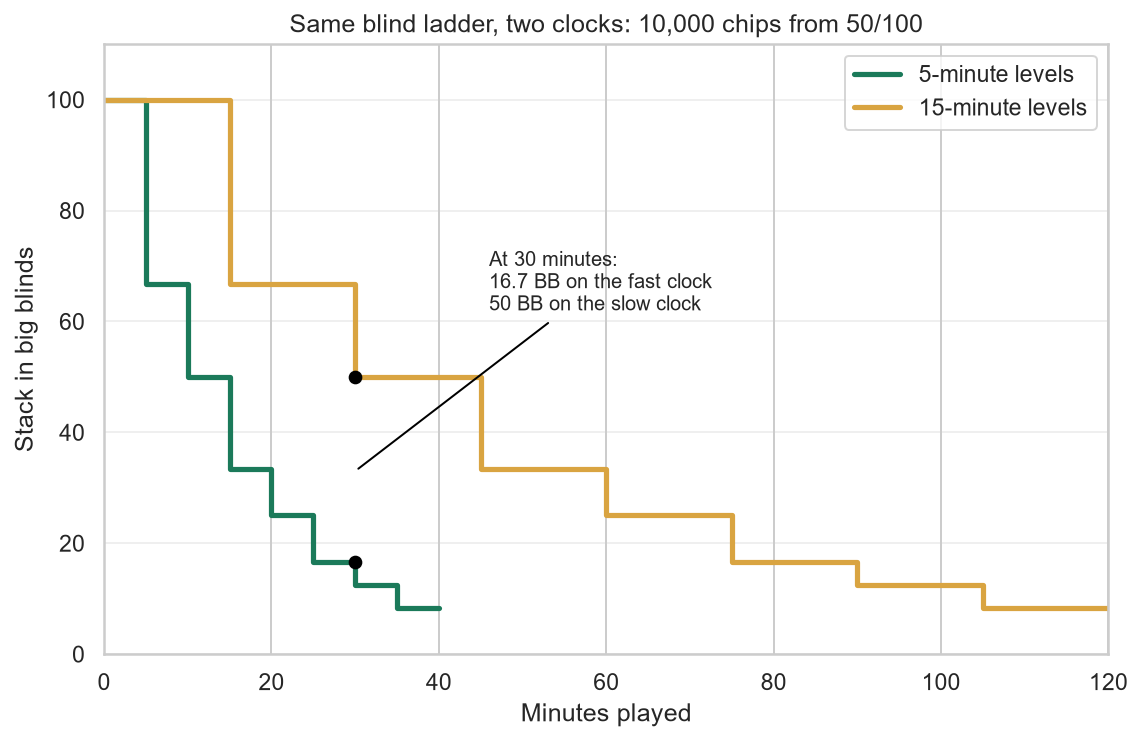
Level six starts 25 minutes into the fast event. In the slow one it starts at 75 minutes. Level eight ends at 40 minutes in the fast event, after about 40 hands. In the slow event it ends after two hours, after about 120 hands.
When the turbo forces you into push/fold
Open-shoving works up to about 15 big blinds (Upswing Poker). On this ladder you pass that line at level seven. That is 30 to 35 minutes into the fast event. It is 90 to 105 minutes into the slow one.
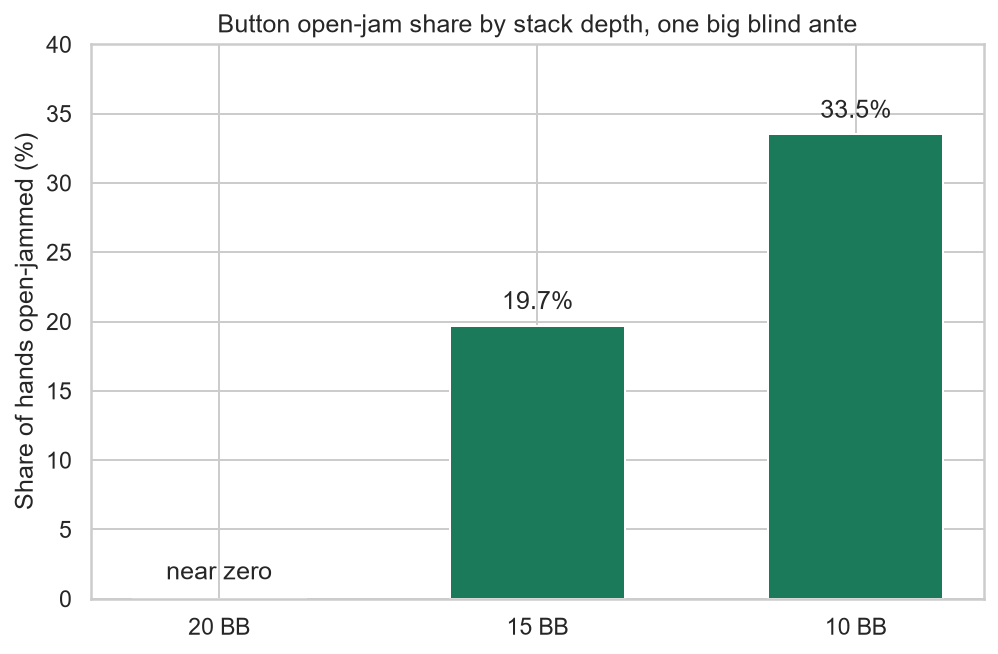
With a one-big-blind ante, a solver run barely jams at 20 big blinds. On the button it jams 19.7% of hands at 15 big blinds. At 10 it jams 33.5% (Poker Academy).
Let’s say you hold A♠9♠ on the button with 14 big blinds. Everyone folds. The blinds and the one-big-blind ante put 2.5 big blinds in the pot.
And let’s assume, for instance, that the players in the blinds call with about 12% of hands: 44+, A8s+, ATo+, KTs+, QJs and JTs.
A♠9♠ wins 39.4% against that range.
Start with the shove. They fold 88% of the time and you win 2.5 big blinds (BB): 0.88 × 2.5 = 2.2. They call 12% of the time and you lose 2.4: 0.12 × 2.4 = 0.3. So the shove is worth about 1.9 BB (2.2 − 0.3). That counts chips only, not tournament payouts.
Now the min-raise. You raise to 2 to win 2.5, so it has to work 2 ÷ 4.5 = 44% of the time to break even. Without the ante the pot is only 1.5, and the same raise needs 2 ÷ 3.5 = 57%.
The short version: The faster the clock, the sooner you’re forced to shove. You hit 15 big blinds at 30 to 35 minutes in the fast event, but not until 90 to 105 minutes in the slow one. With A♠9♠ on the button and 14 big blinds, shoving wins about 1.9 big blinds on average. In the fast event, shove, because the blinds rise again in about 5 hands and waiting only costs you chips. In the slow event you have about 15 hands before that happens, so you can afford to wait for a better spot.
Preflop adjustments: opens, steals and defends in a turbo
Open wider from late position. Flat call less. Those two changes cover most of the differences in play between a turbo tournament or SNG and a regular-paced one.
An ante makes steals cheaper. With a one-big-blind ante, a 2-big-blind raise needs folds 44% of the time. Without the ante it needs 57%.
The defender’s price works the same way. With the ante the pot is 4.5 big blinds before the big blind calls. It is 5.5 after. So their 1-big-blind call needs 18.2% equity. Without the ante the numbers are 3.5 and 4.5. The same call then needs 22.2%. That is why late-position opens get looser once an ante arrives.
A flat costs the same chips as a raise. It gives up fold equity, which is the chance that everyone folds and you take the pot. At 14 big blinds a 2-big-blind flat leaves 12 behind. A suited connector misses the flop most of the time. The guide to big blind defence with an ante covers the other side of the table.
Small pairs lose value first. A set needs a deep stack behind it to pay. A turbo shrinks that stack with every level. So, at 15 big blinds, a small pair is a shove. There is no room to call and flop a set.
Ax suited, big broadway cards and the pairs you plan to jam. Drop the hands that need two more streets and a deep stack, such as suited connectors. The two changes actually work together. Wider opens and tighter flats push your stack toward the levels where an open-shove is right.
Turbo bubbles and ICM: fewer orbits to wait
A turbo bubble arrives sooner than a regular one. That shapes most of the late play.
The 16.7-big-blind stack on this ladder has 11 orbits with no ante. With a one-big-blind ante it has 6.7. The fast event reaches that stack 25 minutes in, and every orbit you wait costs chips.
ICM (the independent chip model) turns chips into prize money. The bubble factor says how much that changes your decision. It compares what a lost chip costs you in prize money with what a won chip gains you. A bubble factor of 2, for example, means losing a pot hurts twice as much as winning it helps.
That matters because it raises the odds you need. In a normal all-in for equal stacks you break even at 50% to win. With a bubble factor of 2 you need about 67%, since the formula is: Necessary equity = BF ÷ (BF + 1). The extra equity you need on top of chip maths is called the risk premium.
GTO LAB puts the bubble factor at 1.5 to 2.0 on the bubble. At final-table pay jumps it runs 2.0 to 3.5 (GTO LAB). PrimeDope’s bubble spot works out 2.43. Its author says the figure can pass 3 for a medium stack on the bubble (PrimeDope).
Here is what one call costs. Four players are left, and the $100 prize pool pays 50/30/20. The stacks are 2,700, 4,500, 3,000 and 3,000. The 2,700 stack shoves all-in into your 4,500, and the blinds and antes have put 750 chips in the pot.
Calling costs you 2,700 chips. On chips alone, you need to win 43.9% of the time to break even. Under ICM you need 53.8%, so the risk premium is 9.9 points.
A♠9♠ wins 53.16% against a wide shoving range. That beats the chip price but falls 0.6 points short of the ICM price. Calling gives up about $0.15 of prize equity, so folding is right, but only just.
A faster clock doesn’t shrink that premium. It only cuts the number of hands you have to wait for a better spot. So near the bubble or final table, the player who covers the shover shoves wider. The player who can be knocked out folds more.
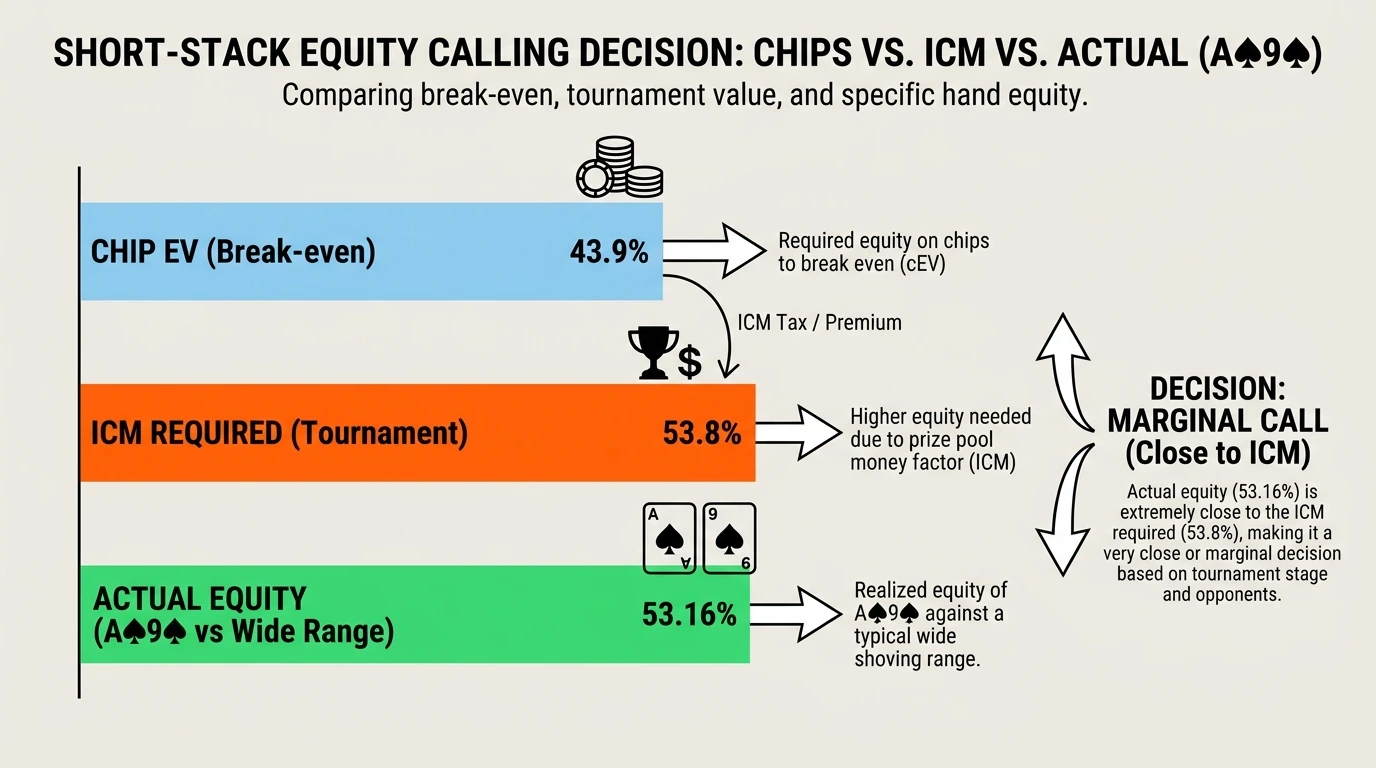
The chip EV against ICM comparison takes a single hand through both methods.
Turbo poker mistakes that cost the most
Waiting for a premium hand. AA, KK, QQ, JJ and AK fill 40 of the 1,326 starting combos. That is about 3% a hand. Six 5-minute levels give you about 30 hands. Over that run you see one of those hands about 60% of the time.
Min-raising under 15 big blinds. A 2-big-blind raise takes 14% of a 14-big-blind stack. The 12 you keep become 8 at the next level of this ladder.
Calling with a chip-EV range on the bubble. In the example above, we saw that the call needs 43.9% in chips and 53.8% under ICM. The equity you need near the bubble or final table is always higher than in a cash game. A turbo also leaves fewer hands to find a better spot.
Treating every turbo as a hyper-turbo. Hyper-turbo levels last two or three minutes. At 60 hands an hour that is 2 to 3 hands per level. A 15-minute level gives you 15.
The opening ranges that work at cash micro stakes still apply in the first three levels. After that, stack depth in big blinds drives every call.
Frequently asked questions
What is turbo poker?
A tournament where the blind levels last less time than in the regular event. GGPoker puts turbo levels at a third to a half of a regular level. The cards and the payouts stay the same.
Is turbo poker harder?
The opponents are the same. You get fewer hands at each stack depth. A plan built for 100 big blinds breaks sooner. Preflop decisions carry more of the weight.
How long does a turbo poker tournament take?
Level length and field size decide it. A club schedule with 10-minute levels finishes a 6-to-10-player event in an hour or less. A hyper-turbo with two- or three-minute levels turns a 100-big-blind stack into a few big blinds inside 20 minutes.
Should you play tighter in turbo tournaments?
Play wider when you open. Play tighter when you call. An ante cuts the fold rate a 2-big-blind steal needs from 57% to 44%. Flatting costs chips that the next level will charge more for.
What is the difference between turbo and hyper-turbo?
Hyper-turbo levels run two or three minutes. Turbo levels run a third to a half of a regular level. Against a 15-minute level that is about 5 to 7.5 minutes.

Written by
Jake Rivera
Founder and No-Limit Hold'em writer
Jake Rivera founded Rivera Poker and writes about No-Limit Hold'em: preflop ranges, ICM and bubble decisions, and the postflop lines that separate tournament play from cash games. He also follows the major series and reports on results, schedules and new formats.