Big Blind Defense Tournament Ante Pot Odds: The 19 bb Call
Big blind defense tournament ante pot odds: how a 600 chip ante drops the price of a 19 bb call, with the same hand at a 2, 2.5 and 3 bb open.
Big blind defense tournament ante pot odds decide this hand before you look at your cards. A 600 ante from every player puts 3,600 extra chips in the middle in a six handed game, so the dead money is larger than the big blind itself. Here is a representative setup that shows what that does to one call.
Big blind defense tournament ante pot odds: the spot
The blinds are 300 and 600, with a 600 chip ante from every player. Six players are dealt in. The seat stacks are illustrative round numbers, and so is the payout ladder later in the piece.
- Hero (big blind): 11,400 chips, which is 19 bb before posting
- Button: 36,000 chips
- Small blind: 18,000 chips
- Other three seats: 20,000, 22,000 and 9,000 chips
- Hero’s hand: J♥ 9♥
The big blind posts 600 for the blind and 600 for the ante, so 1,200 chips are already in from Hero. The small blind posts 300. The button opens to 1,200. Everyone else folds.
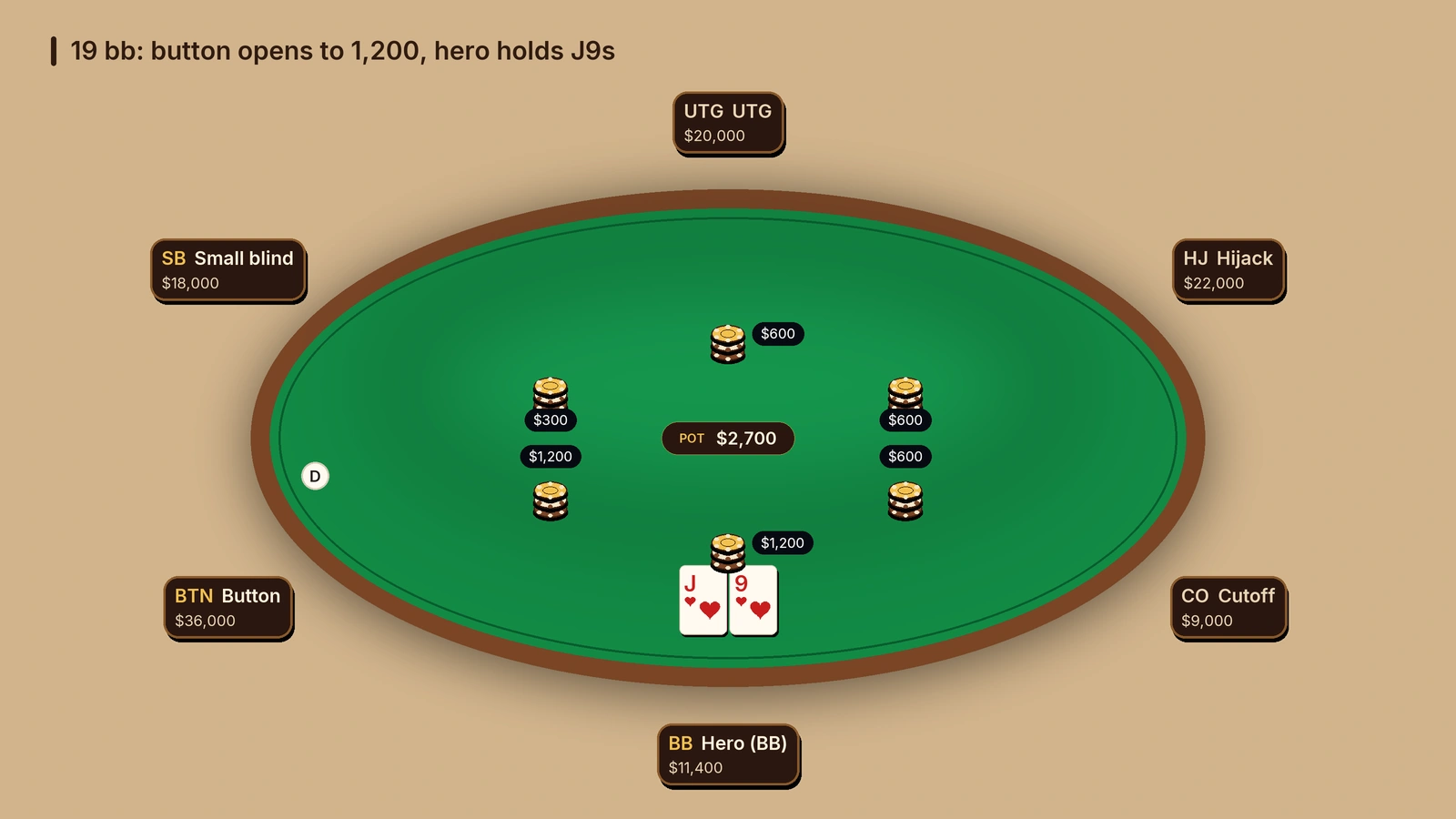
The pot is 2,700 chips when the action comes back to Hero. A call costs 600 more, which brings the pot to 3,300. Hero needs 18.2% equity to break even on that call.
The ante is the whole price change
Take the same hand and the same 1,200 open, then remove the 600 ante from every player. The big blind posts 600, the small blind posts 300, and the pot before Hero’s call is 2,100. A call of 600 brings it to 2,700, and the required equity rises to 22.2%.
That is a rise of 4.0 percentage points from one line item in the structure. The ante is dead money Hero can win without a showdown, so it lowers the bar a call has to clear.
What the open size does to the same call
The ante is not the only lever. A bigger open raises the price, because Hero puts in more chips while the dead money stays the same size.
| Open | Call | Pot after the call | Required equity |
|---|---|---|---|
| 1,200 (2 bb) | 600 | 3,300 | 18.2% |
| 1,500 (2.5 bb) | 900 | 3,900 | 23.1% |
| 1,800 (3 bb) | 1,200 | 4,500 | 26.7% |
Hero’s hand does not change across those rows. Only the opener’s size changes, and the bar moves from 18.2% to 26.7%.
Where J♥ 9♥ actually stands
The button’s range in this example is a wide one: every pair, suited aces, most suited kings, suited connectors from 65s up, and the offsuit broadways A7o and better.
J♥ 9♥ wins 42.09% of showdowns against that range over a full five card runout. That is a floor for a call, and profit still depends on how Hero plays the rest of the hand from out of position.
Compare the floor with the price. Against a 2 bb open Hero needs 18.2% and holds 42.09%. Against a 3 bb open Hero needs 26.7% and still holds 42.09%. The call clears the bar in both cases, with less room against the bigger open.
The stacks behind decide the raise
A call is not the only option, and the stack decides how much room is left for anything else.
- 12 bb (7,200 chips): posting 1,200 leaves 6,000, and calling 600 leaves 5,400 behind against a 3,300 pot. That is a short stack in a big pot, so most of the value comes from seeing five cards.
- 19 bb (11,400 chips): the call leaves 9,600 behind. There is room to call and still see more cards.
- 30 bb (18,000 chips): the call leaves 16,200 behind. There is room to raise some of the time and fold to a jam.
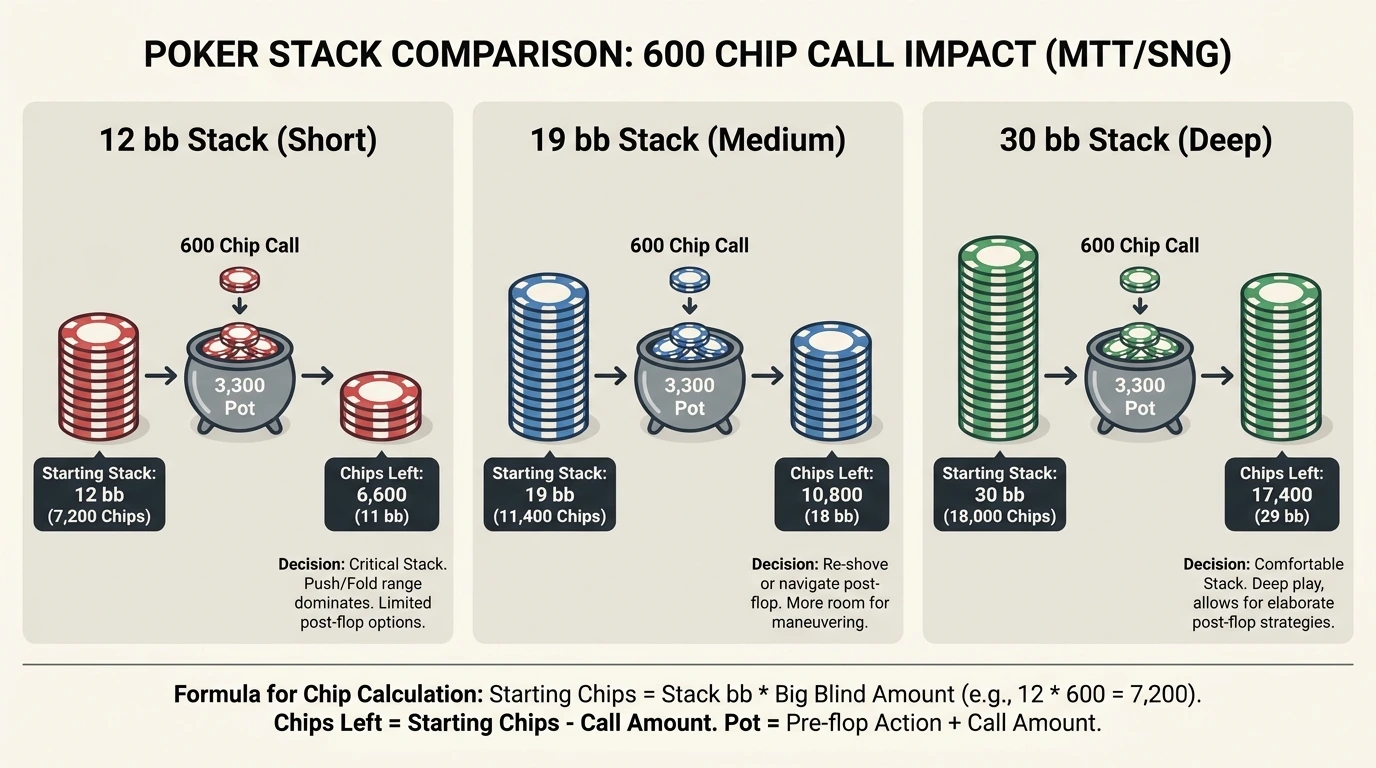
The ante changes none of those stack numbers. It changes the price, and the price is what moves the same hand between a comfortable call and a thin one.
Why this matters at the table
ICM pressure is a separate question from pot odds, and at this stage of an event it is small. On an illustrative payout setup of 50, 30 and 15 units for the top three places, with stacks of 20,000, 36,000, 22,000, 18,000, 11,400 and 9,000 chips, Hero’s prize share is about 16.9 units and the bubble factor between Hero and the button is 1.004.
A bubble factor near 1.0 means a chip won and a chip lost are worth close to the same prize money here. The pot price is the number that decides this call, and the ante is what makes it cheap.
Frequently asked questions
How much does a big blind ante change the call price?
In this setup the ante lowers the required equity from 22.2% to 18.2%, a drop of about 4.0 percentage points. The ante adds 600 chips to a pot Hero can win without a showdown.
Is J♥ 9♥ a call against a 2 bb open at 19 bb?
Against the wide range above, J♥ 9♥ wins 42.09% of showdowns and the call needs 18.2%. The call clears the price, and the hand plays well when it makes a draw.
What if the button opens to 3 bb instead?
The call costs 1,200 chips and the price rises to 26.7%. Hero still holds 42.09% against the same range, so the call stays playable with a smaller margin.
Does the ante matter as much with a short stack?
The price is the same, but the stack behind it is smaller. At 12 bb the call leaves 5,400 chips behind, so the decision is closer to a commitment than a cheap look at the board.
Where does the pot odds number come from?
It is the call divided by the pot after the call. A call of 600 into 2,700 makes the pot 3,300, and 600 divided by 3,300 is 18.2%.

Written by
Jake Rivera
Poker writer
Jake Rivera writes about poker strategy across No-Limit Hold'em, Pot-Limit Omaha and Short Deck. His work covers preflop ranges, ICM and bubble decisions, and postflop lines, along with the adjustments that separate tournament play from cash games.