Short Deck Preflop Charts: Opening Ranges for a 36-Card Deck
Short deck preflop charts for six-handed MTTs: opening ranges for all six seats, the 630-combination arithmetic, and the equities behind every hand choice.
You sit down in a six-handed short deck MTT. Everyone antes, the button posts a double ante, and the opens you trust from the cutoff in hold’em start leaking chips. Suited connectors you would muck in a 52-card game keep winning pots.
Short deck preflop charts look different from your hold’em chart, and the reasons are countable: 36 cards, seven antes in the middle, and one seat that posts a double ante and then acts last before the flop and last after it.
What a short deck preflop chart has to solve
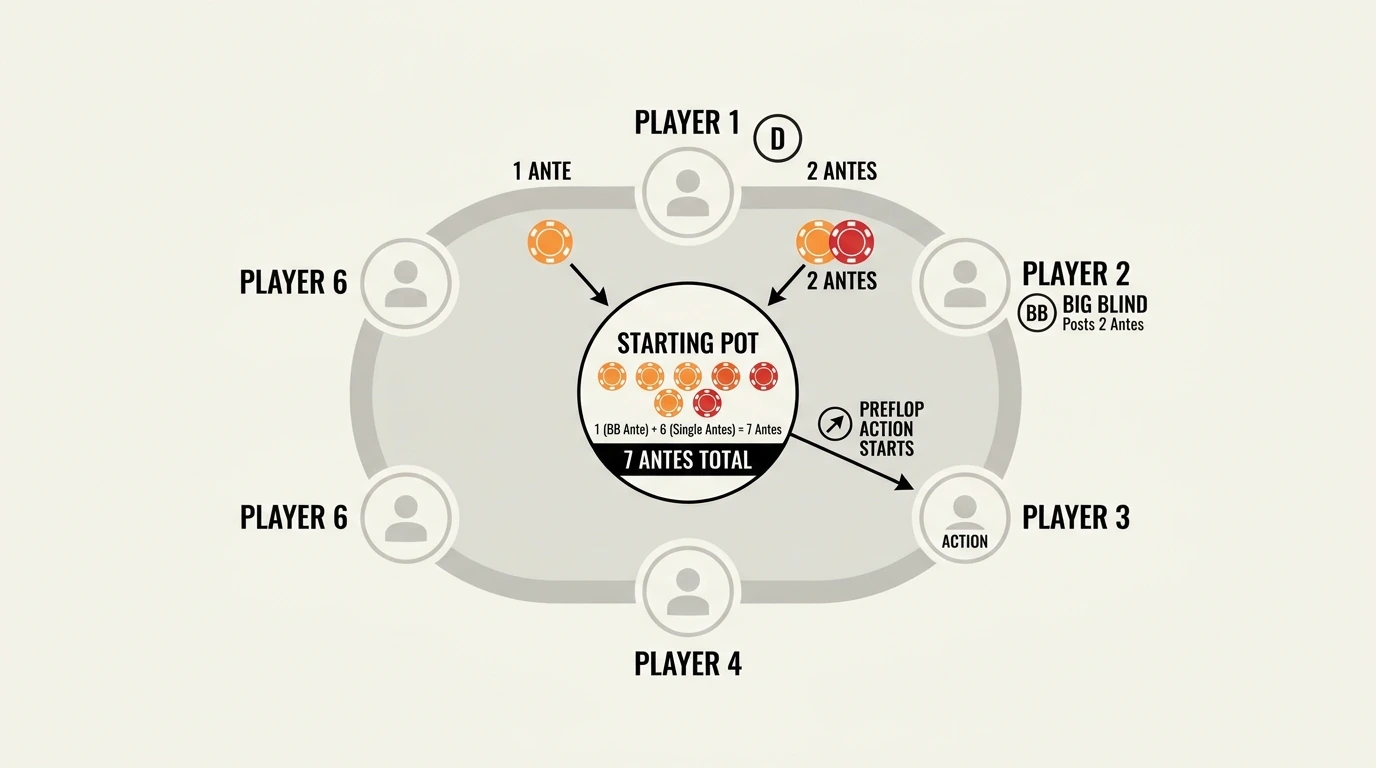
A short deck preflop chart prices a hand in a specific seat. Six players, 36 cards, no blinds: every player antes one unit and the button posts two, the ante-only structure used in Triton events, where Paul Phua Poker notes that “the player on the button posts a double ante.” The button closes the betting before the flop and closes it again on the flop, so the seat to its left opens both rounds.
Nobody defends a blind. Seven units sit in the middle as dead money, so the first seat in gets 7:1 on a limp, as Cardquant points out.
Seven antes sit in the pot before anyone acts, so the first player in gets 7:1 on a limp.
That price changes what a range is for. A hold’em chart mostly answers “which hands are worth a raise?” A short deck chart answers “which hands are worth 1 ante to see a flop, and which are worth 4 or 5 to thin the field?” Limping is standard in ante-only short deck; raising is how you make the seats behind you fold. The antes reshape postflop play too, and the short deck tournament strategy guide covers that side of the game. This page stays on starting hands.
Two structural reasons the chart changes
Fewer combinations of every hand
A 36-card deck gives 630 possible two-card starting hands, against 1,326 in a 52-card deck. Pokerfuse prints the split: pocket pairs are 8.60% of starting hands in short deck and 5.90% in hold’em.
Pairs come up 8.6% of the time in short deck against 5.9% in hold’em, and that gap explains most of the pair decisions in every seat.
Nine pairs make 54 of the 630 combinations. Pairs get 1.46 times more common, which still leaves them rare. Suited hands stay almost flat at 22.9% against 23.5%. A short deck chart spends less of its width on pairs and more on the suited, connected hands that make straights and flushes.
More playable cards in the deck
Six players plus a five-card board use 17 of the 36 cards by the river. Those same 17 cards would come from a third of a hold’em deck, so the ranks bunch together and the board connects with hands more often.
A random hand makes a straight by the river 14.1% of the time in short deck, against 4.6% in hold’em, per Cardquant. The short deck hand rankings punish anyone who ignores that, because most tournament games put straights above trips, which Upswing Poker says Triton did “to promote action.” Flushes also beat full houses everywhere.
The comparison below is from Poker Coaching.

Chart: poker combo hand matrix via Brave
Opening ranges for the six seats
Here is a representative setup: a 1-ante game where the button posts 2, stacks of 50 to 100 antes, six-handed, at the high buy-in short deck MTTs where limped pots are normal. Cardquant’s guide to the format converts 100 antes to about a 20 big blind stack.
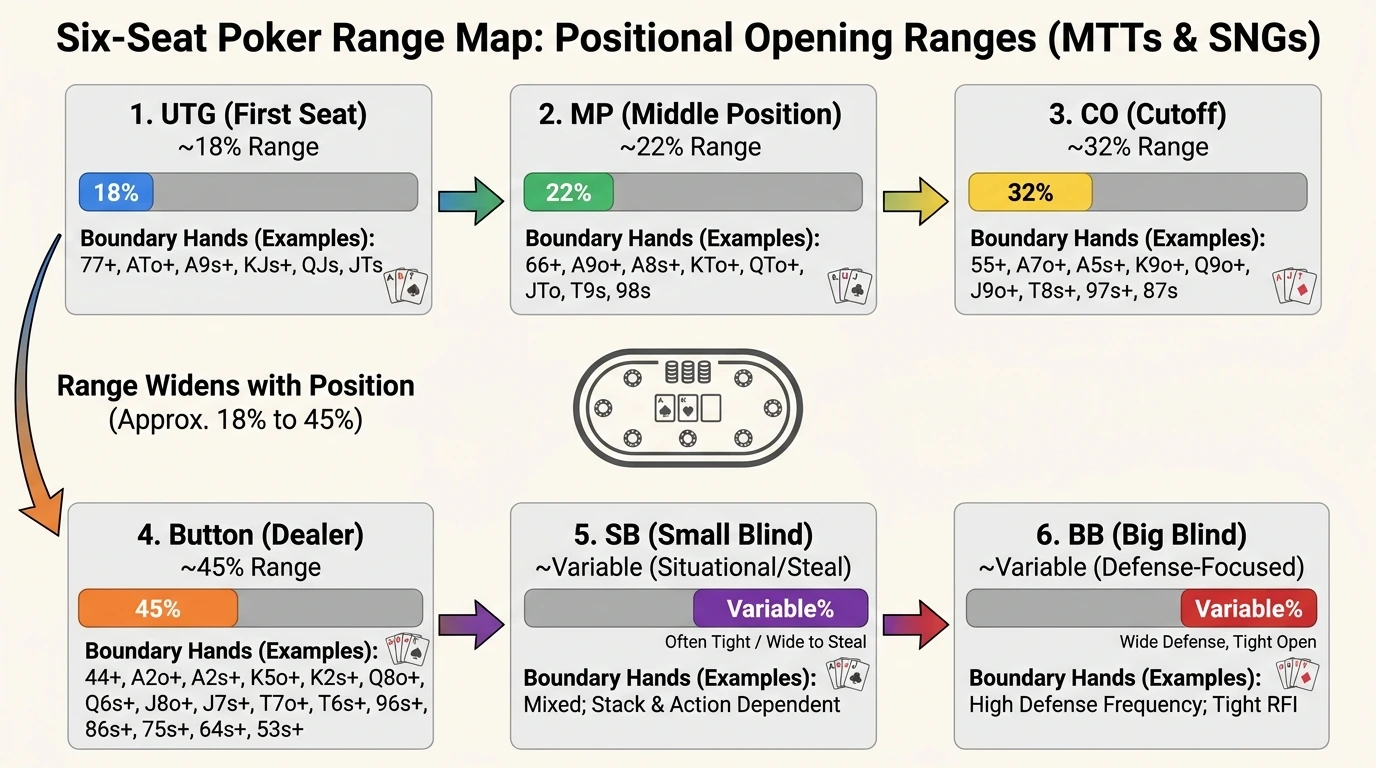
These ranges are a heuristic built from the combination counts and the equity table below. No published chart set covers six-handed button-ante tournament short deck and no public solver solves it, so every width here is an estimate. The share quoted for each seat is a count of the 630 starting hands: 18% is about 113 combinations, and the 45% button range is about 284. Public solver charts solve a different game, since the free RangeConverter set covers 5-max cash at a 50-ante button blind with no rake and no tournament payouts.
AA is a pair of aces, AQs is ace-queen suited, AQo is ace-queen offsuit. Only nine ranks exist, from 6 to ace, so A6s is the lowest suited ace. Percentages are shares of the 630 starting hands.
First seat (left of the button, acts first)
Pairs 99 and up, A6s and up, AKo, AQo, KQs, KJs, QJs, JTs, T9s, 98s. About 18%. Most of that range limps, with AA, KK, QQ and AKs the four hands worth a raise. Five players act behind you, so the 7:1 price earns the entry and the position keeps the range tight.
Second seat
Add 88, 77, 87s, 76s and KQo. About 23%. One fewer player behind makes an offsuit limp less costly, and the low suited connectors make straights the ranking rewards.
Third seat
Add 66, QTs, J9s and AJo. About 27%. Two limps are common by the time you act here, and PokerNews describes limped pots at a 25,000 ante in high buy-in short deck, so the range has to play well multiway.
Hijack
Add T8s, 97s and KJo. About 30%. Two seats left behind you means a raise to 5 antes takes it down often enough to cover the risk, which is where raising starts to appear in the chart.
Cutoff
Add 86s, Q9s, QJo and ATo. About 38%. Raises outnumber limps from this seat. The raise folds out two seats and leaves you against limpers holding weak ranges.
Button
Every pair, every suited ace, all suited connectors and one-gappers from 76s up, plus AKo to ATo, KQo, KJo, QJo and JTo. About 45%. You close the preflop action, and any limper has already matched your 2-ante post, so a limped pot costs you nothing to see. Your raises get to act last after the flop as well.
A chart is a starting point. A table that limps and never raises lets each range run wider, while one player who raises every limped pot trims the offsuit hands first.
Equity numbers behind the short deck preflop charts
A 20,000-run simulation prices these six matchups, short deck beside hold’em, so each short deck figure is a band of about a point either way.
| Matchup | Short deck | Hold’em |
|---|---|---|
| A♠A♥ vs K♠K♥ | ~75% | ~83% |
| A♠A♥ vs J♠T♠ | ~64% | ~79% |
| A♠K♠ vs Q♠Q♥ | ~55% | ~46% |
| A♠K♦ vs Q♠Q♥ | ~52% | ~43% |
| T♠9♠ vs A♠A♥ | ~40% | ~23% |
| A♠K♦ vs 8♠7♠ | ~56% | ~60% |
AA against KK drops from 83% to 75%, so kings are a stack-off far more often than a hold’em chart implies.
AA against J♠T♠ falls from 79% to 64%. Jack-ten suited keeps 36% against the best hand in the game, so it earns a slot wherever the price is 1 or 2 antes.
A♠K♠ against Q♠Q♥ flips the favourite, 46% to 55%, and that makes suited ace-king a raising hand from every seat. A♠K♦ against Q♠Q♥ turns offsuit ace-king into the favourite at 52%.
T♠9♠ against A♠A♥ nearly doubles, 23% to 40%. Suited connectors and one-gappers earn a slot in every range because of that row.
A♠K♦ against 8♠7♠ barely moves, 56% against 60%, and the connector closes the gap. Offsuit big cards hold no edge over suited connectors here.
Add the rows up and one line covers every seat: suited and connected hands gain, pairs and offsuit big cards lose, and the antes pay for the difference.
Which hold’em opening hands to bin, and which to add
Bin these from every seat:
- A6o to A9o. Top pair with the worst kicker in the deck, and three exact cards needed for the low straight.
- KTo, QTo and JTo outside the button. Second-best straights and dominated pairs, playable only at the button’s price.
- T8o, 97o and 86o. They rely on straight value, and no flush value arrives to compensate.
Add these:
- A6s to A9s. The nut flush, the A-6-7-8-9 straight and an ace that wins unimproved at showdown.
- 76s, 87s, 98s and T9s. The 40% row against aces buys a hand that plays well at almost any price.
- 86s, 97s, T8s and J9s. One-gappers become straight draws often enough to raise with from late seats.
- Every pocket pair from 66 up, which turns up 1.46 times as often as a hold’em chart implies.
Near a pay jump, ICM pressure can make that 52% figure for A♠K♦ a worse deal than the raw equity suggests, and the short deck tournament strategy guide works through what the payout ladder does to those calls.
What the price looks like in antes
Set the scene: a 1-ante game, six-handed, the button posts 2 and everyone else posts 1.
- Antes: five players post 1 each, the button posts 2. Seven units are in there.
- The cutoff opens to 5. It already had 1 ante in, so it adds 4. Now 11.
- The button has 2 in, so 3 more completes the call into a pot of 11, and the pot becomes 14.
Seven antes are already posted, so the cutoff’s raise to 5 adds only four units, and the button’s call is 3 into a pot of 11.
That is the whole reason the button range runs so wide. The call is small next to the pot it chases, and every limper in front of the button adds dead money to the pot the button is contesting.
Frequently asked questions
Can I download short deck preflop charts? Yes. Free chart sets exist for the 5-max cash game, including the RangeConverter set, and paid PDF sets with position charts are sold at Six Plus Holdem. Check the structure first, because most free sets assume a 50-ante button blind and no tournament payouts.
Are short deck preflop charts GTO? The published ones are solver output for the structure they were solved on, usually five-handed cash with a button blind. Treat any chart as an approximation and adjust it for the price you actually get.
Does a straight beat trips in short deck? At Triton, yes, and that ordering holds in most tournament games. Some online rooms rank trips higher, and a few pots have been decided on the difference. Read the house rules in the lobby before your first hand.
How many starting hand combinations are in short deck? 630, roughly half the hold’em total of 1,326. Because there are only nine ranks instead of thirteen, pairs make up 8.6% of that pool and suited hands 22.9%, a slightly lower suited share than hold’em.
Who acts first preflop in short deck ante-only? The player one seat clockwise from the dealer button, because the double ante already sits out front and nobody has to post a forced blind to start the betting.
Do you limp in short deck? Limping is a normal part of the format rather than a leak. Seven antes in the pot give the first player 7:1 on a 1-ante limp, and limped pots keep ranges wide and pots multiway, which is why raises tend to be saved for hands that want the field to shrink.
What is short deck poker? A 36-card game: strip the deuces through fives out of a 52-card deck and you have nine ranks per suit. It runs six-handed, antes replace blinds, and the button posts a double ante. Rooms also call it six plus hold’em and 6+ hold’em.

Written by
Jake Rivera
Founder and live poker player
Jake Rivera founded Rivera Poker and writes about No-Limit Hold'em: preflop ranges, ICM and bubble decisions, and the postflop lines that separate tournament play from cash games.