Short Deck Tournament Strategy: Antes, Hand Rankings and ICM
Short deck tournament strategy: how antes, the 36-card rankings and ICM change preflop and bubble play, with ante-pot math and a ranking table.
Short deck tournament strategy comes down to one break from regular hold’em tournament play. The ante goes in before anyone looks at their cards, so the pot is already big before the first decision. Open tight in No-Limit Hold’em (NLHE) tournaments and that habit costs you chips on nearly every orbit. Here is what changes, in chips and percentages.
What a short deck tournament is
Short deck uses a 36-card deck. Strip out the twos through fives and you have the sixes through aces, nine cards in each suit. Short deck MTTs run on this deck, and the structure around it looks nothing like NLHE.
Most short deck tournaments are ante-only. There are no blinds. Every player posts an ante before each hand, and the button posts a double ante. That button chip is the only live forced bet. Triton Poker Series lists ante-only events as their own category in its tournament rules, so the format runs as standard at the highest stakes.
The ante does the job a poker tournament blind structure usually does: it sets the pace. Antes climb, stacks fall behind them. Button ante size varies by event. One strategy site puts the button’s chip at two to four times the regular ante, so read the event sheet before you sit down. Of all the types of poker tournaments you might play, this one loads the most into the pot before anyone acts.
Stack depth gets measured in antes. With ten players left at the $50K Short Deck Ante-Only event in Jeju in March 2026, the big stack had 49 antes, the average had 34, and the short stack had 9. That is one field on one day. Use it as a rough picture and check your own room’s sheet.
Why the hand rankings flip
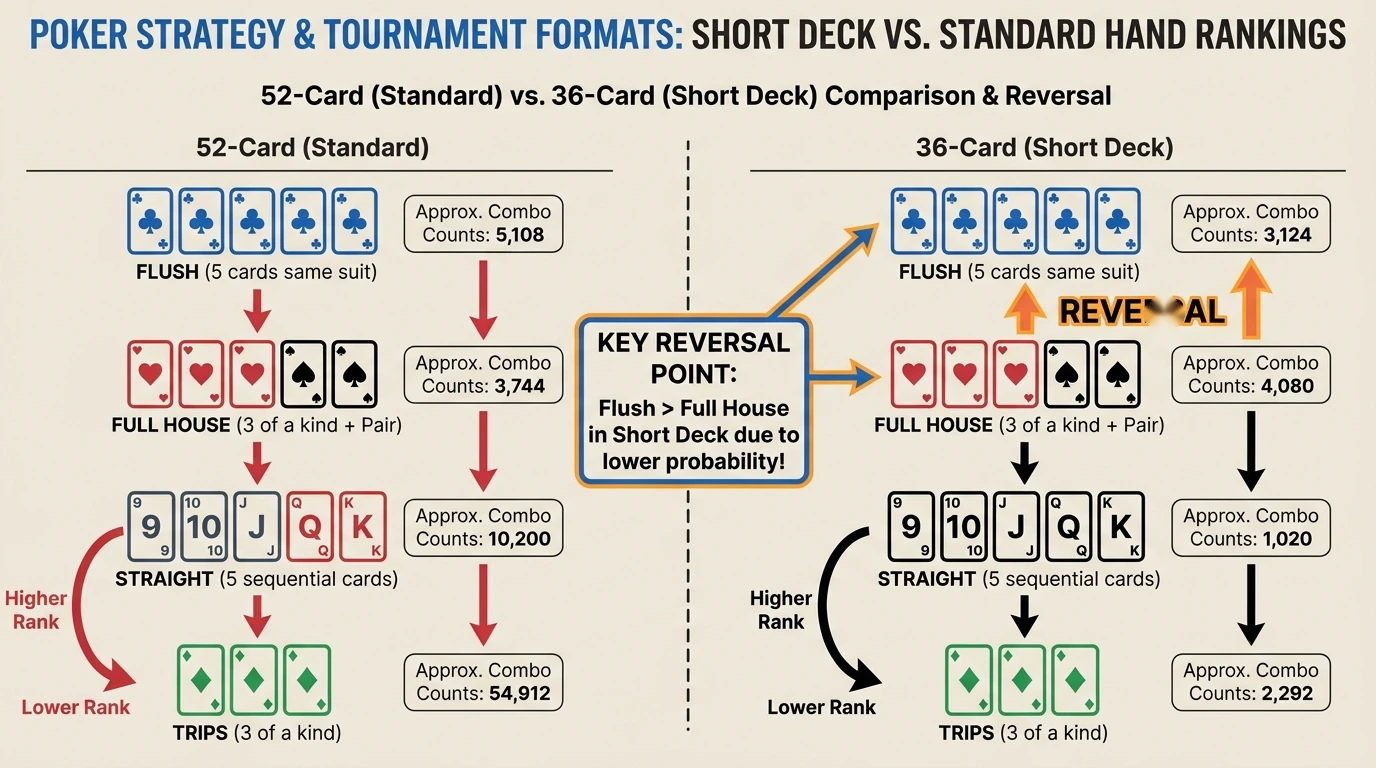
Flush beats full house in short deck. That reversal is the first rule most players learn, and card counting explains it.
Nine cards per suit makes a five-card flush scarce. Full houses use three of one rank and two of another, and a 36-card deck hands those out far more often. The table below counts five-card hands from each deck.
| Hand | Short deck (36 cards) | NLHE (52 cards) | Short deck effect |
|---|---|---|---|
| Flush | 480 | 5,108 | Rare, so it beats a full house |
| Full house | 1,728 | 3,744 | 3.6 times as likely as a flush |
| Straight | 6,120 | 10,200 | 2.6 times as rare as trips |
| Three of a kind (trips) | 16,128 | 54,912 | More common than a straight |
pokerpro.tools publishes these counts for both decks. Every rules page agrees on flush over full house, so treat that order as fixed.
Straight versus trips is a house rule. Some rooms rank a straight above trips, others put trips on top. Check before the first hand. The ace also plays low next to the six, so A-6-7-8-9 is a straight while K-A-6-7-8 is not.
How antes change short deck tournament strategy
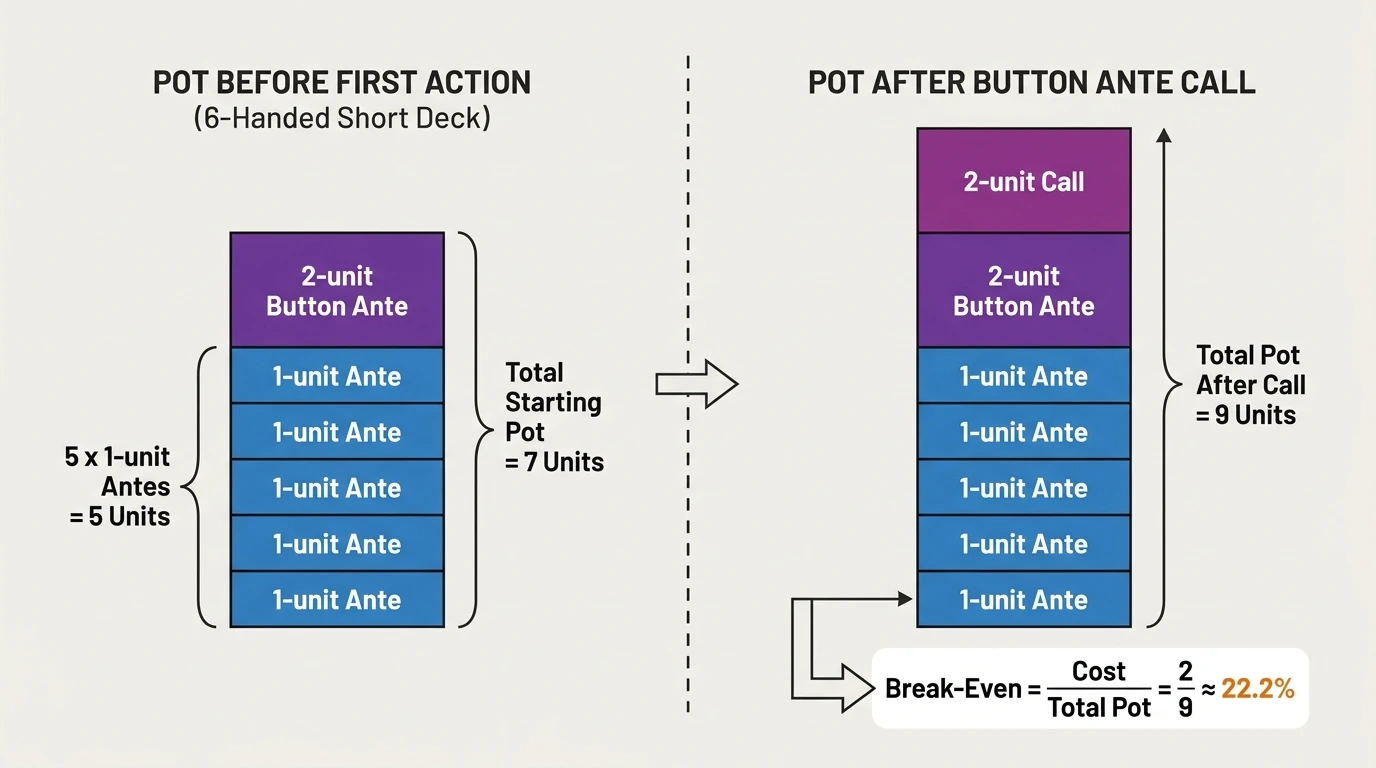
The ante cuts the price of seeing a flop. Run the numbers for a six-handed table with 1-unit antes and a 2-unit button ante.
Before anyone acts, five regular antes and the button’s 2 units sit in the pot: 7 units. The first player to call pays 2 units, and the pot after that call is 9 units. Break-even equity is 2 divided by 9, or 22.2%.
Now a nine-handed table on the same antes. Eight regular antes plus the 2-unit button ante make 10 units before the first decision. The first caller puts in 2 units into a pot that reaches 12 units. Break-even is 2 divided by 12, or 16.7%.
From 5 to 9 players, the pot holds 6 to 10 units before real action, and the price to join stays at 2 units. More players means a bigger pot for the same call. In an NLHE tournament the same entry is a much larger share of the pot; here the first caller needs only 22.2%.
So open wider from middle and late position. Limp and complete more when the price is 2 units into 7 or into 10. Kane Kalas’s course material treats limping as part of the core strategy, and at these prices it fits.
Pocket pairs gain too. A pocket pair flops a set about 17% of the time, against about 12% in NLHE, per Upswing Poker. Set-mining on a 2-unit call into a 7-unit pot works more often here, because the flop cooperates more and the price is low.
Which NLHE hands to keep and which to bin
Cardquant puts only seven unique starting hands above 60% equity against a random hand: ten-ten and better, ace-king, and ace-queen. In NLHE that list runs far longer, so the top of the short deck range is a short one.
Connected middle cards climb higher than they do in NLHE. Patrick Harvey of Upswing Poker argues that ten-nine and jack-ten are generally more valuable than king-queen in short deck.
The simple sort:
- Gain value: jack-nine suited, ten-nine suited, middle pairs, and every pair that can make a set.
- Lose value: small suited connectors such as six-seven suited, and low pairs that need a long shot to make a strong hand.
- Flush draws: nine cards per suit leaves five outs, roughly 30% to come in by the river.
- Open-ended straight draws: those complete about 45.5% of the time by the river, against 31.5% in NLHE, according to Upswing’s short deck page.
Full houses and sets are cheap to make here, so check the board before you call a big bet. Trips on a paired board can already be losing to a made full house.
What short deck tournament strategy does to ICM
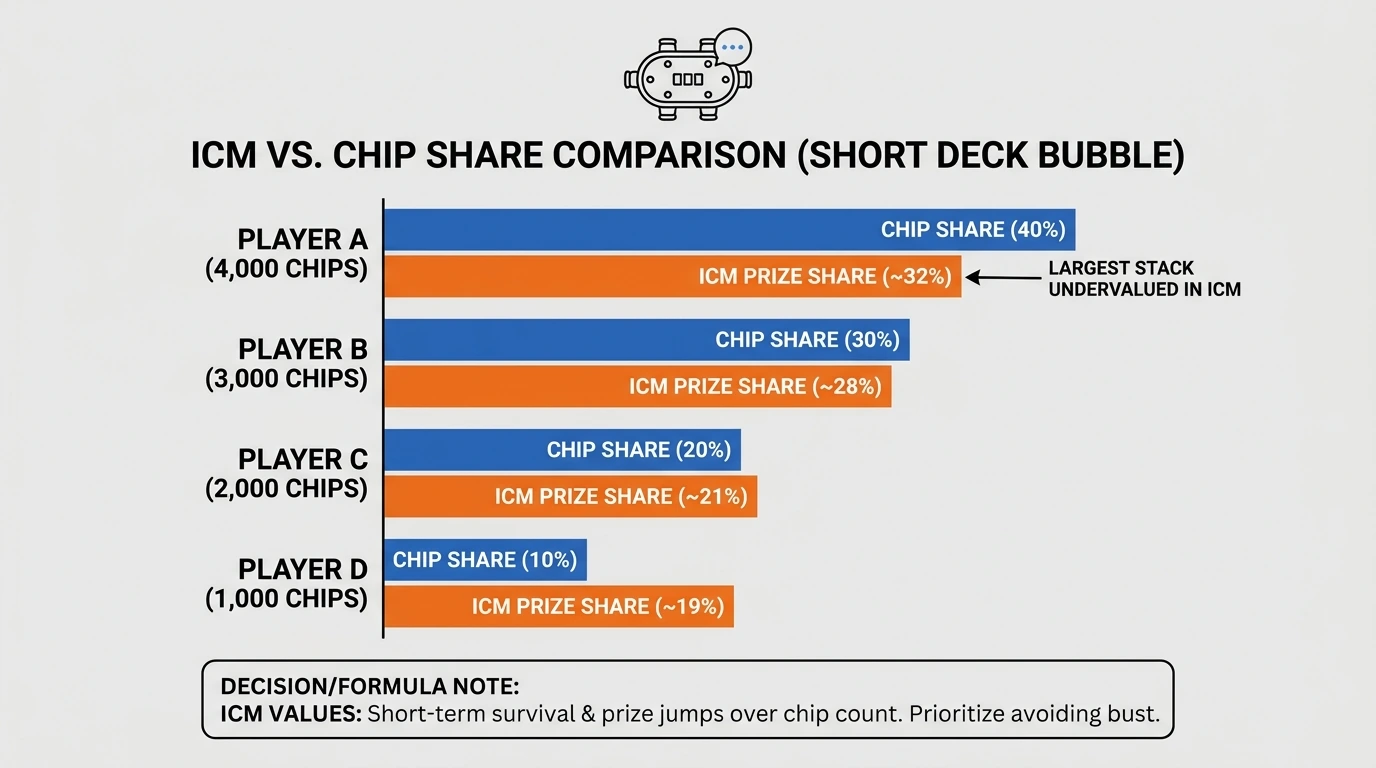
ICM (the Independent Chip Model) converts chips into prize equity in dollars. It matters most on the bubble, the stage just before the money places.
A chip lead is worth less than its chip share. Take a representative example: four players with stacks of 4,000, 3,000, 2,000 and 1,000 chips, and payouts of 500, 300 and 200. The 4,000 stack holds 40% of the chips but earns about 33.6% of the prize pool. The 1,000 stack holds 10% of the chips and earns about 13.3%. The middle stacks land closest to their chip share, which is why they carry the most pressure.
Risk premium is the extra equity you need before calling an all-in. Losing chips cuts your prize equity more than winning the same chips adds to it, as PokerCoaching explains. Its example: a 40% pot-odds call can need 48% to 50% near a pay jump.
Bubble factor puts that in one number. It divides the prize equity you lose when you bust by the prize equity you gain when you win. GTO Wizard gives the conversion: required call equity equals the bubble factor divided by the bubble factor plus one. A 1.5 bubble factor turns a 50% call into a 60% call. Medium stacks carry the highest bubble factors, so they face the most pressure to fold.
Antes sharpen this in short deck. Each seat pays an ante on every hand and the button pays double, so a short stack loses a large slice of its chips every orbit. Waiting costs more than it does in a blinds format. In a freezeout with no rebuys a bust ends your tournament, and shoving into a medium stack on the bubble demands more equity than the pot odds alone suggest.
Practical checklist for your first short deck MTT
- Read the ante and the button ante before the first hand. The ratio sets the price to see a flop.
- Open wider from middle and late position than you would in NLHE. Start with jack-nine suited, ten-nine suited and middle pairs.
- Limp and complete when the pot already holds 7 or more units and the call stays at 2.
- Size three-bets so the raiser’s risk matches the antes in the pot. Keep the size consistent so opponents cannot read your hand from it.
- Check the room’s straight versus trips rule. Assume flush over full house everywhere.
Three mistakes cost the most chips. First, treating the ante as dead money and folding playable hands from early seats. Second, overvaluing a straight when the board can make a flush or a full house. Third, calling too often with a medium stack on the bubble, where the required equity runs higher than pot odds suggest.
For the wider picture, our poker tournament structure guide explains how levels, antes and payouts shape play across formats.
Frequently asked questions
What hand beats what in short deck?
A flush beats a full house in every version of short deck. Straight versus trips depends on the room, so check the house rule. The combo counts in the table above show why each order exists.
Why does a flush beat a full house in short deck?
Nine cards per suit leaves 480 five-card flushes and 1,728 full houses in a 36-card deck. A full house is 3.6 times as likely, so the rank order flips.
How do antes change preflop strategy in short deck?
The ante fills the pot before the first decision. Six-handed, the pot holds 7 units before the first call and 9 after it, so the caller needs 2 divided by 9, or 22.2%. Nine-handed, the pot holds 10 units before the call and 12 after it, so break-even drops to 16.7%. Limping and completing a wider range becomes correct.
What is a risk premium in tournaments?
The extra equity you need before calling an all-in. Losing chips costs more prize equity than winning the same chips gains. A 40% pot-odds call can need 48% to 50% near a pay jump.
Can you play short deck tournaments online?
Short deck cash games run at several online rooms. Tournament schedules change by room and season, so check the lobby before planning a buy-in. Search event names for “short deck” or “six plus” and read the ante rules in the event details.
Is short deck harder than Hold’em?
Equities run close, so many spots are thinner than in NLHE. Kane Kalas’s course material was built for players who already know the game, which tells you something about the learning curve. Expect a few sessions before the ante math feels automatic.

Written by
Jake Rivera
Poker writer
Jake Rivera writes about poker strategy across No-Limit Hold'em, Pot-Limit Omaha and Short Deck. His work covers preflop ranges, ICM and bubble decisions, and postflop lines, along with the adjustments that separate tournament play from cash games.