Short Deck Hand Rankings: Why a Flush Beats a Full House and When Trips Beat a Straight
Short deck hand rankings for 6+ hold'em: the full 36-card order, why a flush beats a full house, the trips-versus-straight house rule and the new draw odds.
You turn over a flush. Your opponent turns over a full house. In hold’em you lose that pot. In short deck you win it.
So what is short deck poker? It’s hold’em on a 36-card deck, and that swap catches out most players who move from a 52-card game. Short deck hand rankings reshuffle the middle of the list, and one of those moves changes from room to room. Here’s the full order, the counting behind it, and what it does to your draws.
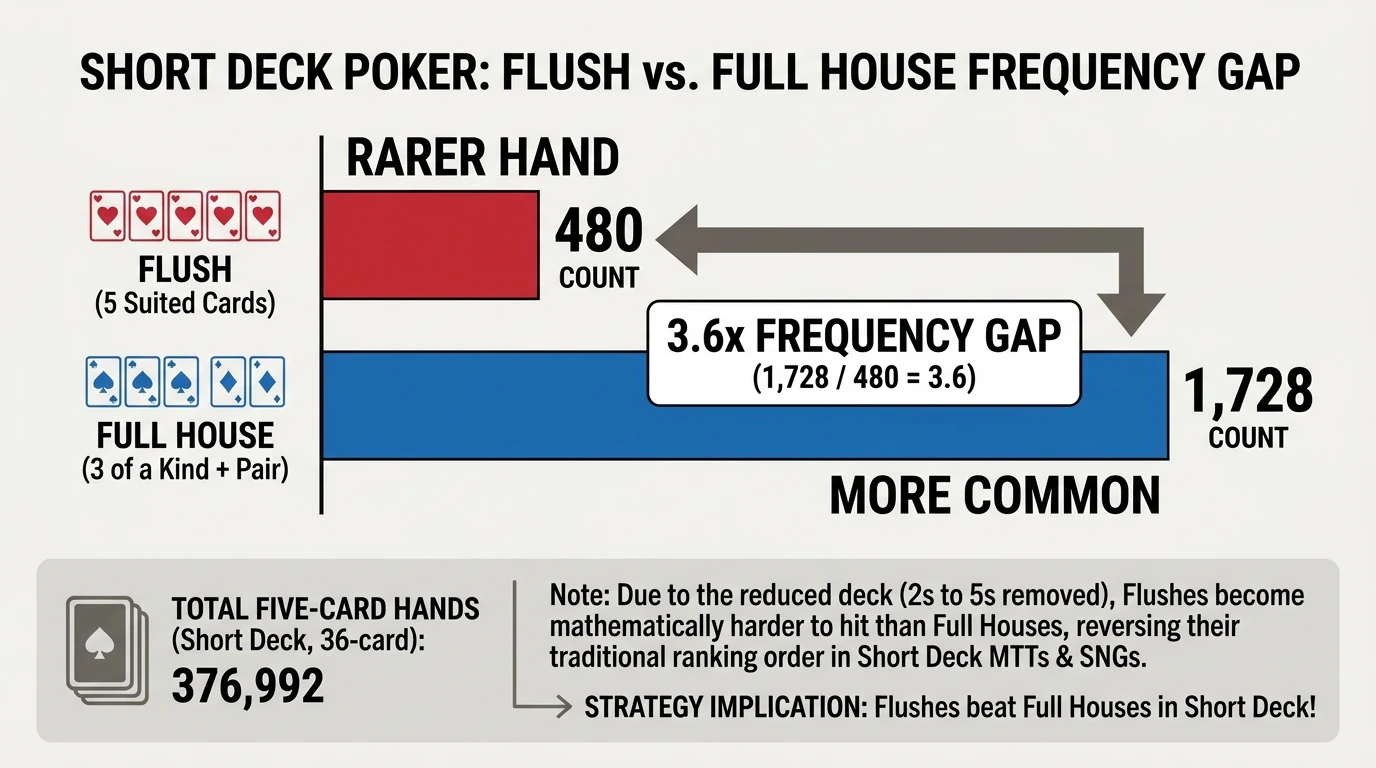
The comparison is charted by Poker Skill.
The short deck hand rankings, top to bottom
The order runs royal flush, straight flush, four of a kind, flush, full house, straight, three of a kind, two pair, one pair, high card.
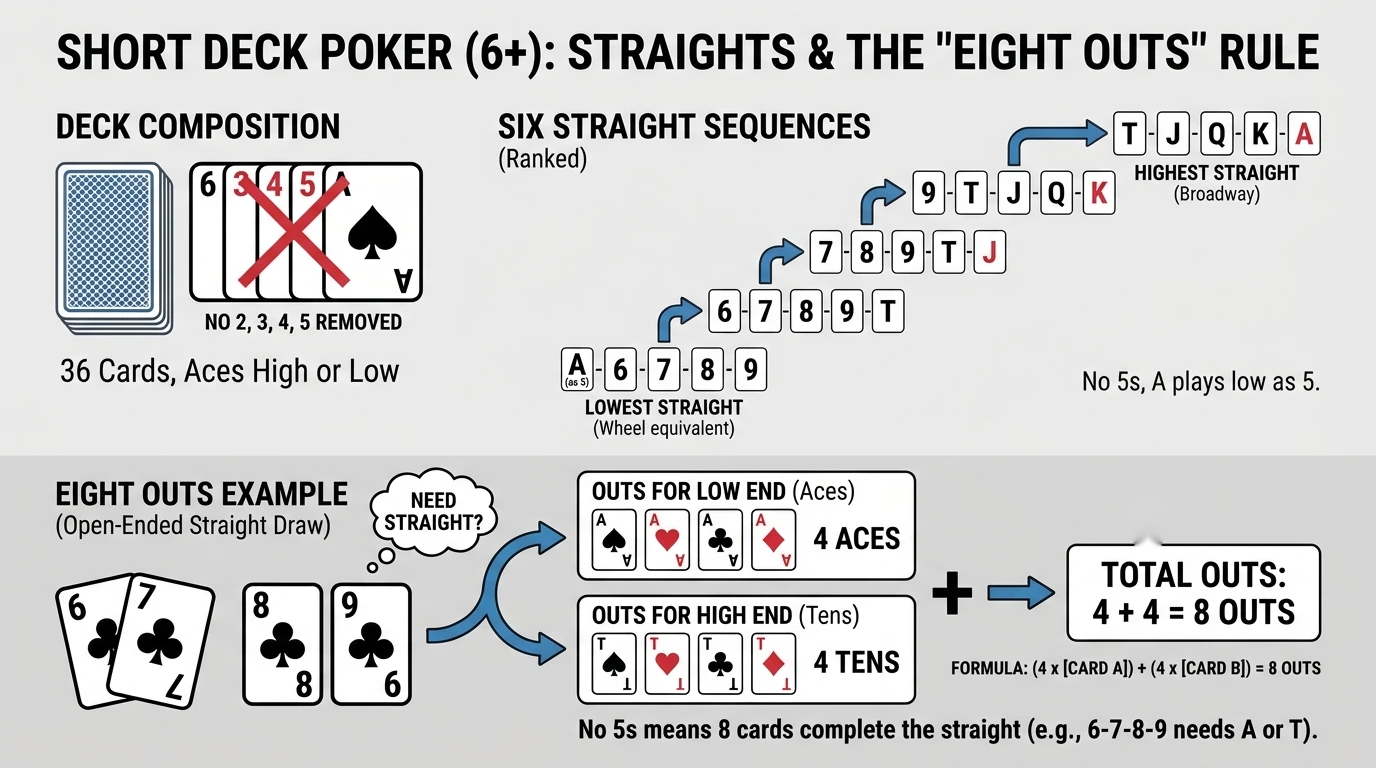
Six plus hold’em is texas hold’em played on 36 cards. The dealer removes every 2, 3, 4 and 5, sixteen cards in all, which leaves nine cards per suit from six up to ace (Wikipedia). The deal, the four betting streets and the showdown work the usual way. A smaller deck and a new ranking list are the whole difference.
Two spots in the middle of that list differ from the chart you already know, and the middle carries most of the money.
- The flush ranks above the full house. Card Player calls this the mainstream standard at Triton events and most online sites. Even so, the house rule at any room wins over a guide, so confirm the order where you play.
- Some rooms swap the straight and three of a kind. The mainstream order puts the straight higher, so ask.
Why a flush beats a full house in short deck
Nine cards per suit make a five-card flush harder to make than a full house, so the flush moves up the list.
Triton states the reason in one line: “mathematically it is harder to make a flush than a full house from the reduced deck” (Triton Poker Series).
The counts agree. Of the 376,992 possible five-card hands in a 36-card deck, 480 are flushes and 1,728 are full houses. Full houses turn up exactly 3.6 times as often, so the flush earns the higher slot (Poker Skill).
A made flush is a hand you play for stacks in short deck, because a paired board no longer beats it.
Hold’em players take a while to accept that. In a 52-card game, a third card of a rank on the board can kill a flush. Here the full house sits below the flush, so the board pairing changes nothing. Quads and straight flushes still beat you, and both are rare. Folding a flush to river pressure on a paired board gives away the best hand. Shoving a full house into a raise gives away a stack. Both mistakes come from reading the board with the wrong chart.
Counting the same thing suit by suit checks the figure. Nine cards per suit give 126 five-card combinations, so four suits give 504. Every straight flush sits inside that 504: six straight sequences across four suits make 24, and four of those are royals. That leaves 20 non-royal straight flushes, and 504 minus 24 leaves the 480 flushes in the table (pokerpro.tools).
Straight versus trips: check the house rule first
Most short deck games rank the straight above three of a kind, and some rooms reverse it.
Card Player puts the current standard plainly: “Some house versions reverse this, where trips beat a straight. Always check the house rules before playing, but the standard today is straight > trips” (Card Player). Pokerfuse reports that the trips-above-straight order has fallen out of fashion, and it names PokerStars, GGPoker and Triton among the operators that keep straights on top (Pokerfuse).
The frequencies point the same way. A 36-card deck produces 16,128 three-of-a-kind hands and 6,120 straights, so trips are 2.6 times as common as a straight, and poker rankings put the rarer hand higher. The trip-versus-straight slot is the one place short deck guides still tell you to confirm the house rule.
A room where trips beat a straight is applying its own house rule. The five-card counts put straights first.
Ask before the cards are in the air: “does a straight beat trips here?” A dealer will know, and in an event one question covers every pot you play, because the rule holds all day. Getting it wrong after the chips are in the middle costs a stack, and nobody hands it back.
Short deck ante strategy, opening ranges and the ICM maths sit outside this chart. The short deck poker strategy guide covers that ground.
The lowest straight is A-6-7-8-9
The ace plays low only next to the six, which makes A-6-7-8-9 a straight. It can’t wrap around, so K-A-6-7-8 stays a high-card hand.
Six runs exist, one for each group of five consecutive ranks: A-6-7-8-9, 6-7-8-9-T, 7-8-9-T-J, 8-9-T-J-Q, 9-T-J-Q-K and T-J-Q-K-A (Poker Skill).
The five is gone with the rest of the low cards, so no straight can run below the six. That gives 6-7-8-9 two separate ways to improve. A ten makes 6-7-8-9-T, and an ace makes A-6-7-8-9. Four tens plus four aces give eight outs, which is why 6-7-8-9 counts as a full open-ended draw in short deck.
The ace stretches a straight downward next to the six, so 6-7-8-9 carries eight outs instead of four.
A board of 7♦8♠9♣ with A♥6♥ in your hand is already the A-6-7-8-9 straight. Hold’em eyes read the ace as a big card and the six as a spare, so that hand gets checked, or folded to a bet. A♥6♥ also picks up a flush draw when two more hearts arrive, so the two cards work together on two plans at once.
What the rankings do to draw odds
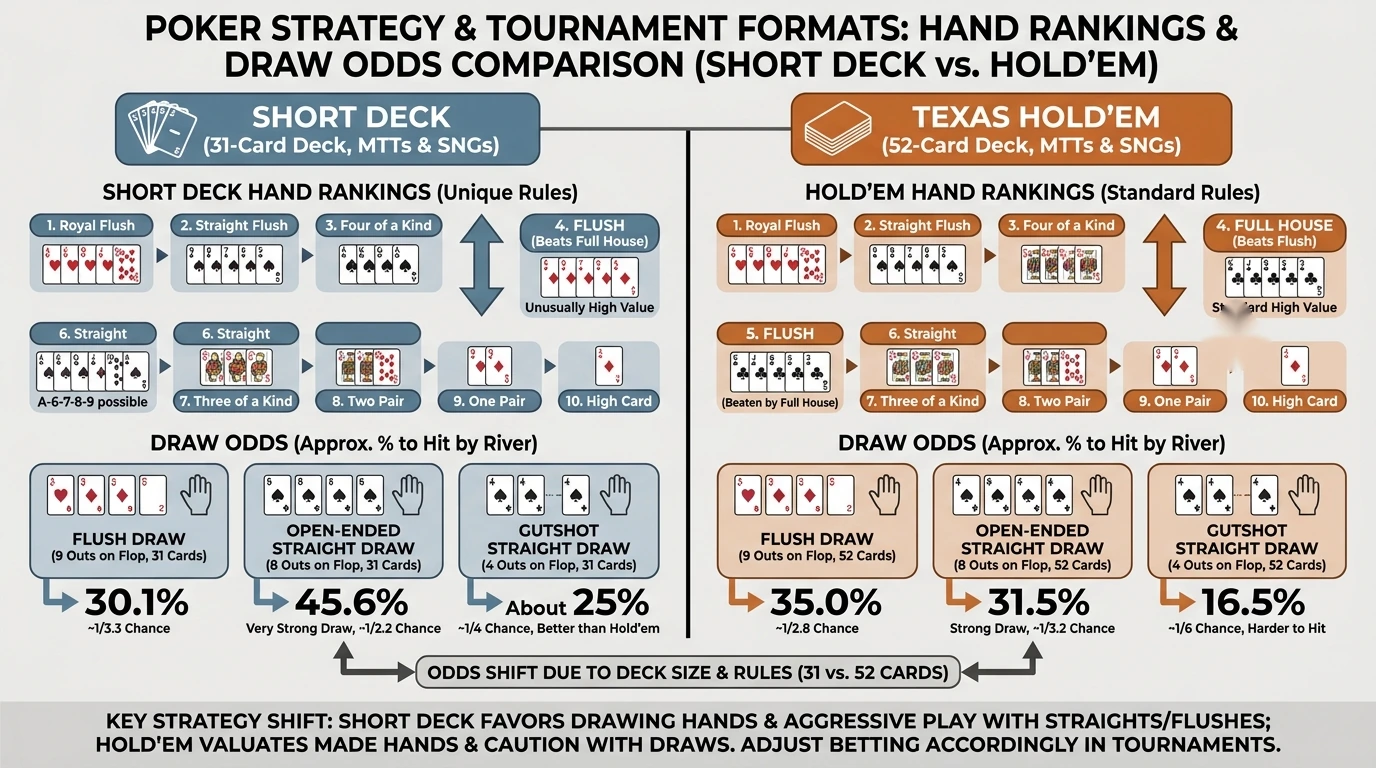
Straight draws get much better and flush draws get worse, and the gap between them is wider than it looks. Two cards to come, on a 31-card deck instead of 47:
| Draw | Outs | Short deck | Hold’em |
|---|---|---|---|
| Flopped flush draw | 5 | 30.1% | 35.0% |
| Open-ended straight draw | 8 | 45.6% | 31.5% |
| Gutshot | 4 | about 25% | 16.5% |
Your suit loses four cards along with the rest of the deck, so the flush draw keeps five outs. Triton’s explainer makes the same point about five outs instead of nine. Fewer cards left to come means each out hits a little more often, and the two effects nearly offset. The draw now arrives 30.1% of the time by the river, down from 35.0% (Cardquant).
A straight draw keeps all eight outs, and it too draws from the 31 that remain. Eight outs out of 31 makes a bigger share than eight out of 47, so the open-ender climbs from 31.5% to 45.6%. Gutshots improve too: four outs out of 31 is about 13% per card, so two cards on the way run close to 25%, up from 16.5% in hold’em. The rule of 2 and 4 you use in hold’em overshoots on a 31-card deck, so treat its number as a rough ceiling.
The two shifts move in opposite directions, so an eight-out straight draw now outruns a five-out flush draw.
That flips a hold’em habit. A flush draw stops being the hand you raise every time, and a straight draw becomes one you can play fast. Big flush draws keep their value; the price you pay for them should come down.
Short deck hand rankings chart with combination counts
Here is the full order with the count for each hand, out of 376,992 possible five-card hands (pokerpro.tools):
| Hand | Combinations | Share of hands |
|---|---|---|
| Royal flush | 4 | 0.0011% |
| Straight flush (non-royal) | 20 | 0.0053% |
| Four of a kind | 288 | 0.0764% |
| Flush | 480 | 0.1273% |
| Full house | 1,728 | 0.4584% |
| Straight | 6,120 | 1.6234% |
| Three of a kind | 16,128 | 4.2781% |
| Two pair | 36,288 | 9.6257% |
| One pair | 193,536 | 51.3369% |
| High card | 122,400 | 32.4675% |
The 20 straight flushes in that table leave out the four royals, which sit on their own line. The column adds to 376,992.
Read the middle of the chart. Straight draws hit 45.6% of the time by the river on eight outs, and a straight draw now beats a flush draw. Treat anything above the straight as a stack-the-pot hand. Settle the trips rule before the first flop.
Frequently asked questions
Why does a flush beat a full house in short deck? Flushes dry up faster than full houses once four low cards leave each suit. The ratio works out at one flush for every 3.6 full houses in a 36-card deck, and the rarer hand gets the higher rung.
Does a straight beat trips in short deck? Under the standard order, yes. A handful of rooms still run the old trips-first rule, so confirm it with the dealer or the table card on your first hand.
Is A-6-7-8-9 a straight? Yes. The six gives the ace a floor to sit on, and the run stops there. K-A-6-7-8 would need a five to bridge the gap, and the deck has none.
How many cards are in a short deck? 36. Strip out the 2, 3, 4 and 5 and you are left with nine cards in each suit, six through ace.
How many outs does a flush draw have in short deck? Five. The 2-5 take four of your suit with them, so what was a nine-out draw starts at five here. With two cards to come that turns into a 30.1% hit rate; hold’em gives you 35.0% from the larger deck.
What beats what in 6+ hold’em? Royal flush, straight flush, four of a kind, flush, full house, straight, three of a kind, two pair, one pair, high card. Card Player calls the flush move the mainstream standard, and the straight-versus-trips slot depends on the house rule.
How is short deck different from hold’em? Short deck vs hold’em comes down to the deck and the chart. Hold’em deals 52 cards and ranks a full house above a flush. Short deck deals 36 cards and flips those two, so a flush wins the pot and straight draws get stronger.
Ask about the trips rule when you sit down. Then treat your flush as the best hand on a paired board, and your straight draw as the one worth raising.

Written by
Jake Rivera
Founder and live poker player
Jake Rivera founded Rivera Poker and writes about No-Limit Hold'em: preflop ranges, ICM and bubble decisions, and the postflop lines that separate tournament play from cash games.