PLO Starting Hands: Five Tests That Decide a Hand
PLO starting hands live or die on how your four cards fit together and how your suits line up. Here is how to grade hands by structure before the flop.
Two cards in No-Limit Hold’em, one hand. Pot-Limit Omaha deals four cards and six two-card hands, so most of what you know about picking PLO starting hands stops working. The cards look stronger. The edges get thinner.
How good is the ceiling? About two wins in three against a random holding. That figure shapes everything below.
A PLO hand gets judged by its best six-card structure and its suit coverage. Pretty-looking cards matter very little. A♥A♠7♦2♣ looks strong and plays badly. 9♥8♠7♥6♠ looks ordinary and plays well. The gap between those two hands is the whole subject.
What makes a PLO starting hand different?
One hard rule sits on top of the four cards: exactly two of yours play, with exactly three from the board.
The California Department of Justice rule set for Omaha spells it out. Each player “must use two out of the four cards initially dealt” and “three out of the five cards dealt on the table” (CA DOJ, Bureau of Gambling Control). One card never plays on its own, and three spades in your hand plus two on the board is not a flush.
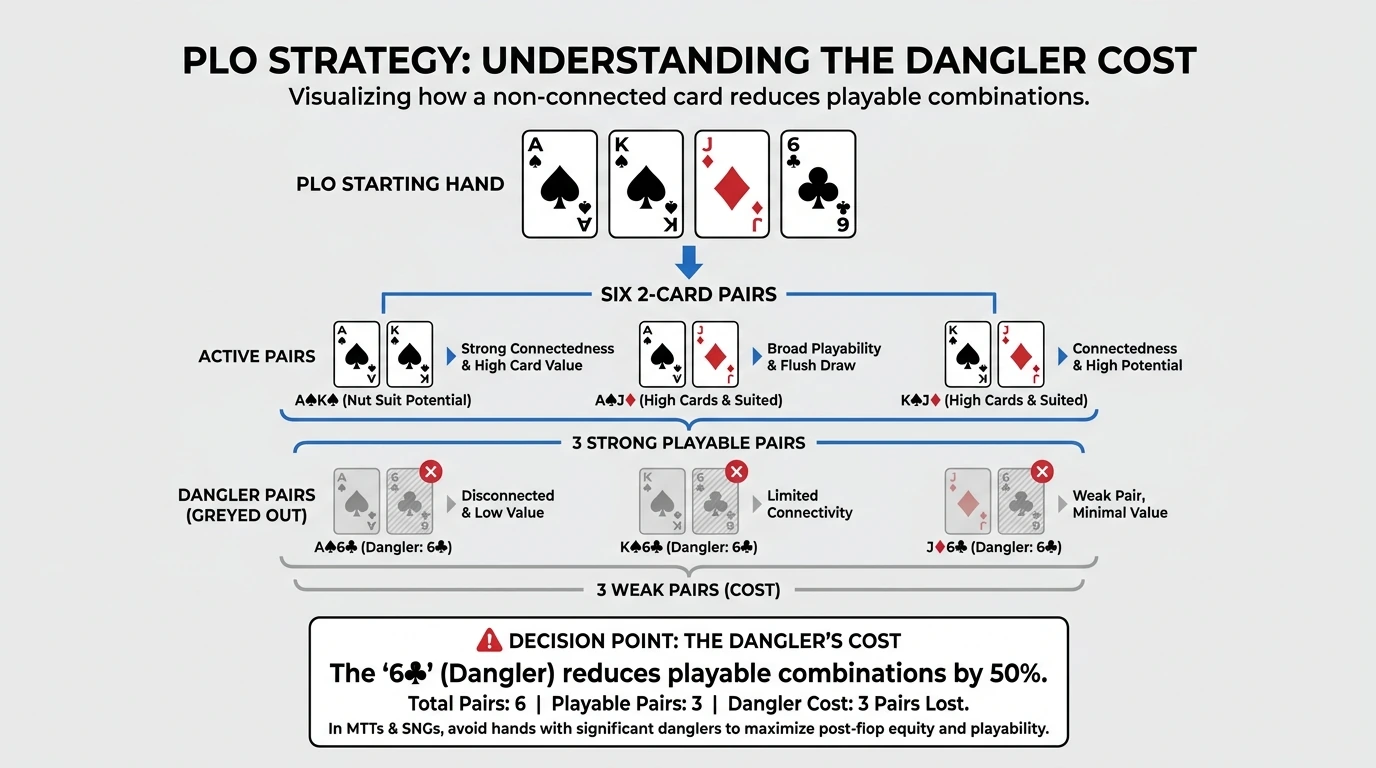
Hold’em hands reach one two-card pairing. Four cards reach six, and each of those six pairs points at a different flop. Third and fourth cards carry much of the value, so one useless card costs you a real chunk of your options.
That useless card has a name. A dangler is a card that doesn’t combine with the other three, and each one cuts the number of hands you can end up making. A♠K♠J♦6♣ has one dangler in the 6♣. A♥A♠7♦2♣ has two.
Omaha deals 270,725 four-card combinations and Hold’em deals 1,326 (ThinkGTO). That is why equity runs close. Big preflop favourites are rare, so the hands that make the most flops well are the ones worth playing. Pot-Limit Omaha itself is the four-card, pot-limit betting game covered in our PLO game guide.
The five tests a PLO starting hand has to pass
Connectivity, suit coverage, nut potential, pair quality and position. Those five decide the hand, and checking them in that order keeps the review consistent. They sit inside the wider preflop work in our preflop topic hub.
Connectivity. Cards that work together make wraps, which are straight draws with many outs. Four ranks bunched within four or five of each other give you the most ways to flop a big draw. One gap is fine when the other qualities are strong. Two gaps leave you chasing thin draws with few outs.
Suit coverage. Two flush draws means double-suited. One means single-suited. Rainbow means none: four different suits leave you without two cards in the same suit, so you can never make a flush at all. About 13.5% of four-card hands get dealt double-suited (Cardquant), so most hands you’re dealt have one suit at most.
Nut potential. Ask what the nuts look like on the flop you want. High cards make top set and the nut straight. A hand like 3♠4♦5♠6♦ makes low straights and low flushes, so it wins small pots and loses big ones.
Pair quality. A pair earns its place when it can make top set and brings straight or flush support. Small pairs with disconnected side cards flop bottom set, and bottom set pays off top set more often than it gets paid.
Position. The same four cards can be a raise from one seat and a fold from another. The position section below has the numbers.
PLO starting hands that pay
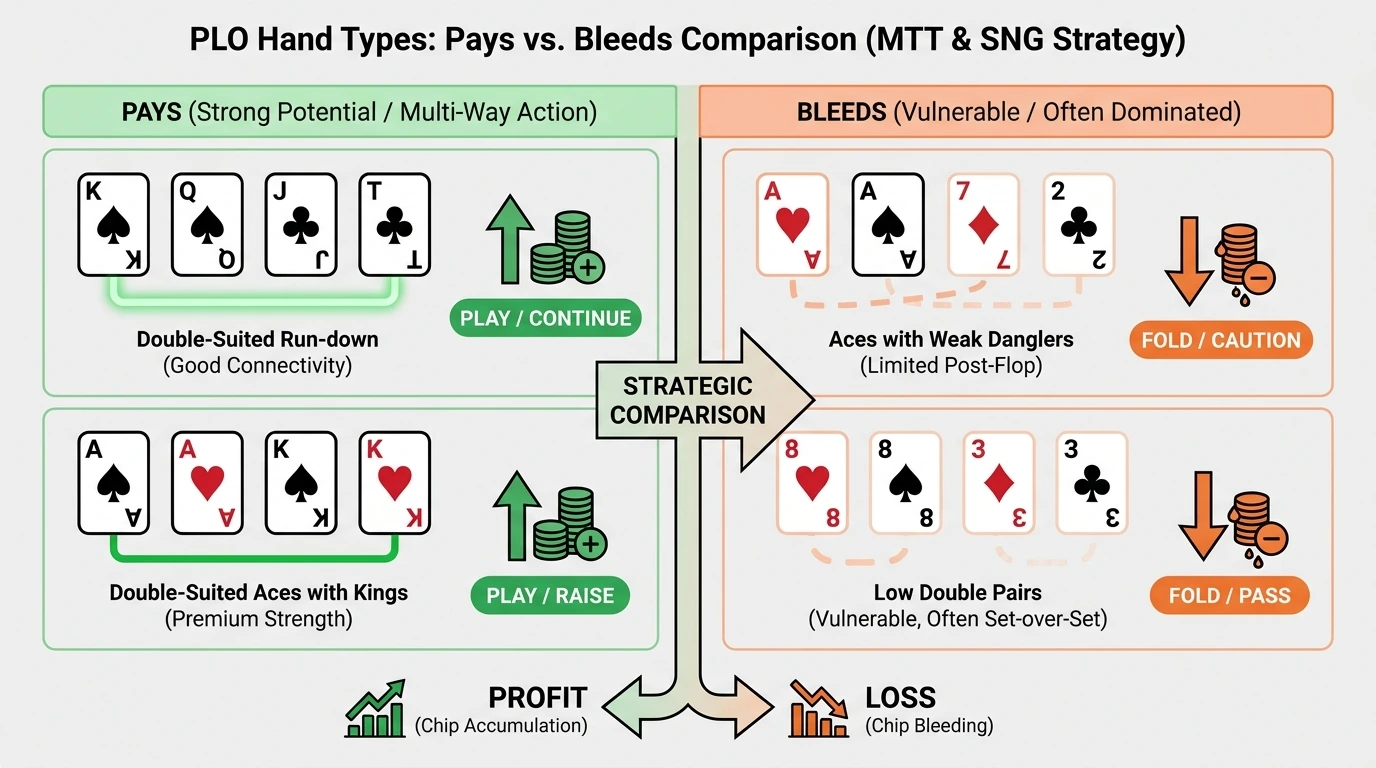
These hand types earn money because every card works: two flush draws, or a pair plus straight coverage, or a nut draw with connected support.
| Hand type | Example | Why it works |
|---|---|---|
| Double-suited rundown | K♠Q♠J♣T♣ | Two flush draws, plus straights in both directions |
| Single-suited rundown | T♥9♥8♠7♣ | Wide straight coverage, one flush draw |
| Big pair, double-suited | A♠A♥K♠K♥ | Top set potential with two flush draws behind it |
| Aces with connected side cards | A♠A♥J♠T♥ | Sets, plus straight and flush support |
| Suited ace, connected | A♣J♣T♦9♦ | Nut flush draw with a rundown attached |
Rundowns with both suits make the best hands without a pair. K♠Q♠J♣T♣ flops a straight draw, a flush draw or both on a huge share of boards. Big pairs need those extra draws. A♠A♥K♠K♥ flops top set often, and its two flush draws keep it live when it misses.
Suited aces work when the side cards connect. A♣J♣T♦9♦ makes the nut flush and wraps, so it wins big pots instead of small ones. Holding the ace of your suit decides whether a flush is worth chasing, because second-best flushes are expensive.
PLO starting hands that bleed
A♥A♠7♦2♣ is the classic trap: four different suits, two danglers, and no way to make a straight that anyone fears.
No flush draw exists in this hand, because the four suits are all different. The 7♦ and the 2♣ connect with nothing, so they act as danglers that shrink the hand to bare aces. One pair is thin at showdown, and the aces are the only pair you have. Most flops give you one pair and one weak draw.
Against 9♥8♠7♥6♠, the aces win 50.7% and lose 49.3%. Against K♠Q♠J♣T♣, the aces win 51.7% and lose 48.3%. A♥A♠7♦2♣ is a coinflip either way, and raw equity hides why it still loses money: it cannot improve. A rainbow hand with two danglers makes one pair on most flops and no draw to go with it.
Other bleeders follow the same logic. 8♥8♠3♦3♣ holds two small pairs that make bottom set and bottom two pair. A♦K♣7♥2♥ is a bare ace-king with no suits and no connection. 3♠4♦5♠6♦ makes only small straights and small flushes. Each one looks playable at a glance and folds out nothing.
How much does suitedness matter?
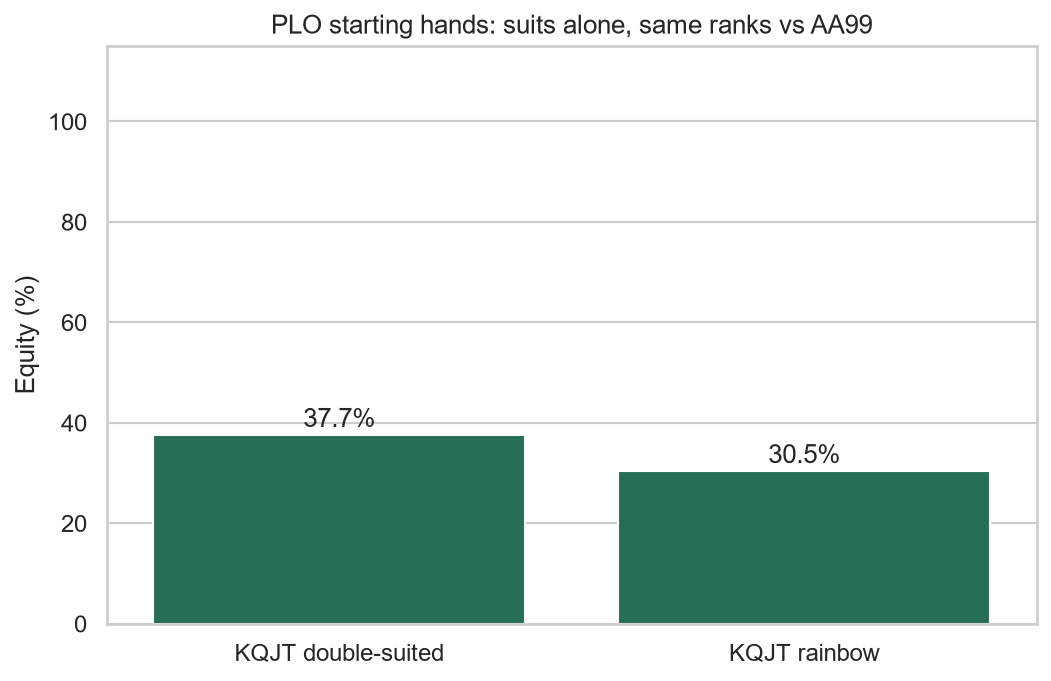
The suits alone are worth 7.2 points of equity in this matchup. Same four ranks, same opponent, all-in equity before the flop.
Spades on the king and queen, clubs on the jack and ten: K♠Q♠J♣T♣ is double-suited, and it beats A♥A♦9♥9♦ 37.66% of the time. Now make the king a spade, the queen a diamond, the jack a club and the ten a heart. K♠Q♦J♣T♥ holds the same four ranks in four different suits, and against the same A♥A♦9♥9♦ it wins 30.46%.
Same ranks, same opponent, and the suits alone move the hand 7.2 points. Other published work puts the double-suited edge at 3 to 6 points for the same ranks (ThinkGTO). Either way the suits pay for themselves, because a two-suit hand gives you two flush draws to build from. In the suits where you hold the ace, that draw runs to the nut flush, so the ace still decides how hard you push.
Position changes the same hand
The seat changes how the same four cards get played. At a 6-max table with 100 BB stacks, under the gun leaves five hands behind you that can reraise. That leaves a hand like 9♥8♠7♥6♠ playing out of position in a bloated pot. On the button, only the blinds sit behind you, so the same cards are far easier to raise. The button plays over two and a half times as many hands as under the gun at 100 BB. Opening ranges widen sharply from the earliest seat to the button. That makes a middling double-suited rundown a more natural button hand.
Put 9♥8♠7♥6♠ against A♥A♦K♥K♦, double-suited aces-king and the strongest starting hand in PLO, and it wins 37.67%. Thirty-eight percent sounds modest, which is the whole case for playing rundowns: even the worst matchup leaves you with more than a third of the pot.
Opening ranges climb from 17.9% under the gun to 47.2% on the button at 100 BB (Upswing Poker preflop charts). Suitedness shapes that curve too, and the same page carries the raise frequencies: a no-pair double-suited hand gets raised 100% of the time from every seat, while a no-pair rainbow hand gets raised 35% of the time under the gun and 96% from the button.
The button opens hands that early position folds, and both decisions are correct at 100 BB. Our ranges topic hub has more on building seat-by-seat ranges.
Cash games and tournaments want different hands
Deep stacks reward hands that can win a big pot at showdown, so nut potential and suit coverage carry the most weight in cash. Short stacks reward hands that flop enough equity to commit, so pairs and suited aces gain ground.
At 100 BB you have room to flop a draw and get paid when it hits. That makes a double-suited rundown with a nut flush draw the best kind of cash hand, because it can stack an overpair on the turn and the river. Shorten the stacks and the drawing room shrinks, while a big pair like A♠A♥J♠T♥ can get the chips in before the flop with decent equity.
Position matters less when stacks are short, because the hand often goes in before the flop either way. Our PLO tournament guide covers the tournament side, and the cash game format hub covers deep-stack play.
PLO starting hand mistakes that cost the most
Six errors account for most of the money lost before the flop, and each one has a fix you can apply in the next session.
- Stacking off with bare aces. A♥A♠7♦2♣ wins 50.7% against 9♥8♠7♥6♠, so the chips go in as a coinflip and you spend the rest of the hand guessing.
- Chasing non-nut flushes. If the ace of your suit sits in someone else’s hand, your flush is second best.
- Playing hands with two danglers. Two useless cards cut your six pairs down to a handful that matter, and the hand flops air most of the time.
- Opening the same range from every seat. The chart raises a rainbow hand 35% from under the gun and 96% from the button, so one range can’t cover both.
- Overvaluing small pairs. 8♥8♠3♦3♣ makes bottom set and bottom two pair, which pay off bigger sets.
- Ignoring the side cards on aces. A♠A♥J♠T♥ and A♥A♠7♦2♣ are both “aces” and they play nothing alike.
Running a hand through the five tests takes a minute, and the same review, applied to the hands opened most often, shows quickly which ones carry two danglers or no suits.
Frequently asked questions
What are the best starting hands in PLO? AAKK double-suited tops every list, with A♠A♥J♠T♥ double-suited next. Double-suited rundowns such as K♠Q♠J♣T♣ rank highest among the hands with no pair. AAKK double-suited wins about 67% against a random hand (PLO Genius).
Is AAKK a good PLO hand? You won’t find stronger four cards preflop. AAKK double-suited wins 69% against KKQQ double-suited, and about 67% against a random hand. Strip the second suit and the profile changes sharply. Rainbow AAKK has no flush draw in either direction, so it wins fewer flops outright and needs more care on later streets.
Should you play ace-ace in PLO? Quality of the two side cards decides that. Hand them K♠K♥ or J♠T♥ and you hold a premium. Hand them 7♦2♣ and you hold a coinflip against a good rundown. Raised pots are where aces earn: you can get money in while your equity is still good, and five-way limped pots give them too many hands to dodge and too little dead money to win.
How many hands should you play in PLO? One quoted band for 6-max PLO cash is a 25% to 30% voluntarily played range (PLO Mastermind). Tables that rarely fold push that number toward the low end, and loose tables let you widen past 30% in position.
Is PLO harder than Hold’em? PLO demands more work from the first decision. The best starting hand wins only about 67% against a random holding. Equities sit close together, so hand selection carries more weight than it does in Hold’em.

Written by
Jake Rivera
Founder and live poker player
Jake Rivera founded Rivera Poker and writes about No-Limit Hold'em: preflop ranges, ICM and bubble decisions, and the postflop lines that separate tournament play from cash games.