Pot Limit Omaha Tournament Strategy: What Four Cards Change
Pot Limit Omaha tournament strategy starts with four cards and six two-card hands. Learn hand selection, wrap outs, bare aces and bet sizing under the pot-limit cap.
Pot Limit Omaha tournament strategy is a hand-selection problem first and a betting problem second. You hold six two-card hands at once, only one of them can win the pot, and the stack you start with decides how many bets you get to make. Get the hand selection right and the pot-limit cap stops mattering; get it wrong and every street is a guessing game.
A♠A♥7♠2♦ looks like a monster to a hold’em player. Pot it from early position, pick up two callers, and watch a K♥J♥8♣ flop arrive. Now you have one pair, no flush draw and no straight draw. In a three-way pot someone has two pair, a set or a big draw, and your chips are already in the middle.
Why four cards change what a hand is
PLO deals 270,725 four-card combinations against 1,326 two-card combinations in hold’em. Ignore suits and you still get 16,432 different starting hands, against 169 in hold’em (Alspach, Simon Fraser University).
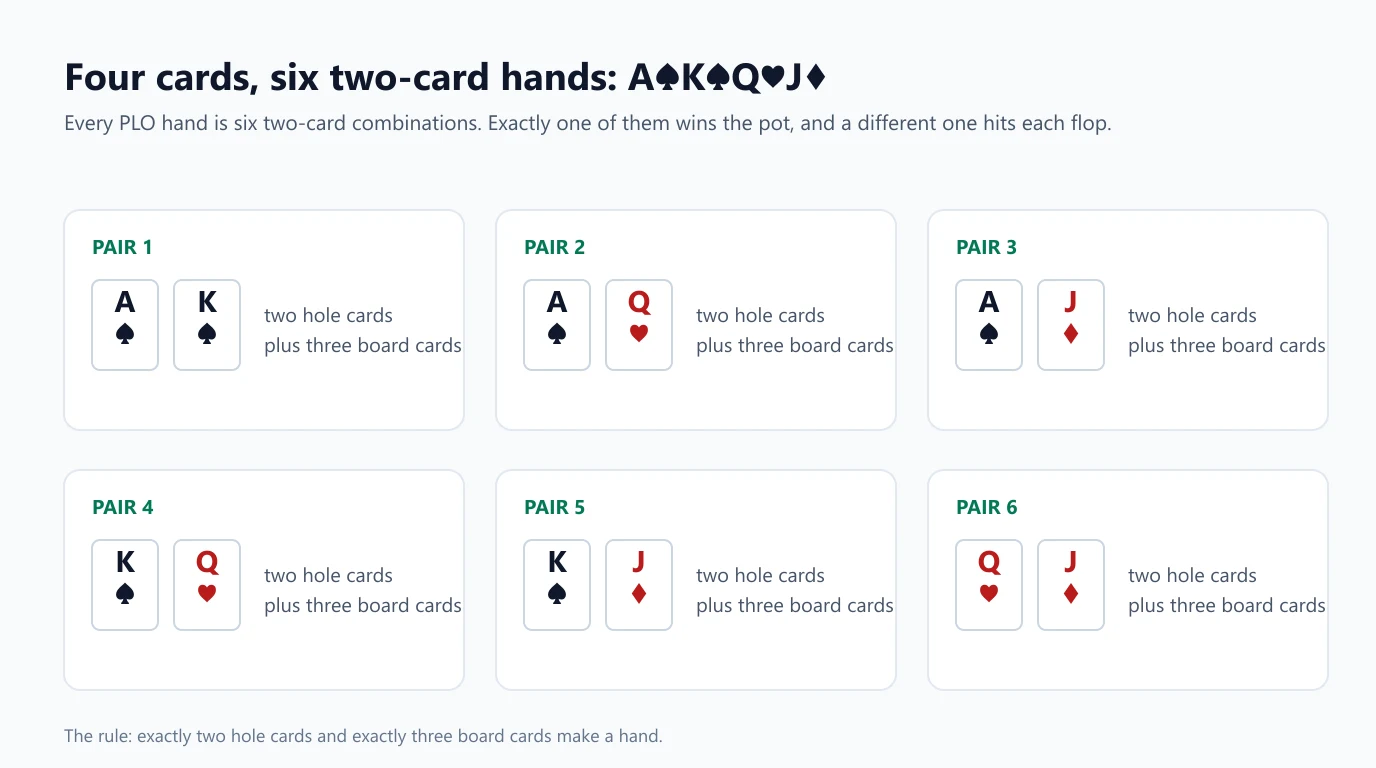
The fourth card arrives with a rule attached. Exactly two hole cards and exactly three board cards make the hand (WSOP Online). Four hole cards make six different two-card pairs, and each pair can build a different hand.
So the question at the table changes. A hold’em player asks how strong the hand is. A PLO player asks which of the six pairs hits this board, and whether it hits the nuts. One pair of your hole cards can flop the nuts while the other five do nothing.
PLO vs hold’em hand selection: three tests
Three tests separate the hands that earn a raise from the hands that do not: nut potential, connectedness and suitedness. A chart is only a shortcut through those tests. Aces with dead side cards fail at least two of the three.
Nut potential
Big pots go to the best hand, and second-best hands pay for them. Suited K-x hands and low rundowns such as 6♠5♥4♦3♣ keep making the second nuts, which lands you in spots where a big raise means you are beaten (Upswing Poker).
Blockers count here too. A blocker is a card in your hand that makes an opponent’s strong holding less likely. Holding the A♠ on a three-spade board means nobody else can hold the nut flush.
Connectedness
Four cards in a row flop straight draws on many boards. Play 9♠8♥7♦6♣ against T♥T♦T♣2♠ on T♠7♣2♦ and hero has a pair of sevens with straight outs, and still wins 47.8% against the made set.
Badly joined cards waste each other. A card that adds nothing to the other three is a dangler, and one dangler cuts a hand from four useful cards to three.
Suitedness
Double-suited hands are rare, and both flush draws travel with the hand into every pot, so it can call wider and raise more often. Rainbow hands are worth less than their ranks suggest.
Bare aces and danglers: the hands that lose value
Ace-ace becomes a speculative hand when the other two cards do nothing. Speculative is Jeff Hwang’s label for A♦A♣9♥6♠ and A♠A♥7♠2♦: worth seeing a flop, not worth raising (PokerNews).
Side cards decide the hand. Give the aces kings as well and everything changes: A♠A♦K♠K♦ wins 66.04% against K♣Q♣J♥T♥ and 65.72% against T♠8♣4♣2♥, and it raises from any seat. Weak support flops one pair, and one pair with no draw is the wrong hand to stack off with at 25 BB.
The test takes a second at the table: cover the aces with a finger and look at what is left. If the two remaining cards could not open the pot on their own, the hand is bare aces, and a raise turns it into a bluff that folds out worse hands and gets called by better ones.
Pot limit Omaha wrap draws: counting outs to the nuts
Outs are not where the wrap story starts. A straight draw with nine or more outs counts as a wrap (Upswing Poker glossary). Extra outs come from having four hole cards, which create several ways to fill the same straight.
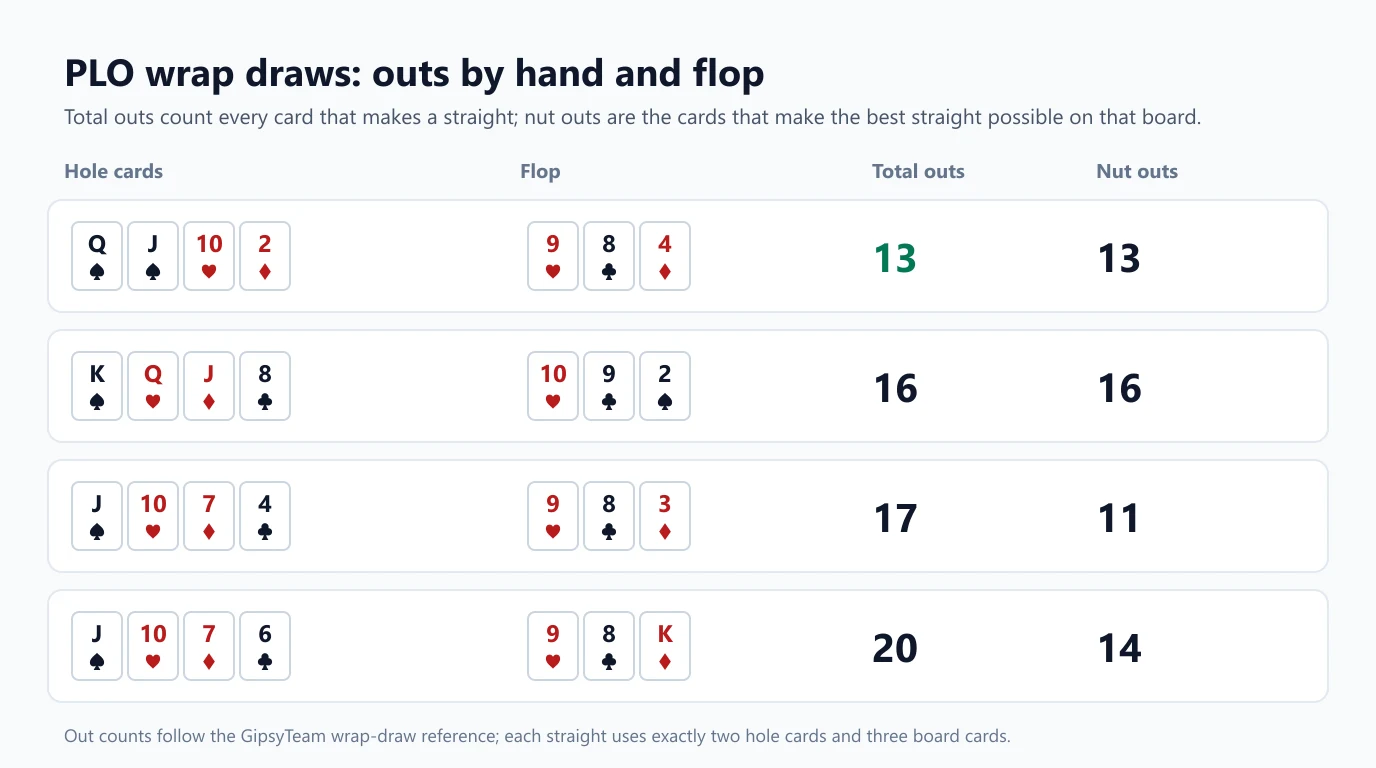
Take Q♠J♠T♥2♦ on 9♥8♣4♦. Thirteen cards make a straight, and each one makes the nuts:
- Four sevens. J♠T♥ with 9♥8♣ and the 7 gives J-T-9-8-7.
- Three tens. Q♠J♠ with the T, 9♥ and 8♣ gives Q-J-T-9-8.
- Three jacks. Q♠T♥ with the J, 9♥ and 8♣ gives the same Q-J-T-9-8.
- Three queens. J♠T♥ with the Q, 9♥ and 8♣ gives Q-J-T-9-8 again.
Add the copies: 4 + 3 + 3 + 3 = 13 outs. Only the sevens have four copies left, because the queen, jack and ten in hero’s hand each remove one from the deck. No higher straight is possible on that board, because anything bigger would need three hole cards. The same count on other boards: K♠Q♥J♦8♣ on T♥9♣2♠ has 16 outs, all to the nuts; J♠T♥7♦4♣ on 9♥8♣3♦ has 17 outs with 11 to the nuts; J♠T♥7♦6♣ on 9♥8♣K♦ has 20 outs with only 14 to the nuts (GipsyTeam).
Against a set with two cards to come, a wrap can be the favorite. K♠Q♥J♦8♣ has 51.46% against T♥T♦T♣2♠ on T♠9♥2♣, which makes the draw a slight favorite on the flop. That number is why the flop is where a PLO tournament pot gets built.
Pot Limit Omaha tournament strategy: stack sizes and bet sizing
Stack depth decides how many bets a hand gets, and that decides which hands are worth playing. At the depths a PLO tournament actually deals, most pots are settled by the second or third bet.
How antes change the preflop math
Every chip in the pot before the flop raises the prize for taking it down and cuts the stack you have left after the flop. A raise of a few big blinds into a pot that already holds antes is a different bet from the same raise into a bare set of blinds, and the pot-limit cap lets the flop bettor size up immediately. Track what is in the middle before you call.
PLO tournament stack sizes: 25 BB and 40 BB
The cap changes how many bets a stack buys. At 40 BB, a raise to 3.5 BB and one caller build a 7.5 BB pot with 36.5 BB behind, an SPR just under 5. Pot-sized bets of 7.5 BB on the flop and 22.5 BB on the turn still leave 6.5 BB for the river, so a 40 BB stack needs three streets to get in.
At 25 BB the same raise and call leave 21.5 BB behind in a 7.5 BB pot, an SPR just under 3. A pot-sized bet on the flop and another on the turn is the whole stack, so the hand is a two-street game and a one-pair hand that cannot improve has no third street to fall back on.
The bar for a call on the bubble
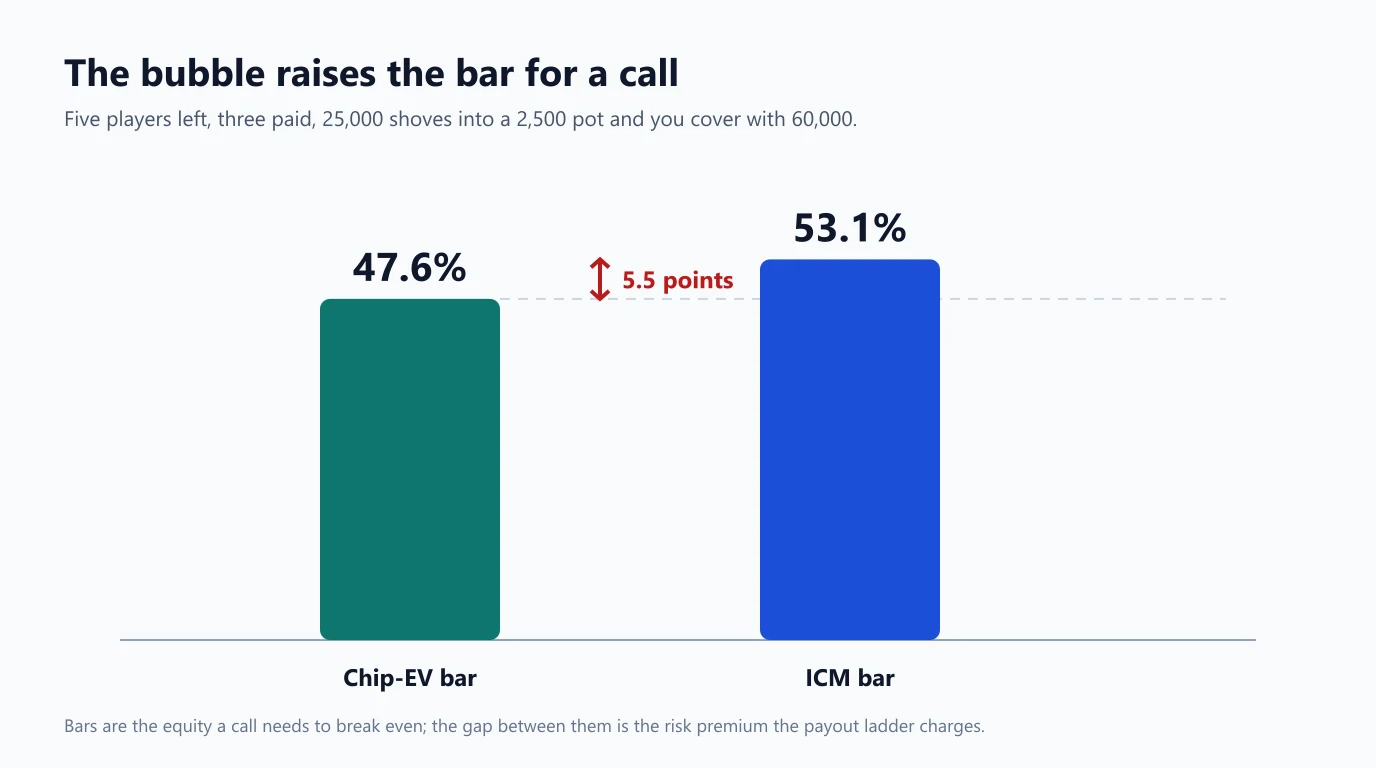
Five players remain, three get paid, and the prizes are $5,000, $3,000 and $2,000. The stacks are 60,000 (you), 25,000, 40,000, 35,000 and 15,000, with blinds at 500 and 1,000. The 25,000 stack moves all in. 2,500 chips were already in the middle, so the pot is 27,500 and the call is 25,000. You cover the shove with 60,000.
A pure chip count sets the calling bar at 47.6%: you risk 25,000 to win 27,500, which is 25,000 ÷ 52,500. The prize ladder moves it. Run those five stacks and the $5,000/$3,000/$2,000 ladder through the site’s ICM model, exact across every finishing order, and the calling bar is 53.1%, a risk premium of 5.5 points. A hand that wins less than about 53% of the time loses tournament money on the call.
A♠A♦K♠K♦ wins 66.04% against K♣Q♣J♥T♥ and calls. Facing A♠A♦K♣Q♣, 9♠8♥7♦6♣ wins only 36.55% and folds. Real shoving ranges hold more than one hand, so the equity moves with the range while the bar stays put.
A 25 BB hand
Here is a representative setup, constructed for illustration. Blinds are 500 and 1,000. In the cutoff, Hero holds 9♠8♥7♦6♣ with 25 BB (25,000 chips). Across the table, the big blind covers with 45 BB and T♥T♦T♣2♠.
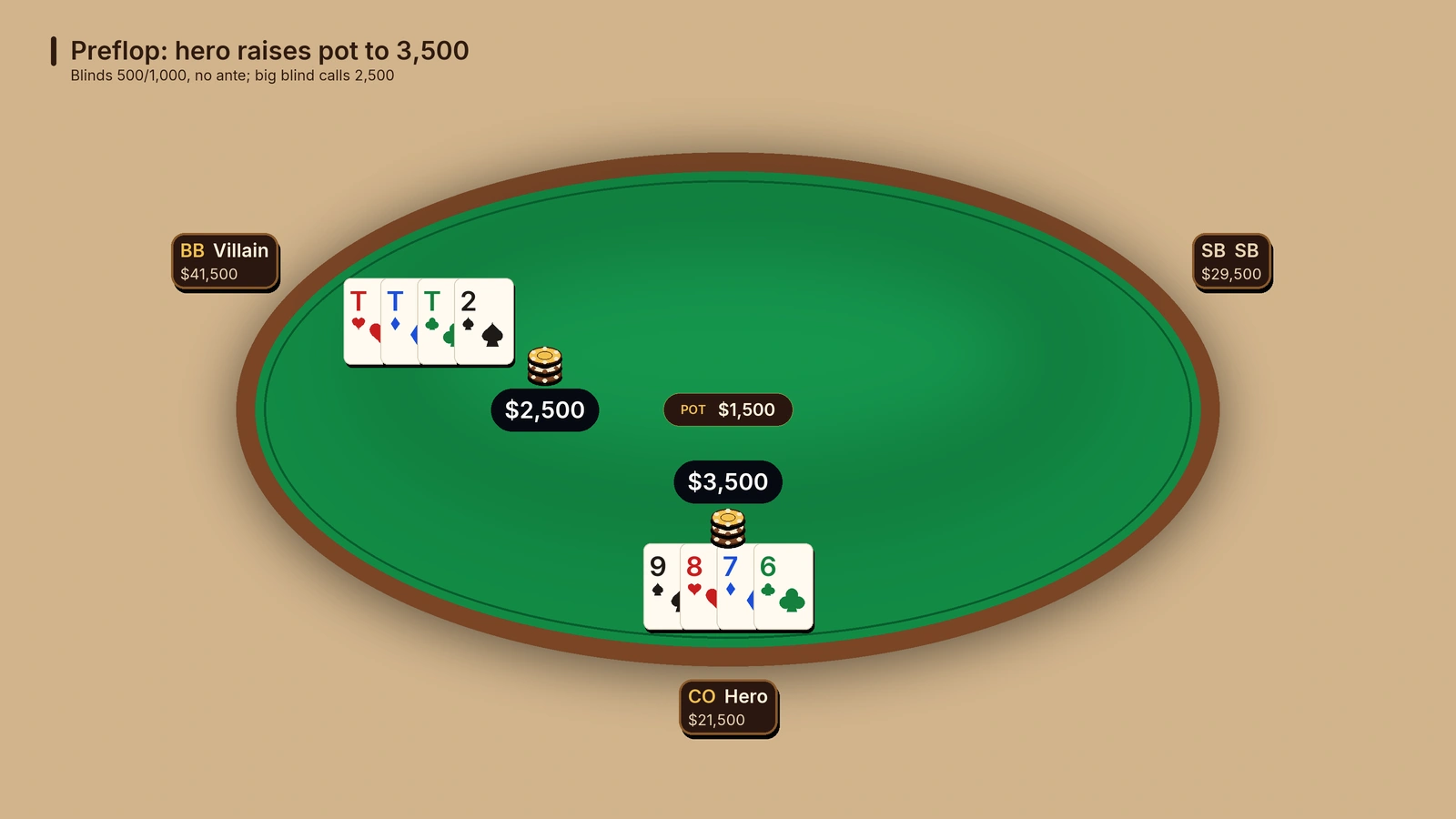
Hero raises to 3,500, a pot-sized raise. Big blind calls 2,500 and the pot reaches 7,500. Against the hand the big blind holds, hero has 43.77% equity: a small dog, with position and a hand that plays well on many flops.
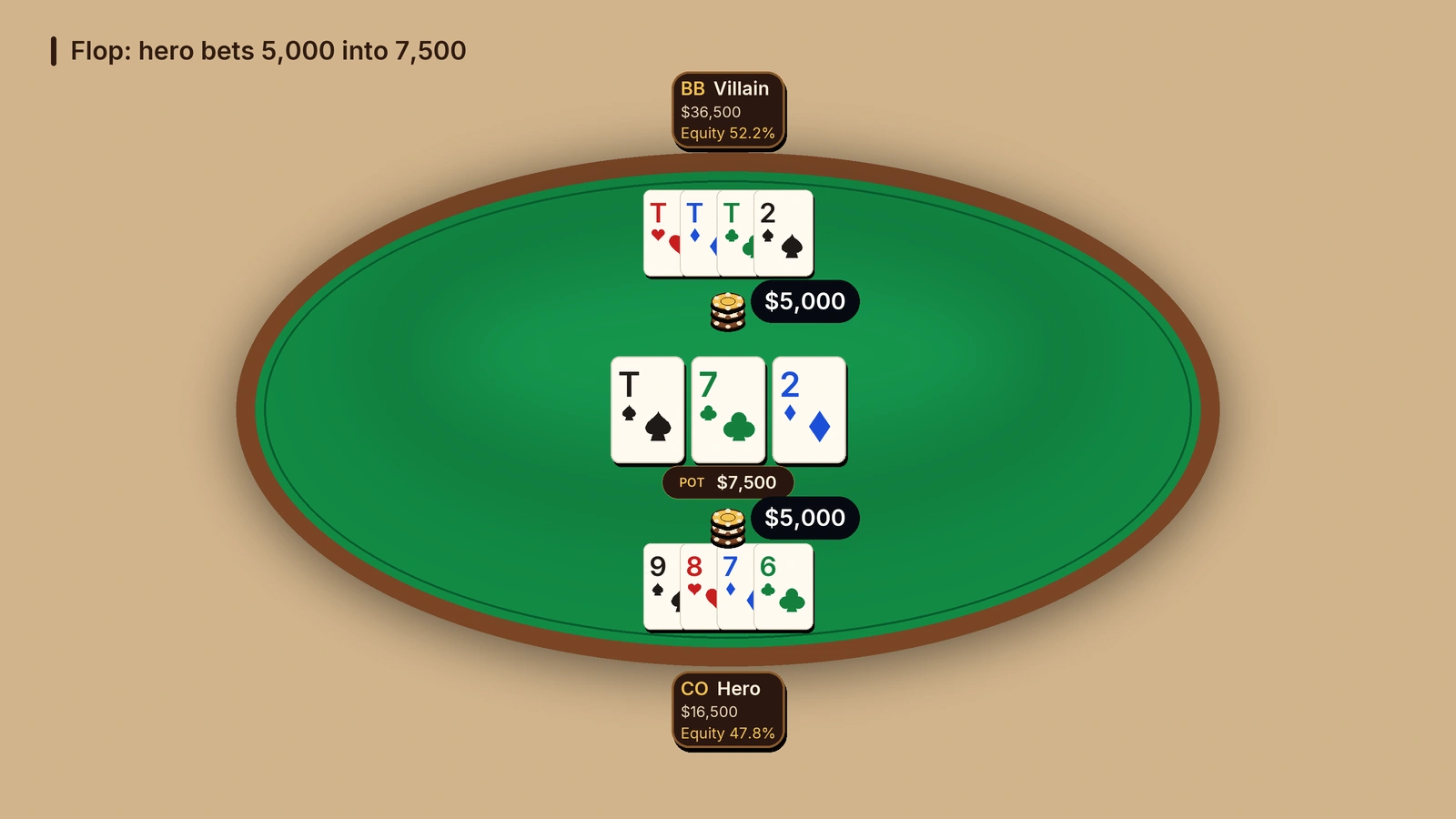
T♠7♣2♦ hits the flop. Middle pair plus straight chances give Hero 47.8% against top set with two cards to come. Hero bets 5,000 into 7,500 and the big blind calls. The pot is 17,500 and Hero has 16,500 behind.
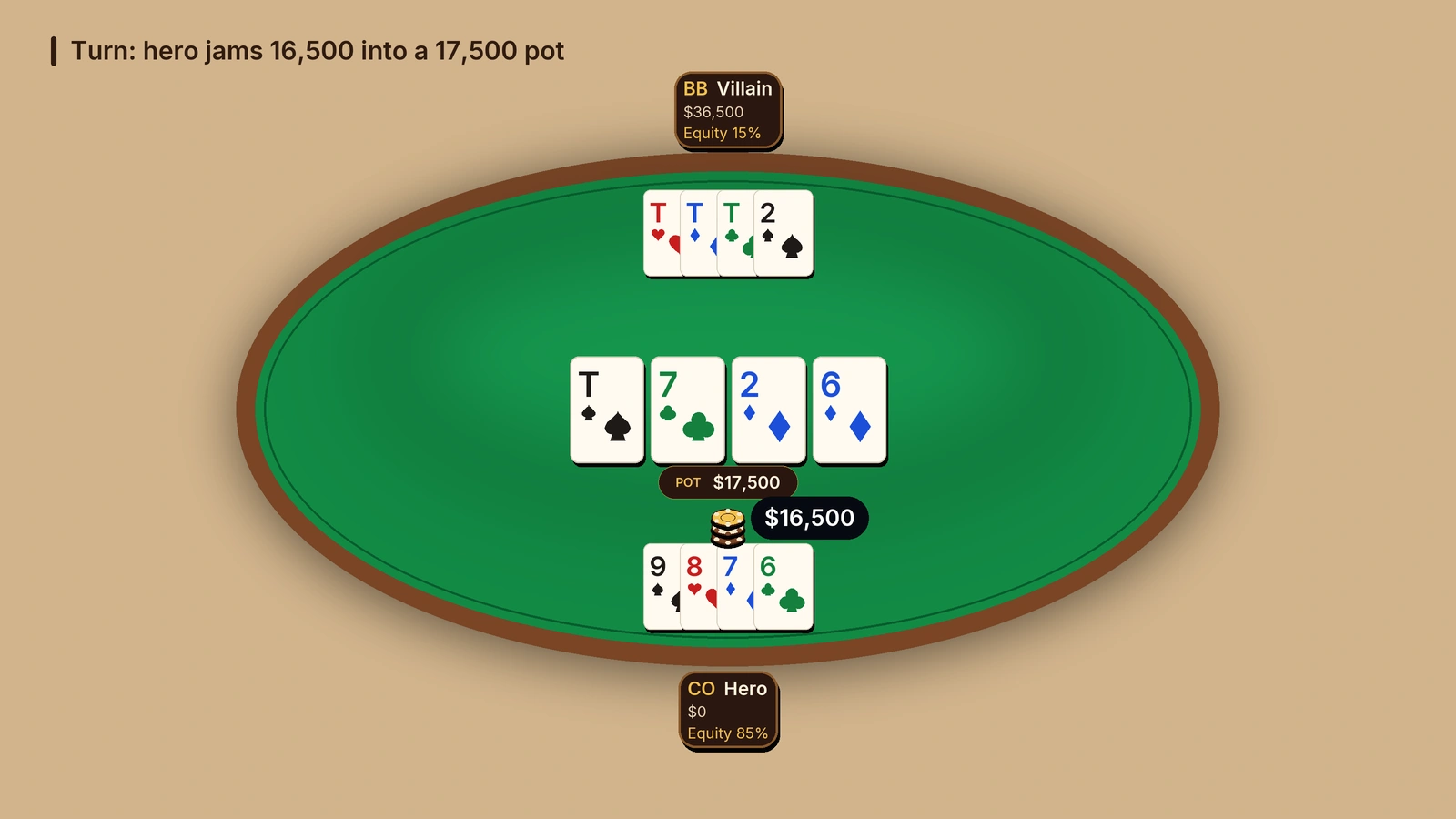
The jam is legal because the pot is 17,500 and Hero has 16,500 left: a pot-limit bet can never exceed the size of the pot, and this one fits under it. The big blind must call 16,500 to win 34,000, which needs 32.7% equity, and 15% is not enough. The jam takes the pot.
That sequence is the whole point of the depth. At 25 BB the stack goes in on a single turn bet, but only because the jam fits under the pot. A player who waits for the river with a 40 BB stack is still holding chips when the hand ends.
What 25 to 40 BB asks of you
Everything above comes from the stack size rather than from a chart, and three consequences follow.
Danglers cost more than they look. A hand that needs three streets to make its money does not get them at an SPR under 3, so the fourth card has to earn on the flop rather than on the river.
Draws collapse into a single decision. A wrap with 47.8% on the flop is played for the whole stack or not at all, because 16,500 behind against a 17,500 pot makes the turn the last decision point in the hand.
Cash PLO usually starts deeper than 25 to 40 BB, and the same A♠A♥7♠2♦ that can be limped there is a raise-or-fold hand here. At these depths the side cards have to earn the raise immediately, and bare aces face pressure on most flops with one pair and no redraw.
Frequently asked questions
What is the best starting hand in PLO?
A♠A♦K♠K♦ tops the equity table: 66.04% against K♣Q♣J♥T♥ and 65.72% against T♠8♣4♣2♥. Double-suited aces with connected side cards are the premium shape, and aces with dead side cards are a speculative hand.
Why must you use two cards in PLO?
The rules require exactly two hole cards and exactly three board cards. Four hole cards give you six two-card pairs, and one strong pair can carry the hand while the other five miss the board.
How many PLO starting hands are there?
270,725 four-card combinations. Ignore suits and the number falls to 16,432 distinct starting hands, against 169 in no-limit hold’em.
What is a wrap draw and how many outs does it have?
A straight draw with nine or more outs counts as a wrap, and the examples on this page run from 13 to 20. Q♠J♠T♥2♦ on 9♥8♣4♦ has 13, all to the nuts; K♠Q♥J♦8♣ on T♥9♣2♠ has 16. The nut count matters as much as the total, and a 20-out wrap can hold only 14 outs to the nuts.
Why are bare aces bad in PLO tournaments?
They make one pair and few draws, so they win small pots and lose big ones. The two side cards decide whether the hand is worth a raise, and at 25 BB a raise commits a large share of the stack to a hand that cannot improve.
How deep are stacks in a PLO tournament?
Starting stacks and blind levels are set by each event, so the number that matters is the depth you actually hold. At 25 BB the hand is a two-street game, because a pot-sized bet on the flop and another on the turn is the whole stack. At 40 BB it is a three-bet game, and the last chips go in on the river.
The two depth bands above settle most preflop choices before the cards arrive: at 25 BB the hands that can commit on the flop, and at 40 BB the rundowns that can stand three bets with position.

Written by
Rob Witt
Pot-Limit Omaha writer
Rob Witt writes about Pot-Limit Omaha, from preflop hand selection to the wrap and blocker situations that decide big pots. His work covers four-card equity, side-card effects, and the adjustments that move a PLO line between cash games and tournaments.