Satellite Tournament Strategy: How to Win a Seat Without Playing It Like a Regular Tournament
Satellite tournament strategy built on seat math: what a seat is worth, why chips stop meaning dollars on the bubble, and an ace-king fold with 12 players left.
You’re 12th of 12 players left in an online satellite. Eleven seats pay $3,000 each, and 12th place gets $800. You look down at A♦K♥ in the big blind, and the chip leader moves all in.
Satellite tournament strategy starts with a question a normal tournament never asks. What is this hand worth in tickets? By chips, the call can be correct. By seats, the same call can cost you a $3,000 ticket, because a bust pays $800 and the chips you win are worth less than the chips you lose. The gap between those two answers is where satellite strategy lives.
A satellite pays in steps, not up a ladder
Qualifying positions in a multi-seat satellite all pay the same prize. Finish first, finish eleventh, you collect the same $3,000 seat. GTO Wizard describes the payout as a step function, with a flat top.
The Lodge Card Club runs its satellites exactly that way. Their $400 buy-in sends $338 into the pool and keeps $62 as the fee. With 100 entries the pool reaches $33,800. They split it into 11 seats at $3,000 plus $800 for 12th, and the event ends the moment the last seat is handed out. The dollar figures come from the club’s example. The percentages hold at any seat value.
Dara O’Kearney puts it plainly: you just have to be there at the end, and your stack size when you arrive doesn’t matter.
Every qualifying spot pays the same prize, so a satellite rewards survival into the group and pays nothing extra for a big stack.
That’s why a double-or-nothing SNG and a 500-entry online satellite belong to the same family. Both pay you for being alive at a cutoff point.
Why chips stop meaning dollars
Chips in a normal tournament buy a share of a graduated payout. Each extra chip buys more money. Even there the exchange rate is poor. ICMIZER’s guide has a player double up in a poker ICM breakdown of a $100 sit-and-go and gain $84.44 of equity instead of $100. That pushes a coin flip from 50% to 54% required equity.
The flattening goes all the way once a seat is on the line. Extra chips above the survival line buy almost nothing, and falling below it costs you the whole seat. That one asymmetry drives every adjustment that follows.
Satellite tournament strategy: what one seat is worth
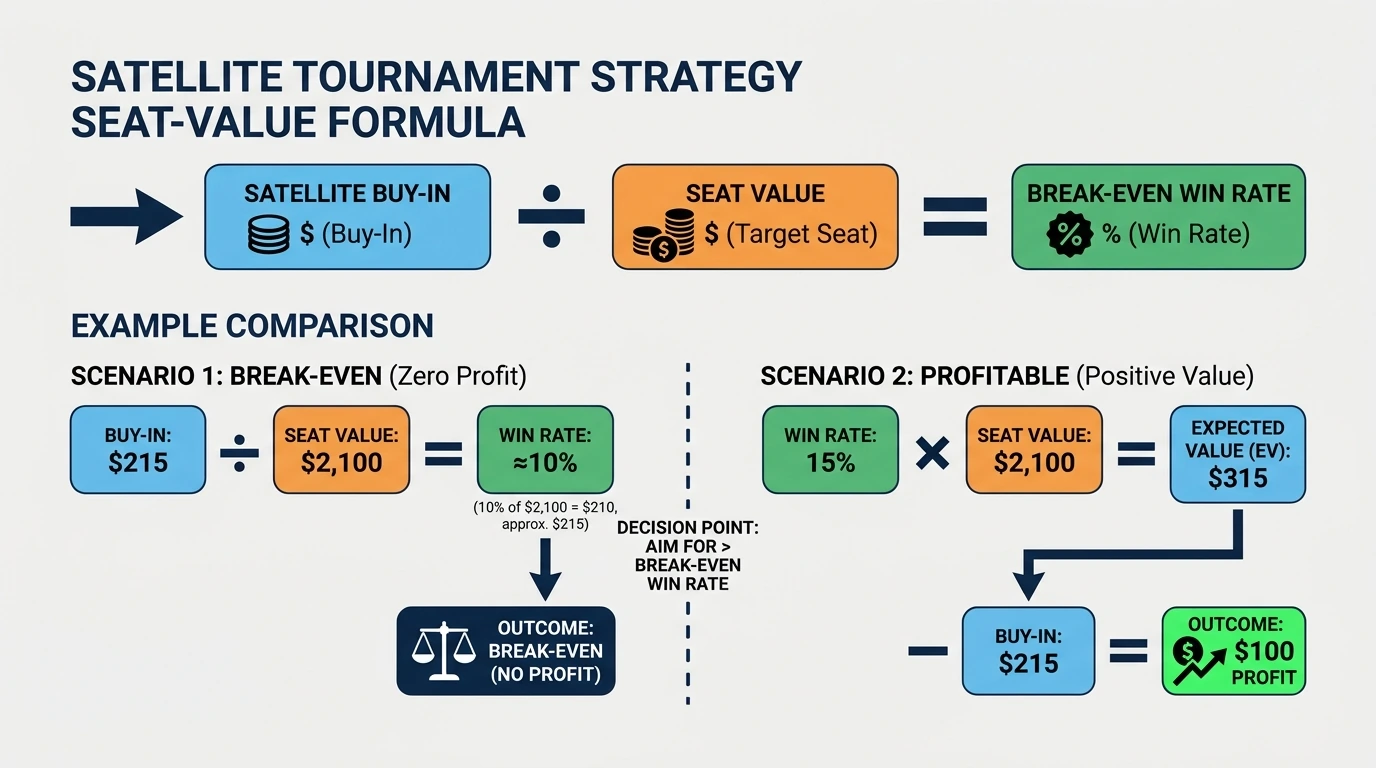
Take the satellite’s buy-in and divide it by what the prize seat is worth. That is how often you must win to break even.
A $215 satellite awards 50 seats to a $2,100 tournament and draws 500 entries. Fifty seats from 500 entries gives an average player one win in ten. So a 10% win rate pays back the buy-in and nothing more. Win 15% of the time and you collect 0.15 × $2,100 = $315 of seat value on average. Against a $215 buy-in, that’s an expected $100 of profit per entry.
GTO Gecko runs the same arithmetic. It’s the only number you need before you register.
Your own win rate in that field is the number to hold against the break-even rate.
Fee is the first thing that moves that figure, and it works differently from the win rate. The rake sets how often you must win, not how often you do. The Lodge keeps 15.5% of each $400 entry, so only $338 of every buy-in reaches the pool. Entries fired comes second, and that one returns under re-entries.
Why chip EV stops working near the seats
Near the seat bubble, a chip you win is worth less than a chip you lose. The bubble factor turns that gap into a ratio.
Bubble factor = (chips lost) ÷ (chips won)
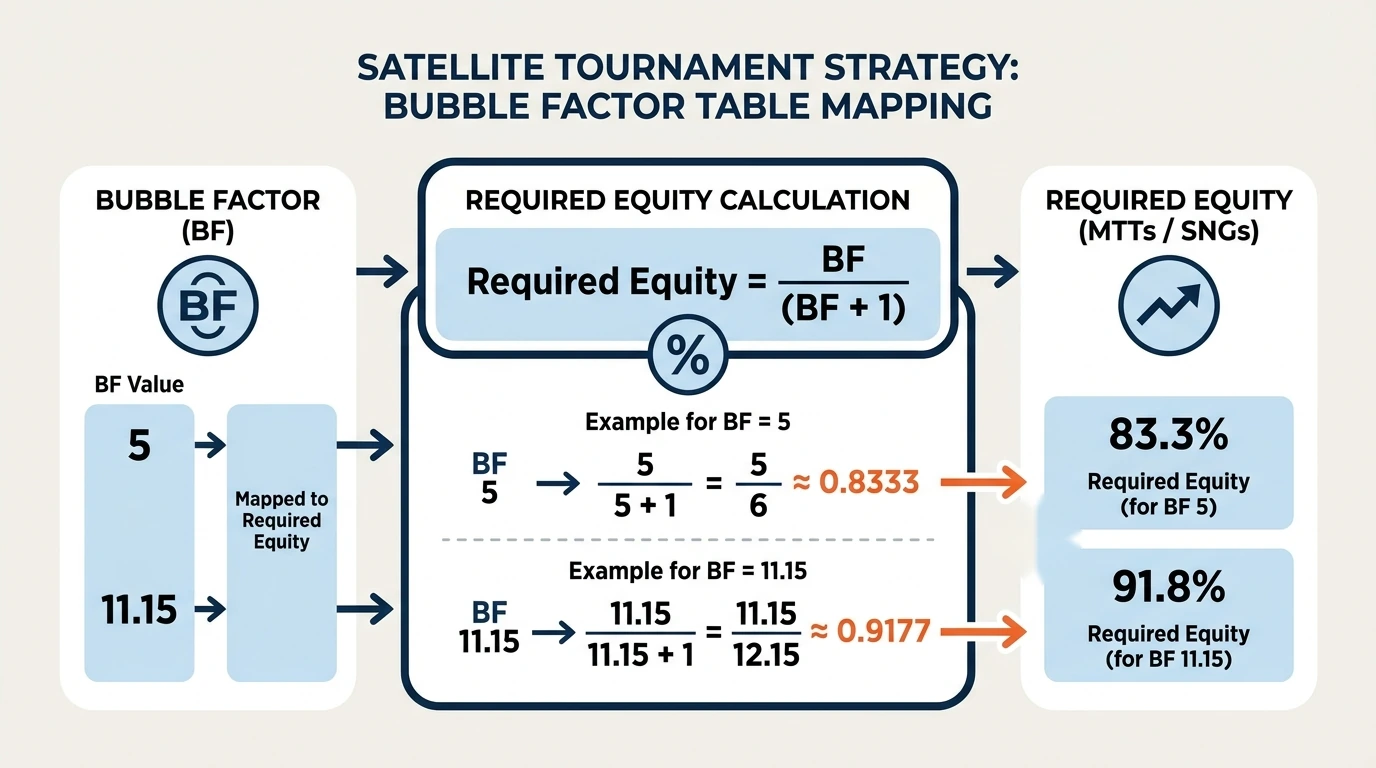
Required equity = bubble factor ÷ (bubble factor + 1)
Say a lost chip costs twice what a won chip pays. That is a factor of 2, so a call that risks what it would win has to come good two times in three.
At one, chips cost what they pay and you are back in cash-game chip EV. Every point above one raises the equity a call needs.
The GTO Wizard satellite guide works through six players left and five seats, all on 20 big blinds. Its model puts the bubble factor at 5 there. That sets the bar at 83.3% before pot odds even enter the picture.
Add one 5 big blind short stack to the same table, and the guide’s model lifts everyone else’s bubble factor to 11.15. The bar becomes 91.8%, and no hand, aces included, has that much preflop equity.
The same model loosens the other side too. When the big blind can only call with a narrow range, the player under the gun can shove almost anything.
Tight calls and wide shoves are one adjustment seen from two seats.
Ace-king on the last-seat bubble
This hand runs on The Lodge’s real 11-seat structure, with illustrative stacks and one illustrative shove.
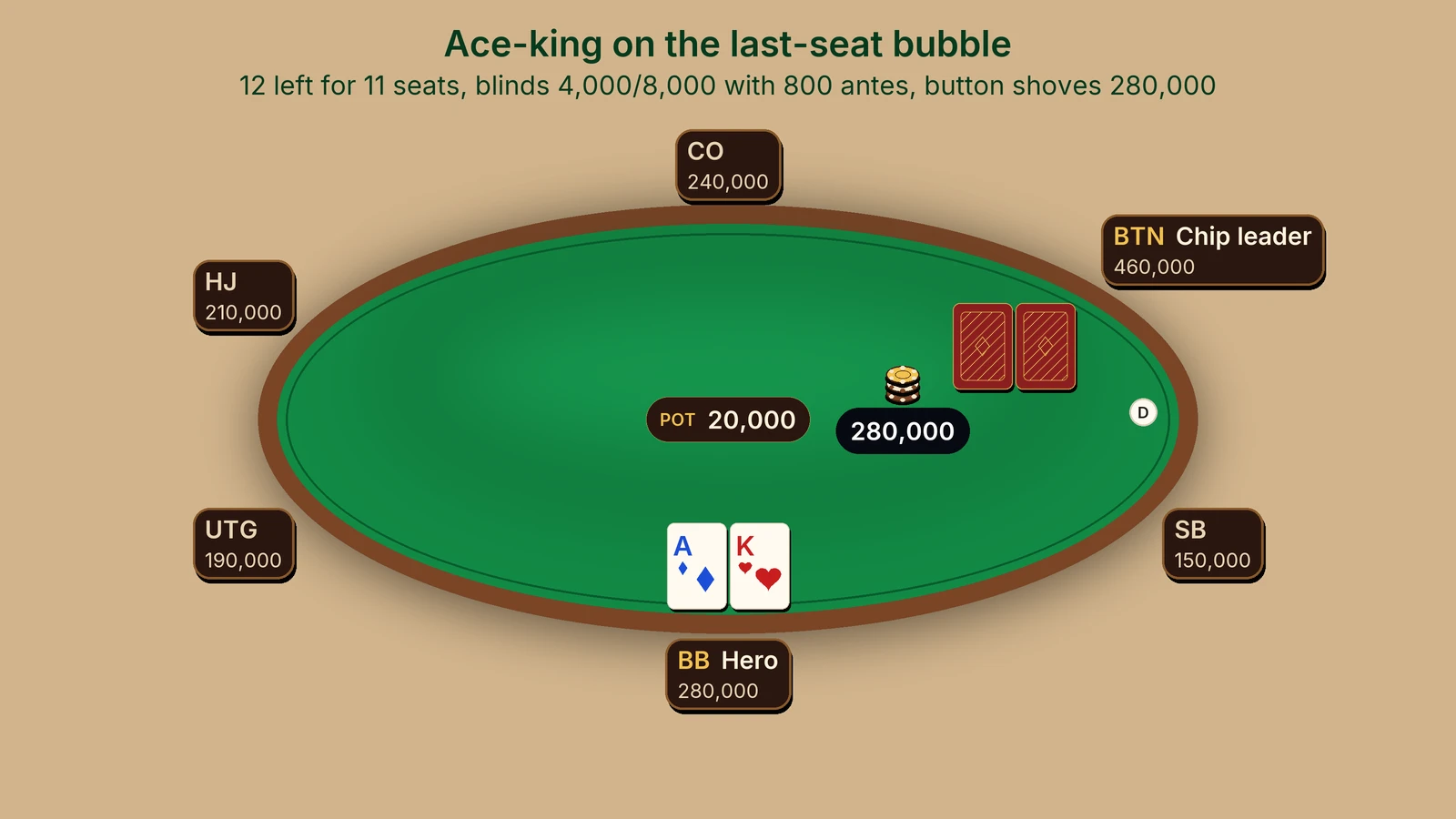
Twelve players remain in a No-Limit Hold’em MTT satellite. Eleven seats of $3,000 are up, with $800 for 12th. Blinds are 4,000/8,000 with 800 antes from the ten other players, and the average stack is just over 208,000. Hero holds 280,000 in the big blind, well short of the chip leader’s 460,000 on the button.
The pot holds 20,000 when the action reaches the button. The chip leader shoves, covering hero’s remaining 272,000, and there’s 572,000 in the middle once hero calls.
Step one: the chips
Hero has 8,000 of his stack in the pot as the big blind, so the call costs his last 272,000 into a 572,000 pot. Chip EV needs 272,000 ÷ 572,000 = about 47.6% equity.
The range matters. Take 22+, A2s+, K7s+, Q8s+, J8s+, T8s+, 98s, 87s, A7o+, K9o+, Q9o+, J9o+ and T9o as the button’s shoving range. That’s 338 combinations, and a 100,000-run simulation puts A♦K♥ at 62.55% against that range. Sampling like that can drift a little, so read it as roughly 62-63%.
By chips the call isn’t close. Hero has about 15 points more equity than the pot is offering.
Step two: the dollars
Now price the three outcomes with the Malmuth-Harville model. That’s the standard Independent Chip Model, and it turns stacks into equity shares. Run it on those stacks, with eleven payouts of $3,000 and one of $800. The other ten stacks sit between 102,000 and 300,000.
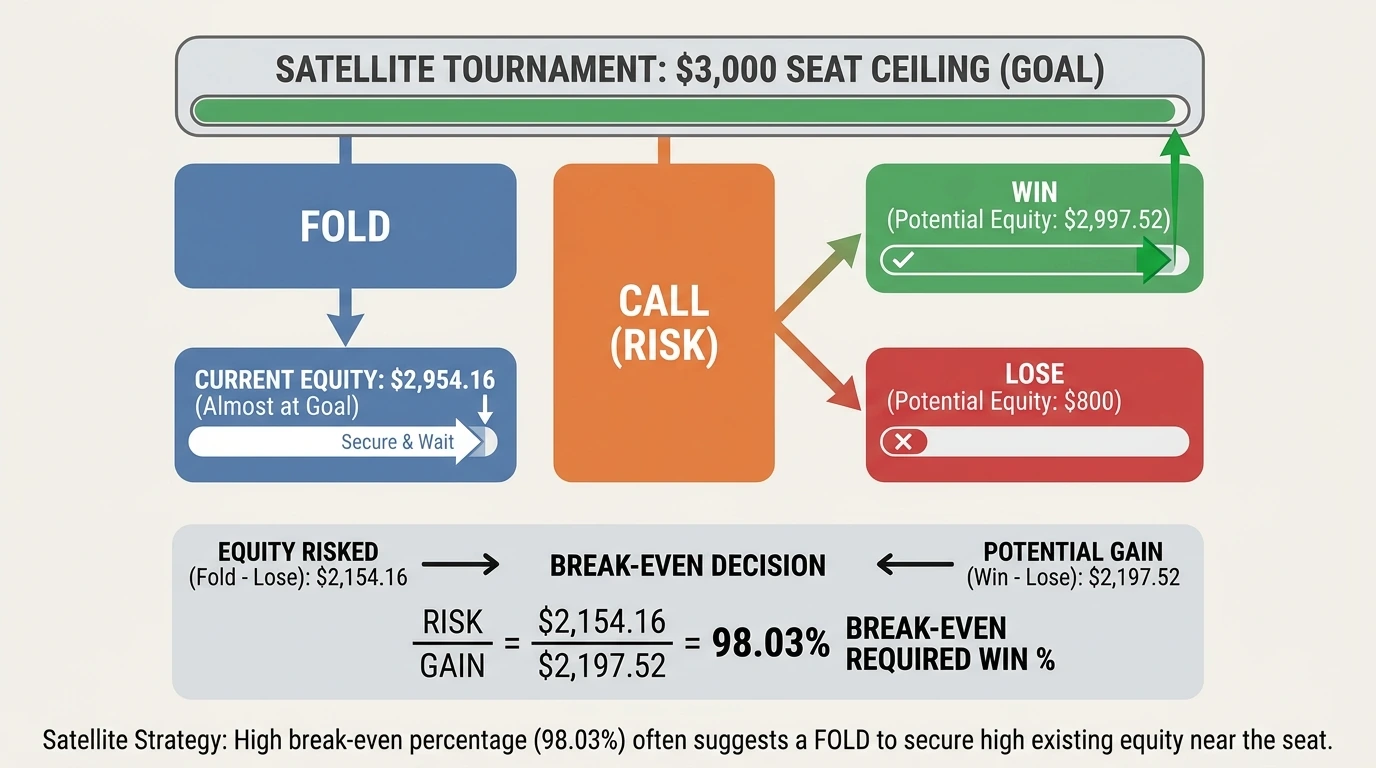
- Hero folds: 272,000 chips left, the button collects the 20,000 pot and rises to 480,000, hero’s equity $2,954.16.
- Hero calls and wins: 572,000 chips, hero’s equity $2,997.52.
- Hero calls and loses: out in 12th, so hero collects the $800 12th-place payout.
The losing stack is only an approximation: the model needs a positive stack, so hero’s last chip stands in for busting, and that run returns $800.05 against the $800 payout.
Folding keeps $2,954.16 of seat equity, winning the all-in lifts that to $2,997.52, and losing drops it to $800.
Winning therefore gains $43.36 of equity. Losing costs $2,154.16. Break-even equity is the loss divided by the total swing, so 2,154.16 ÷ 2,197.52 = 98.03%.
Hero’s 62.55% sits about 35 points below the 98.03% seat threshold. Folding is the play. The chip number and the seat number answer different questions. One prices the pot, the other prices the ticket, which is why, in this spot, the same hand is a call by chips and a fold by seats.
How far the premium bites depends on your stack. Hero holds 272,000 of the 2,500,000 chips in play, which is 10.9% of them and about 1.3 times the 208,000 average, so folding is worth nearly the full seat. Two things push the fold even harder here: hero already sits close to the seat ceiling, and losing the all-in drops him to $800.
How to play the last-seat bubble
Find the lock threshold before you get there. Take the chips in play, divide by the number of seats, and you have the average stack you expect once the bubble bursts.
GTO Wizard uses a tidy version of this. If one player in ten wins a ticket and stacks start at 10,000, the average stack after the bubble is about 100,000. Reach that mark and the solver sits on its hands.
You don’t need the full average to start protecting. Dara O’Kearney’s WSOP satellite advice puts the trigger at about 70% of the projected average stack. In the same piece he goes further: sitting 70th of 120 with 100 seats left, he folds aces preflop.
Three habits follow from the math:
- Above the threshold, marginal stack-offs work against you. In the ace-king spot, the call won $43.36 of equity and risked $2,154.16, so the trade loses money over time.
- The seat math also widens your shoves. Everyone else faces the same 90%-plus equity requirement, so they fold nearly everything.
- Watch the short stacks. While they survive, they soak up the pressure, and the bubble factor stays high for everyone else. Once one is nearly gone, the pressure moves and the shove side widens further.
Turbo satellites
Fewer hands carry the seat math in a turbo or super turbo satellite. Your number of shots at a good spot falls with the hand count.
The ranges themselves barely move. O’Kearney argues that the turbo element should not change the ranges you play, and the only adjustment is to stop passing profitable spots. A normal-speed event lets you wait two orbits for a better shove. Those two orbits may cost half your stack in blinds and antes in a turbo, so waiting costs more.
That changes what an edge is worth. A profitable spot in a turbo carries the same seat math, and the next level lands in a few minutes. The structure also matters. WSOP schedule data lists super turbo events at 20-minute levels against 60 minutes for standard events, so your stack shrinks far faster between hands.
Late registration, re-entries and add-ons
Late registration cuts against you in a satellite. Your short-stacked normal MTT can still run deep for the top payouts. On a satellite a short stack has to survive to a fixed line, and it does that by doubling, often more than once.
So a late entry means a smaller stack relative to the lock threshold. That brings more forced gambles on the way in. In a big field with plenty of seats, a late stack can still double up its way in. In a thin field with few seats, an early entry leaves more room to pick spots.
Re-entries change the seat math on the cost side. Three bullets at $215 cost $645, and each bullet still needs its own 10% win rate against a $2,100 seat to pay back its own price. Budget the $645 as one outlay and hold it against the seat value rather than against a single $215 entry.
Add-ons and rebuys are chip purchases, so judge them against the threshold. An add-on that lifts you from below the lock line to above it buys most of a seat. Bought from well above the line, it buys almost nothing, since the seat is already likely yours and chips past the line do not buy another one.
Multi-seat packages and series satellites
Payout in a series satellite is often a package rather than a bare seat. That bundle changes the value you divide into.
PokerStars runs the ladder from the bottom. Pokerfuse tracks the Power Path climb from a $0.50 Step 1 to $1 and $1.50 tickets, then $11, then a $55 Step 4. Those steps carry no re-entries. The tickets feed qualifiers that award a $109 Spade Pass, a $530 Bronze Pass, a $2,500 Silver Pass or a $10,300 Gold Pass.
A bigger pass moves that number again. A $1,100 qualifier into a $10,300 Gold Pass works out to 10.7%, which is your buy-in divided by the pass value, with any fee left out.
The WSOP runs a different structure. PokerNews lists landmark satellites at $240 for a $2,000 credit, $585 for $5,000 and $1,100 for $10,000. Smaller rungs sit at $135 for $1,000 and $50 for a $300 Gladiators credit. A $1,100 satellite for a $10,000 seat works out to 11%. A $240 satellite for a $2,000 credit works out to 12%. Hold those against the Lodge satellite’s own break-even rate of about 13%, which works out at $400 divided by its $3,000 seat with the 15.5% fee already inside the price. That is a different number from the 11 seats out of 100 entries. Eleven winners in a hundred is what the average player manages, and it returns $330 of a $400 entry. The fee is the gap between that and the break-even rate.
Landmark satellites flip the strategy back toward accumulation. You’re racing toward a credit target rather than a seat group, so chip building matters again.
Check the rules before you fire. Under the WSOP registration terms, winners are registered automatically for that specific event. They can’t resell the seat. Unused tickets must go toward the next event, and nobody can buy a ticket in another person’s name.
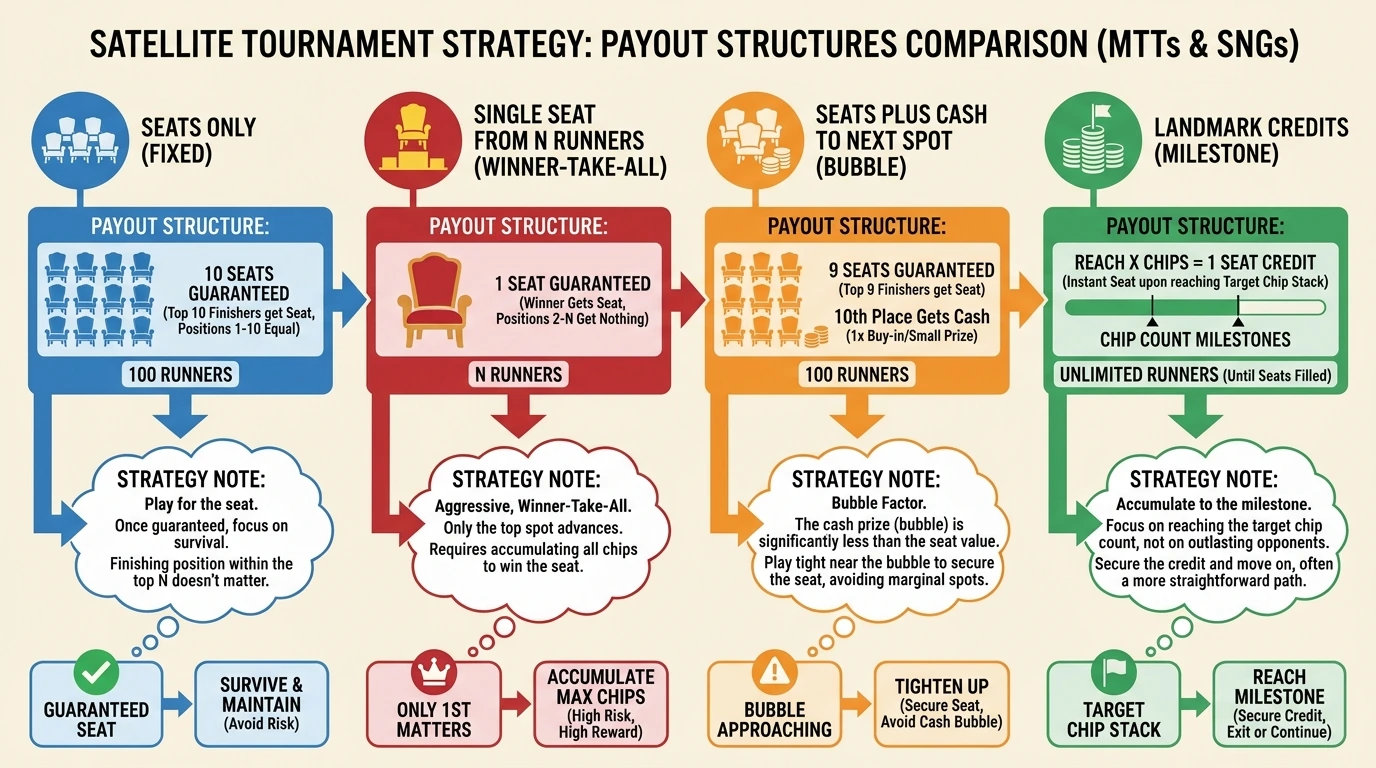
Satellite payout structures compared
The payout shape decides the strategy, and five shapes cover almost every satellite you’ll meet.
| Structure | How it pays | What it does to your play |
|---|---|---|
| Seats only, multiple equal seats | Every qualifying spot pays the same seat, then play stops | Play for survival into the group. The lock threshold rules the bubble |
| Single seat from N runners | One seat, nothing for second | Sudden-death bubble. The last table plays like a heads-up freezeout |
| Seats plus cash to the next spot | For example 11 seats at $3,000 and $800 for 12th | The cash spot adds a small pay jump, which sharpens the fold in 12th |
| Landmark credit toward a target | Fixed credit per winner, applied to the target event | Chip accumulation matters. You’re racing a target |
| Seat plus package | Seat, travel and accommodation bundled | Higher seat value, so the break-even win rate drops |
An uneven split changes things at the margin. When 12th pays $800, the player in 12th has a reason to fold into the money. That jump is 2.4% of the $33,800 pool, so it sits well below the seat values that drive most of the decision.
Direct buy-in or satellite?
Run the break-even rate against your honest win rate and the answer usually falls out.
A $2,100 event bought directly costs $2,100. The same event through a $215 satellite costs $215 for a 10% break-even rate. Win seats at 15% and each entry returns $315 of expected seat value. The satellite is the cheaper route by a wide margin.
Three checks matter before you commit:
- Field strength. Satellite fields are usually weaker than the field in the target event. Your seat win rate can sit well above your cash rate in the main event, so count the free and small-field satellites too.
- Fee and structure. A 15.5% fee on a $400 satellite is real money. So is a turbo structure if you can’t play many hands in the time you have.
- Variance. A 15% win rate still means you miss about six entries out of every seven. When a fixed date matters more than the price, the direct buy-in removes that risk.
Play the satellite when your win rate in that field clears the break-even rate.
Frequently asked questions
What is the best strategy for satellite poker tournaments?
Treat every decision as a seat decision. The group that wins seats all collects the same prize, so a big stack buys no extra ticket and one bust costs you the whole thing. PokerSkill frames the format the same way. Near the bubble that pulls you toward tight calls and wide shoves.
How many chips do you need to win a satellite seat?
Roughly the average stack once the bubble bursts, which is chips in play divided by seats. One ticket per ten players and 10,000 starting stacks put that average near 100,000. Protection usually starts earlier, near 70% of the projection.
Should you play tight in a satellite?
On calls, yes, and earlier than most players expect. GTO Wizard’s model has equal 20 big blind stacks at 83.3%, and one short stack at the table lifts it to 91.8%. Hands that look automatic become folds, and usually only aces survive. Shoving runs the other way and widens a long way.
Is it better to satellite or buy in directly?
Put your win rate in that satellite beside the break-even rate. The $215 into a $2,100 satellite breaks even near 10%, and a 15% winner banks about $100 per entry. Choose the direct buy-in when you can’t clear that number, or when you need the date fixed more than the discount.
Can you sell a satellite seat?
Not at the WSOP. The series registers winners automatically for that specific event, forbids resale, and requires that unused tickets go toward the next event. Other series set their own terms, so read the operator’s rules for the satellite you intend to play.
How do you play the bubble in a satellite?
Fold any hand you can’t afford to lose with. O’Kearney’s benchmark is throwing away aces while sitting 70th of 120 runners with 100 seats left. His rule of thumb starts the tightening near 70% of the projected bubble average. Satellite tournament strategy here rests on seat math, where a fold protects most of a seat’s value.
What to do before your next satellite
Before you register, write down two numbers: the seat value and the break-even win rate. Then work out the projected bubble average stack from the chips in play and the seat count. O’Kearney starts protecting at 70% of that projection. Those three numbers turn the bubble into a decision you’ve already made.
The ace-king hand shows how to read one spot. When your stack sits near the seat line and an all-in would end your tournament, price the swing in chips, then in dollars. The gap between those two numbers tells you what to do.
The ace-king fold stops feeling strange once you’ve seen the numbers.

Written by
Jake Rivera
Founder and No-Limit Hold'em writer
Jake Rivera founded Rivera Poker and writes about No-Limit Hold'em: preflop ranges, ICM and bubble decisions, and the postflop lines that separate tournament play from cash games. He also follows the major series and reports on results, schedules and new formats.