Poker rules for your first home game: the table, positions and hand rankings
Learn the poker rules for No-Limit Texas Hold'em before your first home game: the table and button, four betting rounds, five actions and ten hand rankings.
Poker rules for No-Limit Texas Hold’em cover a lot of ground: who acts when, which bets are legal, and how the pot gets paid out. Once you know the order and the ranking, most of the arguments at the table disappear.
Short list, then you’re done. The table and the button, the four betting rounds, the five actions, the ten hand rankings with an example of each, and the showdown calls beginners get wrong. That fits into one sitting.
Where poker rules come from
Most cardrooms follow the rule set from the Poker Tournament Directors Association, a voluntary trade group for tournament operators. The current edition is the 2026 rule set, version 1.0, dated September 7, 2026, and it keeps binding rules apart from Recommended Procedures, which the TDA calls policy suggestions. Poker TDA
Rule one there does a lot of the work. Fairness and the best interest of the game come first, so a director can use common sense when a spot is unclear. Common sense, at a home game, sits with your host.
Blind levels, the buy-in, and what happens to the button when a player busts: your host picks all of it. Ask about each one before the first deal, and you skip most of the arguments that start at midnight.
The table, the button and the blinds
The button is a disc that marks the dealer seat. It moves one seat clockwise after every hand, and the two seats to its left post forced bets called blinds. Those bets give the table something to play for before a single card turns over.
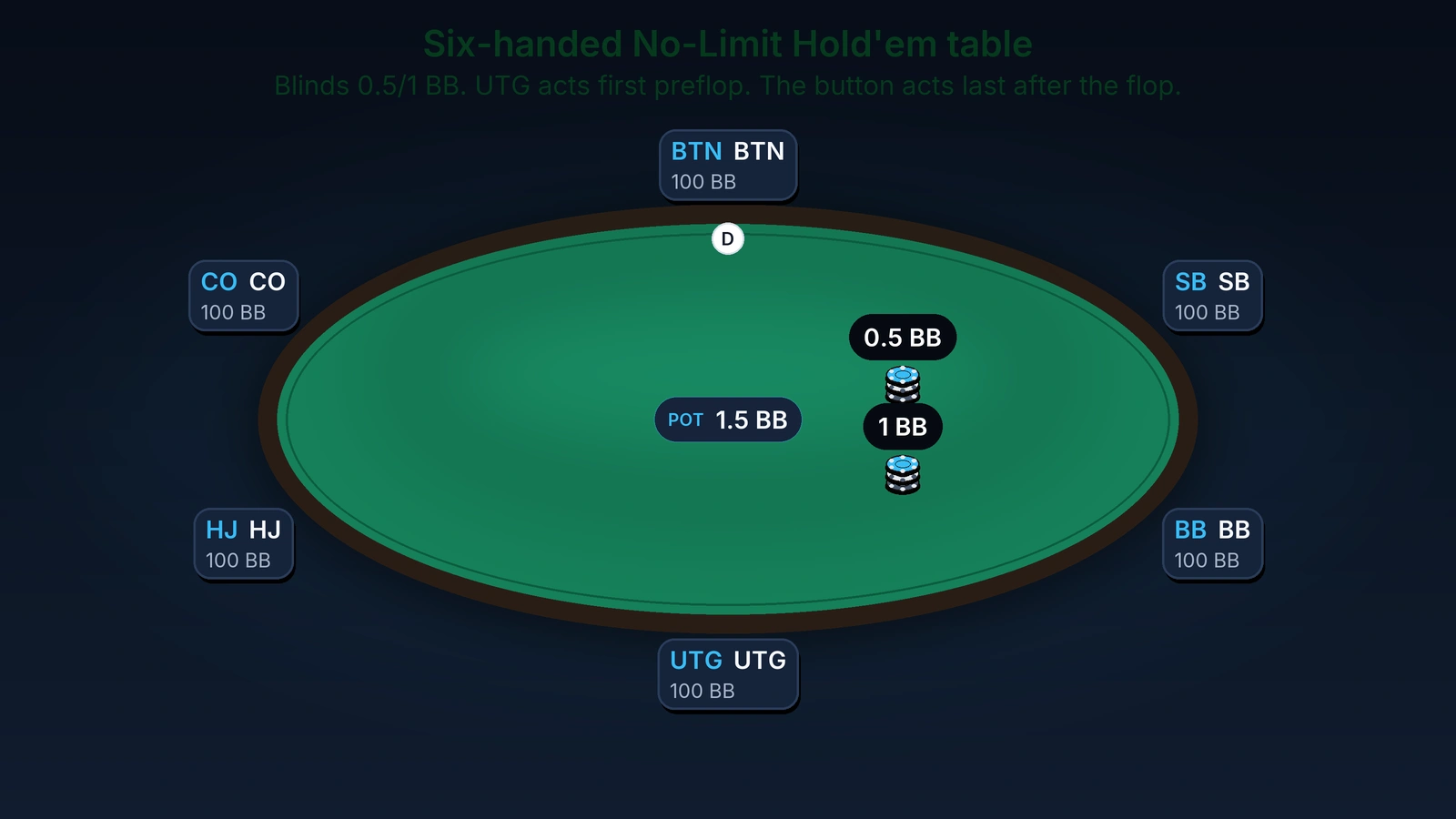
Here are the names you’ll hear at a six-handed table:
- Button (BTN): acts last on every round after the flop.
- Small blind (SB): posts half a big blind and sits left of the button.
- Big blind (BB): posts one big blind and sits left of the small blind.
- Under the gun (UTG): first to act before the flop.
- Hijack (HJ) and cutoff (CO): the two seats just before the button.
Half a big blind already sits in front of the small blind, so a call costs only the difference. With blinds of 15 and 30, that seat owes 15 more. Beginners who toss in a full big blind at that spot hand chips back a minute later.
Who acts first
Before the flop, action starts with the player to the direct left of the big blind, then moves clockwise around the table. Last to act on that round is the big blind. Upswing Poker
After the flop, the first player still in the hand to the left of the button acts first. The button acts last after the flop, so that seat sees every check and bet before it decides.
Heads-up and the dead button
Heads-up, the button also posts the small blind. That player acts first before the flop, then acts last on the flop, turn and river. 2019 TDA rules
Busted players leave empty seats behind, so the blinds can land in odd places. Tournament play uses a dead button: the big blind is posted by the player due for it, even when the button sits in front of an empty chair. Home games can use a moving button instead, and either rule works once the host announces it before the first hand. Home Poker Tourney
The four betting rounds
Four betting rounds, one growing pot.
- Preflop: each player gets two cards face down, then betting starts left of the big blind.
- Flop: three cards go face up in the middle, then betting starts left of the button.
- Turn: one more card, then another round of betting.
- River: the fifth and last card, then the final betting round and the showdown.
Those five cards in the middle belong to everyone. Your hand is the best five cards you can build from your two hole cards and the five on the board, and you may use one, both or neither of your own cards.
Check through every round and the hand moves on to the next card. No chips go in, and nobody has won yet.
The five actions
Five words cover every decision.
- Check: pass the action when the bet to you is zero. You cannot check when you face a bet.
- Bet: put chips in first, when nobody has bet before you on that round.
- Call: match the current bet.
- Raise: add more chips on top of the current bet.
- Fold: give up the hand and the chips already in the pot.
You may also check first and raise when the bet comes back to you. That play is a check-raise, and cardrooms allow it in every game you’ll sit in, including rooms that print it in their house rules. Seminole Hard Rock Coconut Creek
No-limit puts no cap on how many times a hand can be raised. Your stack is the limit, which is where the no-limit name comes from. A few rooms set their own cap, so ask.
Short all-ins and reopened betting
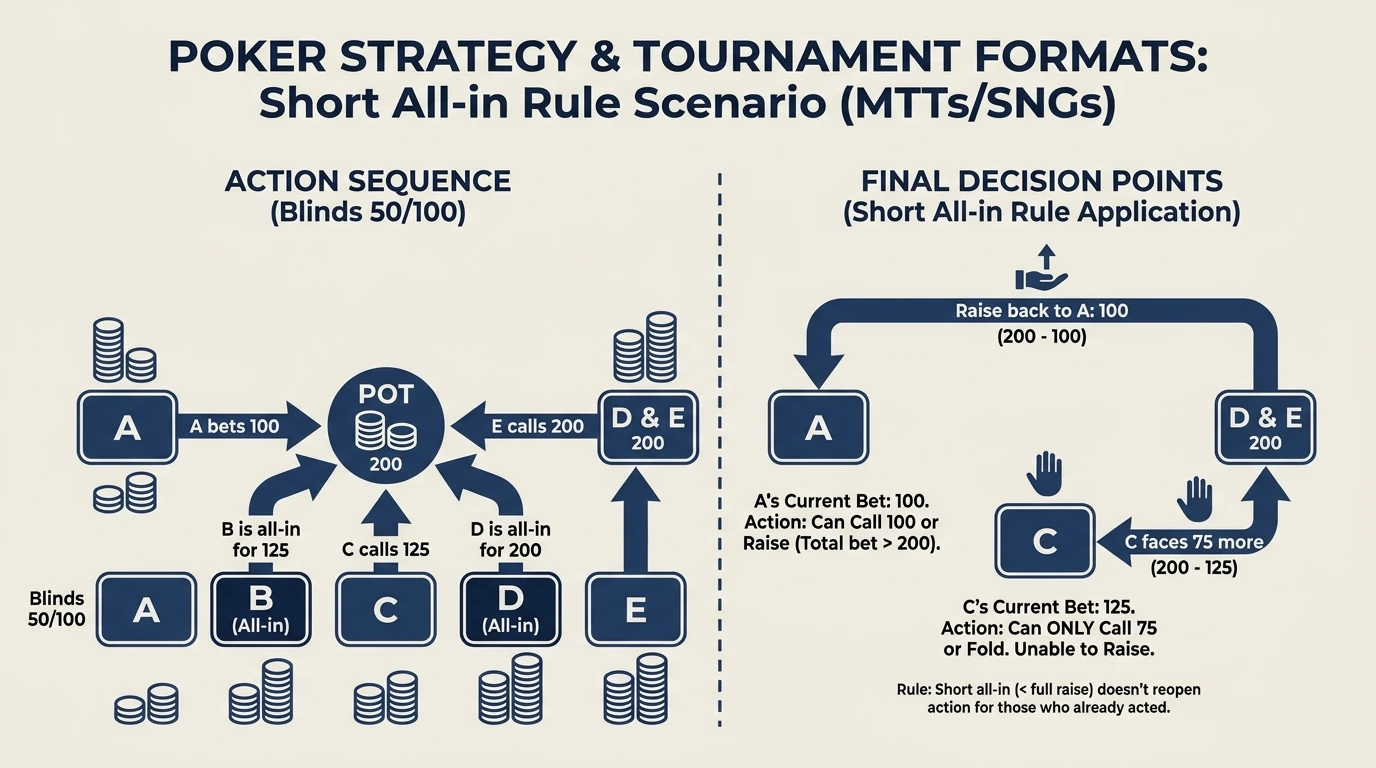
An all-in for less than a full raise does not reopen the betting for players who already acted. Here’s one setup. Blinds are 50 and 100. Player A bets 100, B is all in for 125, C calls 125, D is all in for 200, and E calls 200. The raise back to A is 100, made of 25 plus 75, so it counts as a full raise and A may raise.
Two short all-ins can add up to a full raise, and then the betting does reopen. TDA Rule 47-A applies the same threshold to cumulative short all-ins. Poker TDA
The ten hand rankings
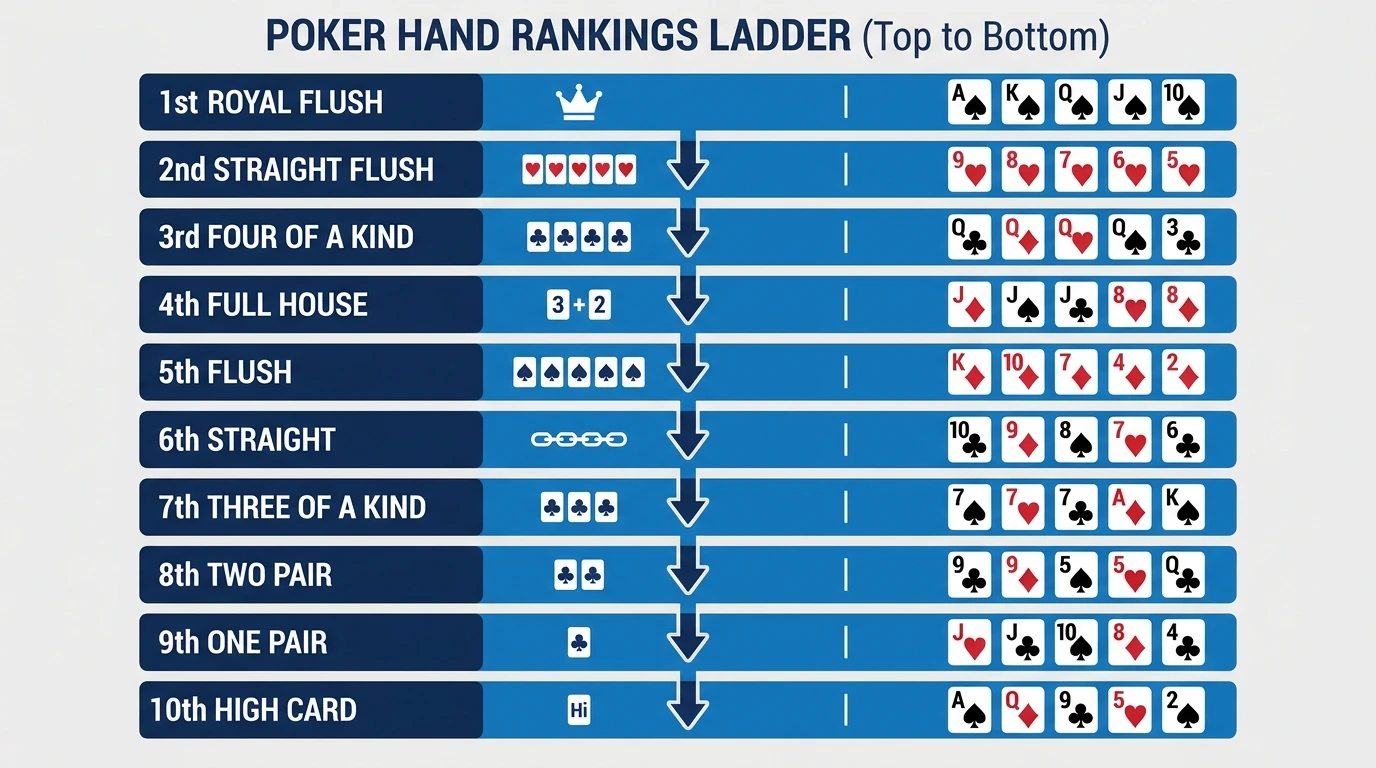
Ten steps rank finished hands, from the royal flush down to high card. Here they are, with an example of each.
| Rank | Hand | Example |
|---|---|---|
| 1 | Royal flush | A♠ K♠ Q♠ J♠ T♠ |
| 2 | Straight flush | 9♥ 8♥ 7♥ 6♥ 5♥ |
| 3 | Four of a kind | Q♣ Q♦ Q♥ Q♠ 7♦ |
| 4 | Full house | J♠ J♦ J♣ 4♥ 4♣ |
| 5 | Flush | A♦ J♦ 8♦ 5♦ 2♦ |
| 6 | Straight | 9♣ 8♦ 7♠ 6♥ 5♣ |
| 7 | Three of a kind | 8♠ 8♥ 8♦ K♣ 3♠ |
| 8 | Two pair | A♠ A♦ 9♥ 9♣ 5♦ |
| 9 | One pair | K♠ K♥ 7♦ 4♣ 2♠ |
| 10 | High card | A♠ J♦ 8♣ 5♥ 3♦ |
A royal flush is the ace-high straight flush, and it tops the list. Suits carry no rank, so a flush in spades ties with the same flush in hearts, and the chips get split.
Kickers and split pots
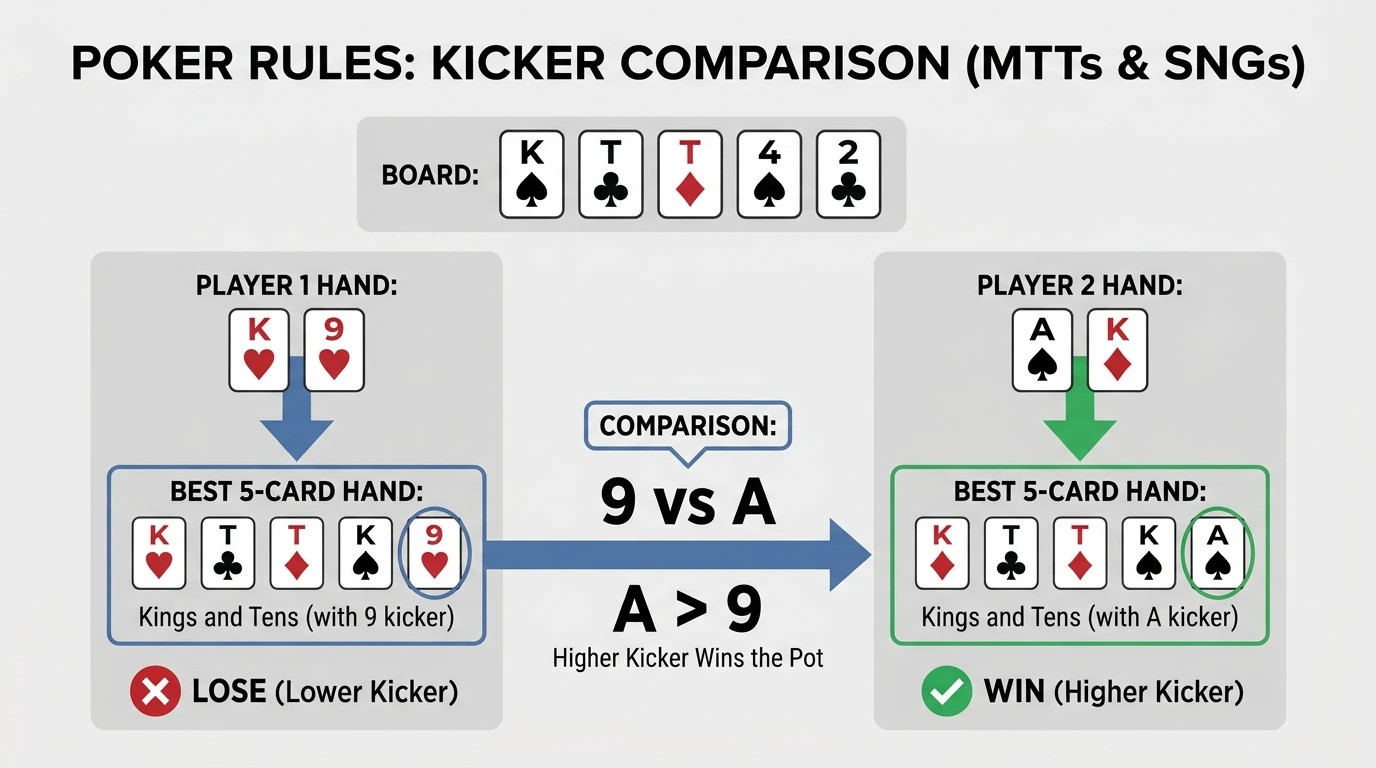
Kickers decide most of the close pots. A kicker is the spare card that fills out your five-card hand once the main part is settled. It matters only when two players share that main part.
Board K♠ T♣ T♦ 4♠ 2♣, and the hands are K♥ 9♥ against A♠ K♦. Both make two pair, kings and tens, and the ace plays as the fifth card, so A♠ K♦ takes the whole pot.
Flushes work differently. A flush uses no kicker, and the highest card inside the flush decides the hand.
When two players make the exact same five cards, the pot splits between them. Say the board is A♦ K♦ Q♦ 8♦ 2♦ and one player holds 9♠ 9♥ while another holds J♣ T♣. Neither player holds a diamond, so both play the ace-high flush sitting on the board: the same five cards. Suits never break that tie, so the chips get halved and play continues.
At showdown, the winner must show both cards. Losers can muck without showing anything.
Mistakes beginners make
Acting out of turn tops the list. Wait for the seat to your right to act before you reach for chips. An out-of-turn action can stand in a cardroom, and it hands free information to everyone at a home table.
String bets cause arguments. You push out one bet, pause, then reach back for more chips. The usual ruling counts the first move alone, so you have called rather than raised. Say the word first, then move the chips, because your first clear action stands.
Words bind too. Saying “I call” commits you to a call even if you meant to raise, so say raise before anything else.
Paying the wrong blind is another common slip. The small blind already has half a big blind in front of it, so a call costs only the rest when nobody has raised.
Table stakes catch people out too. You can only bet chips that sit in front of you. Short on a bet and you go all in for what’s left, and the extra money from the other players goes into a side pot you can’t win.
Weak aces cost real money. A-5 and A-6 lose to A-K, and the same kicker problem shows up on every pair you make. PokerCoaching
Trusting a dealer’s count is the last one. Read the board and your own five cards before you muck.
House rules to agree before the first deal
Casino rules and home rules differ in a few small places, and each one can start an argument. Settle these before the cards are out:
- The button: dead or moving when a player busts.
- Blind levels, and how many hands or minutes each level lasts.
- The buy-in. Many home games set a minimum of 20 times the big blind, though the number varies by host and room. Poker Game Database
- Whether a straddle is allowed. A straddle is a voluntary blind, almost always double the big blind from under the gun, and the player who posts it acts last before the flop. House rules vary on whether it’s allowed, so settle it up front. Poker Skill
Etiquette sits outside the rulebook. Poker etiquette is manners that keep the game moving, and it covers paying attention, not splashing the pot and not talking through a hand in progress. Home Poker Tourney
Write those four rules on a card and leave it next to the chip rack. Then deal, watch the button, and check your own five cards before the pot gets pushed. Knowing the order, the actions and the rankings covers almost every spot you’ll meet at a home table.
Frequently asked questions
Who acts first in Texas Hold’em?
Before the flop, the player to the direct left of the big blind acts first. After the flop, the first player still in the hand to the left of the button acts first, and the button acts last.
Who posts the small blind heads-up?
The button posts the small blind and the other player posts the big blind. The button acts first before the flop, then acts last on the flop, turn and river.
Can you check-raise in poker?
Yes. Checking and then raising when the bet comes back to you is allowed in every No-Limit Hold’em game, and published cardroom rules confirm it.
What happens if two players have the same hand?
The pot splits between them. Suits never break a tie, so two players showing the same straight or the same flush get half the chips each.
What are the golden rules of poker?
Wait your turn, protect your cards and say what you mean before you move chips. Acting out of turn is the habit that causes the most trouble at a home table.
What happens if you run out of chips in poker?
In a table-stakes game you can only bet what sits in front of you. Short on chips, you go all in for what’s left, and the rest of the money from the other players goes into a side pot you can’t win.

Written by
Jake Rivera
Founder and No-Limit Hold'em writer
Jake Rivera founded Rivera Poker and writes about No-Limit Hold'em: preflop ranges, ICM and bubble decisions, and the postflop lines that separate tournament play from cash games. He also follows the major series and reports on results, schedules and new formats.