Mystery Bounty Poker Strategy: How to Price a Knockout When You Don't Know What It's Worth
Mystery bounty poker strategy in plain English: how to convert an unknown bounty into chips, when to call wider, and how the bounty phase changes your ranges.
A mystery bounty tournament hides the price of every knockout. You knock a player out, you get a sealed envelope, and you find out what it’s worth when you open it. The usual bounty rule, call wider because the knockout adds money to the pot, doesn’t really work in a mystery bounty tournament.
So start from the pool: every envelope is drawn from one shared pile of money, and that pile has an average. That average is what prices your calls. Mystery bounty poker strategy is mostly the skill of tracking it while the rest of the table stares at the jackpot.
The rest of this guide shows you how to do that.
What are mystery bounty “hidden envelopes”, and how do they work?
In a mystery bounty tournament, every player has a hidden envelope. When you knock someone out, you open their envelope and get the prize, and that envelope is gone from the pool. Nothing is added to your own head, unlike progressive knockout (PKO) formats, where part of each bounty you win is added to yours. In a mystery bounty, each player’s envelope stays fixed until they bust.
So the remaining bounty pool shrinks as players are eliminated, and the average value of an envelope is just what’s left in the pool divided by the number of envelopes left.
Mystery bounty poker strategy: three formats side by side
Only one of these formats hides what a knockout is worth. A standard knockout pays a fixed price, and a progressive knockout shows the current price on each head even as it grows. Both let you plan ranges ahead of time. The mystery version is the one where the price has to be inferred. That PKO vs standard knockout gap is the first thing to get straight.
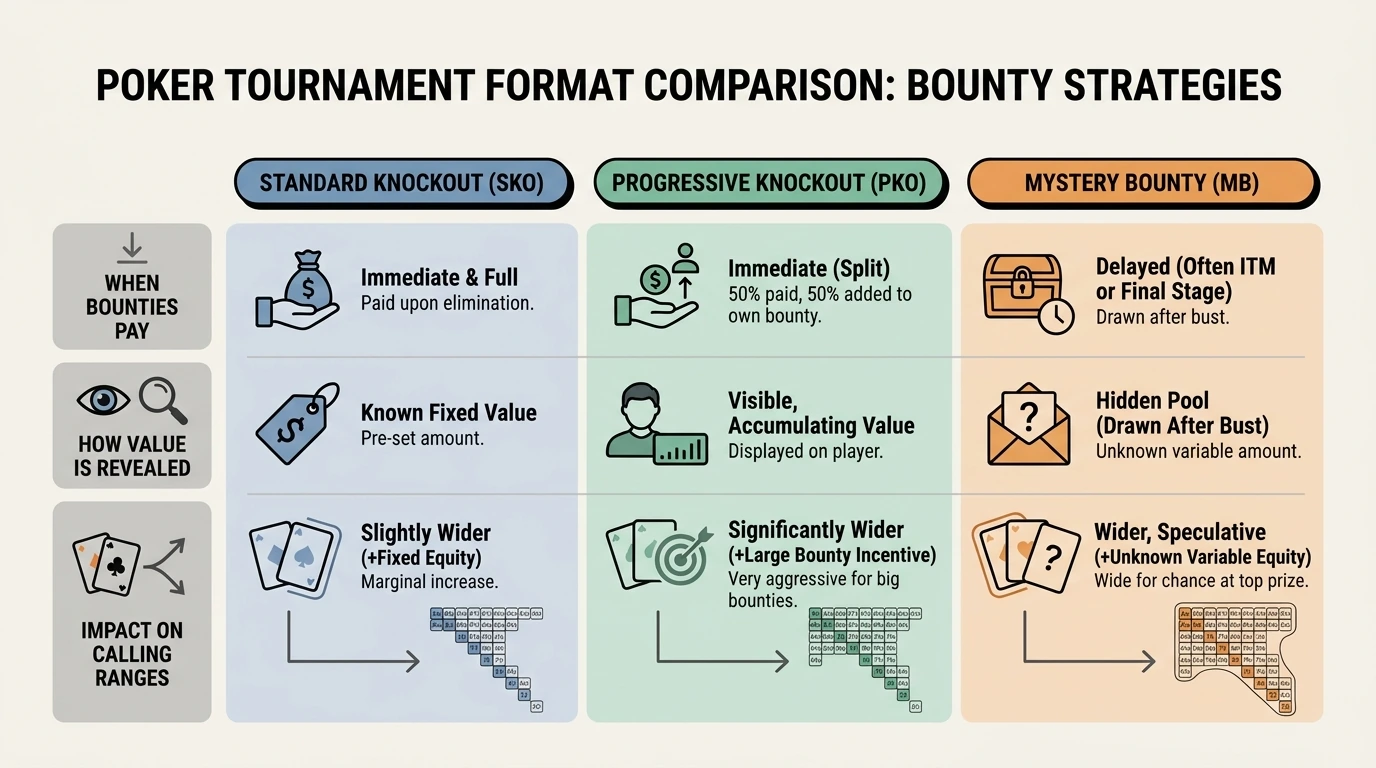
| Format | When bounties pay | How you learn the value | What it does to calling ranges |
|---|---|---|---|
| Standard knockout | From the first hand | A fixed cash amount, known to everyone | Widens every all-in by the same slice |
| Progressive knockout | From the first hand | Half in cash, half added to your own head | Widens ranges most against big stacks with big heads |
| Mystery bounty | After a set milestone | A sealed envelope, random from a tiered pool | Widens ranges by the current average bounty, which moves all day |
In a standard knockout the number never changes. The knockout tournament payout structure fixes the amount on day one. Knock a player out and you collect the same amount every time. So you add the same slice of dead money to the pot on hand one and on the bubble.
How progressive knockout bounties work: the PKO split
A progressive knockout splits the bounty in two. Half goes to the player who scores the knockout, and half goes onto that same player’s own head, which they collect if they go on to win the event, as this explainer on progressive knockout theory sets out. Big stacks carry big heads, so who covers whom decides a lot of your play in that format.
Mystery bounty: two phases and a pool
Two phases decide how mystery bounty poker plays out, as this guide to mystery bounty tournament rules explains. Before the milestone, the event runs like a plain freezeout and no envelope is in play. After it, every knockout pays an envelope, and the value stays secret until you open it. The money goes straight into your pocket, and your own head never grows.
That last part reshapes the payouts you’re used to. Bounty power stops compounding, so one big envelope doesn’t make your next knockout worth more. You’re drawing from a pool, and every draw comes out of the same pile.
Expected value isn’t the envelope in front of you
Most envelopes are worth about the buy-in, and a handful are worth a fortune. The gap between the average and the jackpot is where many players lose their discipline.
One illustrative model of a typical live structure puts roughly 70% of envelopes near the buy-in value, 20% at three to five times the buy-in, 9% at ten to fifty times, and about 1% at a hundred times or more, per this breakdown of mystery bounty prize tiers. Treat it as a sketch of how the money spreads, and expect your event’s own numbers to differ.
The guide on the GTO Wizard blog frames the same question with $100,000 spread over 100 envelopes. One pool pays $375 sixty times out of a hundred, with a scatter of larger envelopes behind it. The other pays $375 ninety-nine times and puts nearly everything into a single $96,625 envelope. Most of the time you draw the small prize in either version, and the guide’s answer is that you should play them the same way, as Carter’s mystery bounty strategy guide lays out.
That’s hard to do when a seven-figure envelope is written on the tournament clock. Barry Carter says the biggest error in the format is giving too much weight to whatever the largest bounty is worth, in that same guide to playing mystery bounties, and the arithmetic backs him up. One huge envelope shifts your expected value by a small amount. The average bounty in the middle of the pool is the one that should price your call.
How to calculate bounty value in poker chips
Divide the remaining bounty pool by the players left to get the average bounty. Then turn that cash figure into chips.
The conversion is short: starting stack × average bounty ÷ total buy-in Simplify Poker.
Round numbers make it easy. A $1,000 event sends $300 of each buy-in to the bounty pool. Three hundred players enter, so the bounty pool is $90,000. One hundred players remain, so the average bounty is $90,000/100 = $900. With 10,000 starting chips, the envelope is worth (10,000 × 900) ÷ 1,000 = 9,000 chips.
How to calculate the chips of the average bounty
- Average bounty = bounty pool ÷ players left
- Bounty in chips = starting stack × average bounty ÷ buy-in
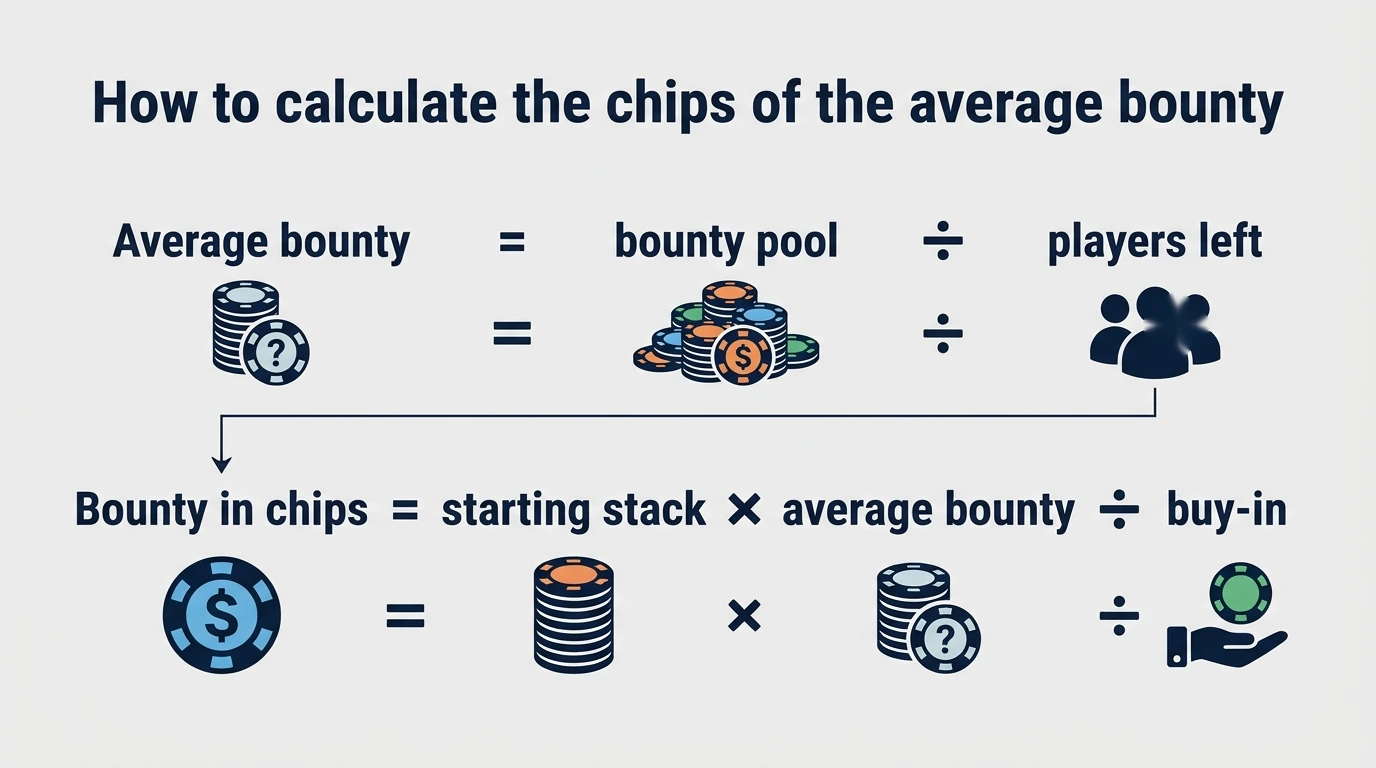
That’s the number you carry with you. When you call an all-in, 9,000 chips of envelope money sits on top of the win, so you can call with less equity than a freezeout would need.
Chip conversion suits this format well. Barry Carter and Dara O’Kearney, who wrote the main book on progressive knockouts, dropped the chip method for those events and picked it up for mystery bounties, as Carter explains in this piece on why chip conversion suits mystery bounties. Their reason is simple. Every knockout in a mystery bounty is worth the same average, so one chip value covers the whole table.
So before the bounty phase starts, note the bounty pool and the field size. At every break or so, divide again to get the chips gained from the average bounty.
In conclusion, mystery bounty decreases the equity needed to call shoves (i.e. you call with more hands) and decreases the equity needed to enter pots with smaller stacks players, as there’s always a chance those pots will end up in a shove as well..
Why the average bounty moves while you play
Your chip value changes as envelopes leave the pool. Each knockout draws one envelope at random, and that envelope is gone for good. The value of a knockout is the average of what’s left: the remaining prize money divided by the remaining envelopes. If big prizes come out early, that average falls for everyone still playing. If small prizes come out, it rises.
A single draw moves the average more as the pool gets smaller. One large prize leaving a 100-envelope pool barely registers, but the same prize leaving a 30-envelope pool shifts it noticeably.
Take a representative setup with round numbers. The pool holds $90,000 across 100 envelopes, so the average is $900, worth 9,000 chips. Now imagine 70 envelopes have been opened and $75,000 has left the pool, because several of the biggest prizes were drawn early. Thirty envelopes and $15,000 remain, so the average falls to $500. The same formula gives (10,000 × 500) ÷ 1,000 = 5,000 chips.
The chip value of a knockout dropped from 9,000 to 5,000 while you were playing hands, so your ranges should tighten with it. Had the remaining envelopes been richer than average, the value would have risen and you could have played looser.
The jackpot pulls the average down less than its size suggests. In one published case, claiming the biggest envelope took the chip value from 9,000 to about 8,000, described in this O’Kearney and Carter mystery bounty walkthrough as a smaller drop than people assume. So the average holds up well against a single draw.
Recalculate after every cluster of bustouts near the bubble, because that’s when most envelopes leave the pool in a hurry.
The bounty phase: play two different tournaments
Mystery bounty events have two phases, and the switch between them is set by the tournament rules: usually at a given level, number of players left, or around the money bubble. Check the tournament structure before you register, where this condition should be explicit.
Before the bounty phase begins, knockouts pay nothing extra, so play it like a regular freezeout. Once the envelopes go live, every knockout you make draws one at random. When you’re in an all-in where you cover your opponent, add the average envelope value, in chips, to your winnings. If your opponent covers you, you can’t win their envelope, but they get yours, so keep in mind they may be calling a lot looser than usual.
Jonathan Little describes players who treat the pre-bounty phase as a bounty event as leaking chips, and players who treat the bounty phase as a freezeout as leaving money behind, in his guide to winning at mystery bounty poker.
The pre-bounty phase is easy to misjudge, because the field is huge and the jackpot is loud. Take the $550 Mini Mystery Millions at the 2026 World Series of Poker. It sends $200 of each buy-in to the bounty pool, starts bounties on Day 2, and guarantees a $1,000,000 top bounty WSOP structure sheet. The starting stack is 25,000 chips, and the sheet only lets players redeem bounties after 4:00 p.m. on Day 2. That lines up with Carter’s advice to play the early phase like an ordinary freezeout.
Once the envelopes open, your required equity drops. One example from a $200 event with 50,000 chips per $100 turns a call that needed 47.6% into a call that needs 34.5% once an $800 average bounty converts to 400,000 chips, in Leo Song’s Upswing piece on attacking the bubble burst. That’s about 13 points of extra hands you can profitably call with.
How far it moves depends on the size of the average. The same arithmetic barely shifts anything when the pot is small. One Upswing knockout example, with a fixed bounty rather than a hidden one, showed a shift of 0.2 percentage points, which is basically no effect, as this Upswing knockout bounty strategy writeup shows. A small envelope barely moves the bar either.
At the phase change, answer two questions. What is the average bounty in chips right now? Do I cover the players I want to knock out?
Calling off with a marginal hand: the same spot, two answers
Here is a representative setup with round numbers and illustrative envelope values. Take a $1,000 mystery bounty with 10,000 starting stacks, blinds at 1,000/2,000 and the bounty phase under way. You’re in the big blind with 80,000 chips, which is 40 big blinds. The button has 40,000 and shoves all in. Everyone else folds.
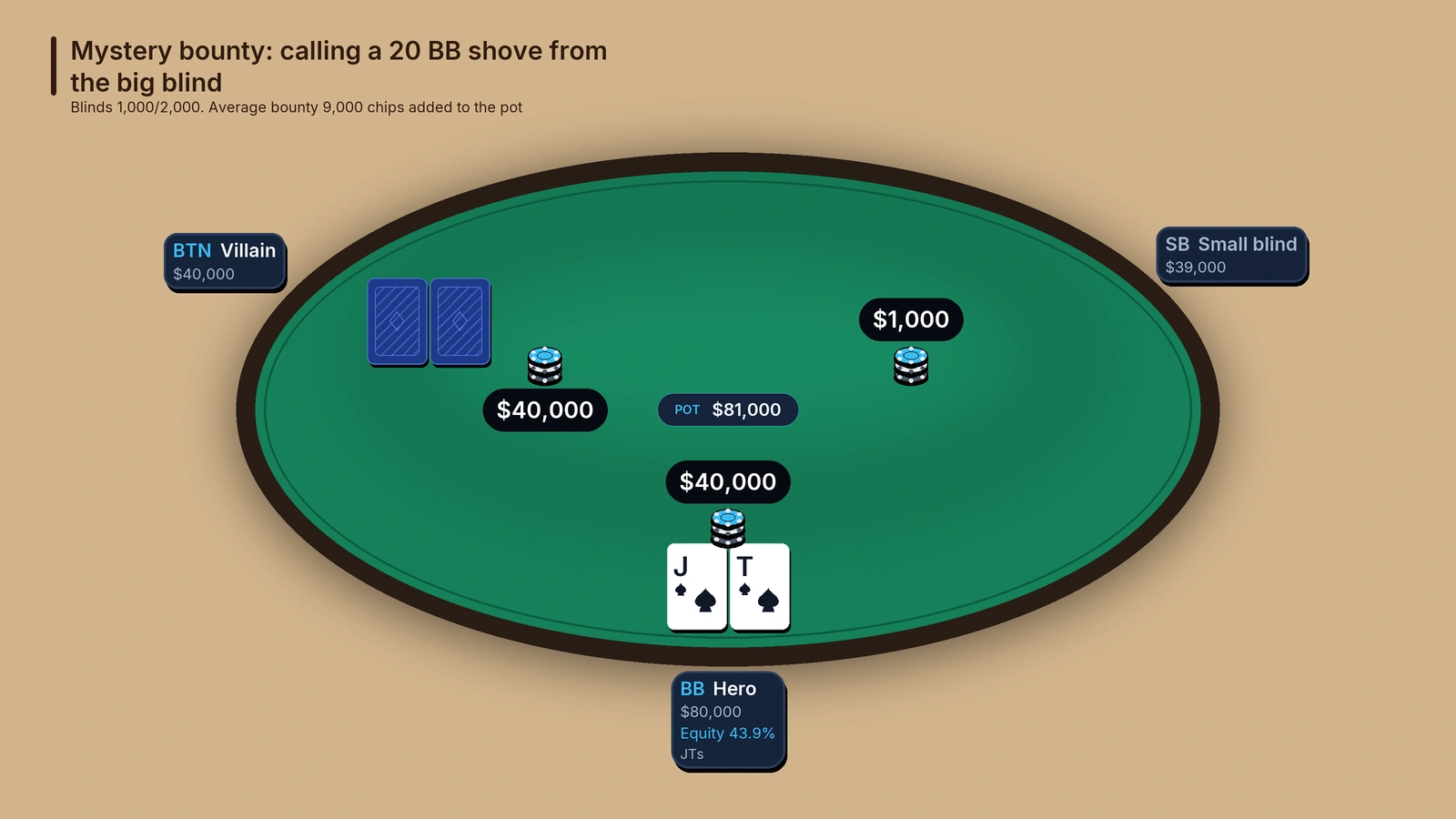
You hold J♠ T♠. The small blind has 1,000 in and the button’s shove is 40,000. You already posted the 2,000 big blind, so 43,000 sits in the middle before you act. Calling costs 38,000 more, which makes the pot 81,000. The pot holds 81,000 once your 38,000 is in, so the call needs 46.9% equity with no envelope in play.
Against a wide shoving range (every pair, A2s+, K7s+, Q8s+, J8s+, T8s+, plus A7o+, K9o+, Q9o+, J9o+ and T9o), your J♠ T♠ wins 43.9% of the time. In a freezeout that is a small losing call.
Now add the envelope. Say the average bounty is worth 9,000 chips, and you collect it the moment your hand wins. It joins the 43,000 already in the middle, so 52,000 sits there before you call. Your 38,000 then takes the pot to 90,000. You risk 38,000 to win 90,000, so the call needs 42.2% equity. Your 43.9% clears that bar, which turns the hand into a profitable call. A tighter button shove would drop your equity below the bar, and a wider one would lift it.
Later in the phase the same spot pays less. Suppose 70 envelopes are gone and only $15,000 of the pool is left. The average is now $500, which converts to 5,000 chips, so 48,000 sits in the middle before you call. Your 38,000 takes that to 86,000, and the call needs 44.2%. Your 43.9% misses by a hair and the hand goes back to a fold.
Same hand, same shove, same stacks. The call gets worse as the envelope pool thins out behind you. The size of the shift tracks the bounty’s share of the pot. A 9,000-chip bounty against an 81,000 pot moves the bar by under five points. The Upswing spot above moves it by thirteen because the bounty there is worth several stacks.
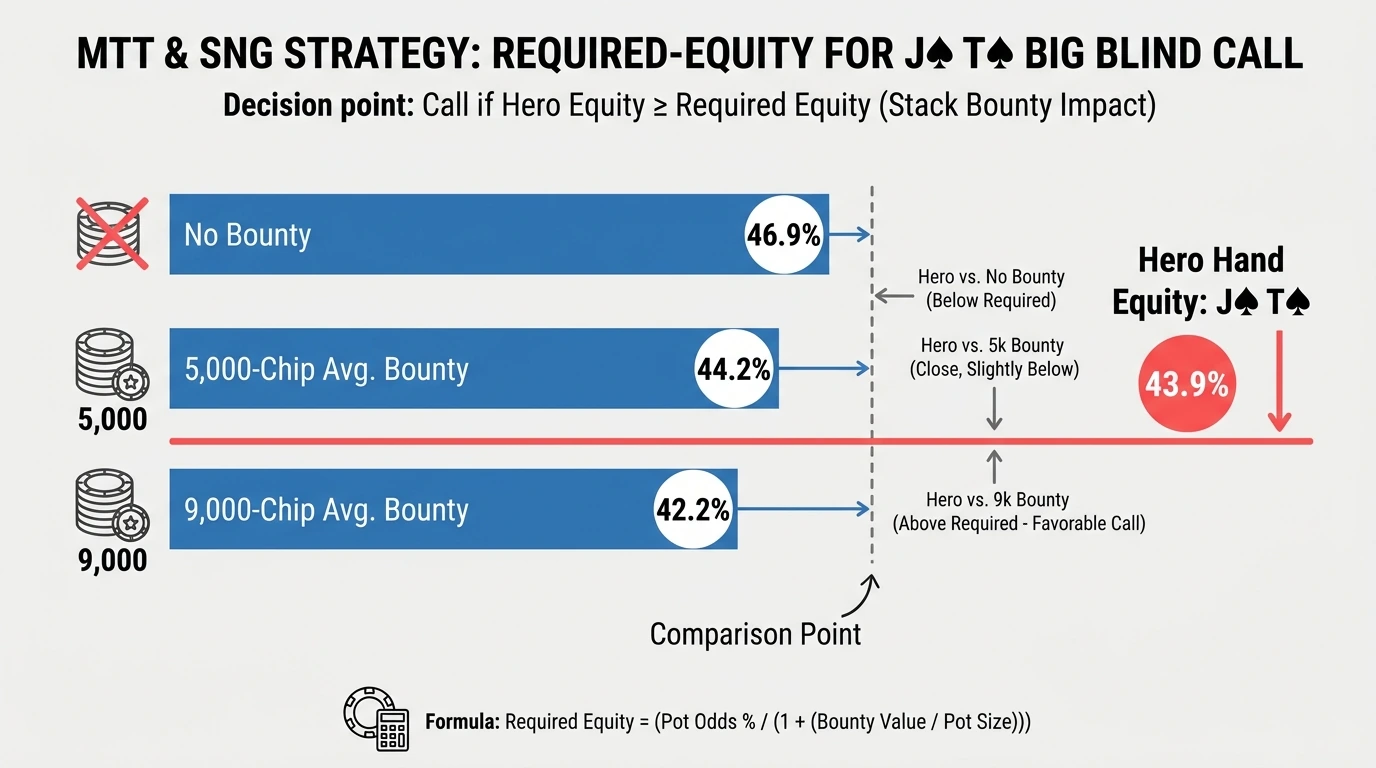
Two things follow from this. A call this close lives and dies on your read of the shoving range, so a tighter shove makes it a clear fold. And the biggest edges sit early in the bounty phase, while the pool is deep and the average is high.
This example prices chips only. On the money bubble you need more equity than the chip math says, so the envelope has to cover that gap too.
Stack dynamics: covering decides who gets paid
You must cover a player to win their bounty, so take a few extra risks to build a covering stack, or pass up small edges late in the freezeout phase to protect a chip lead you already hold.
Hunting short stacks is the practical version of that rule. A short stack will shove a wide range, and once you cover them the average bounty lands in the pot. While the average sits near 9,000 chips, you can call with hands you’d fold in a freezeout. Call with the wide range they shove. Those chips turn a close call into a good one, and they don’t rescue a hand that was never ahead of that range.
The other side of covering matters just as much. When a bigger stack shoves over you, you can’t win their envelope, so their bounty adds nothing to your pot. Price that call like a freezeout call, before you talk yourself into a hero call for a prize you can’t collect.
Five leaks from no-limit hold’em tournaments
1. Playing the freezeout phase like a bounty event. No envelope exists yet, so no extra money sits in the pot. Chasing a prize that isn’t there costs chips.
2. Playing the bounty phase like a freezeout. Once envelopes are live, your required equity falls by several points. Folding every marginal hand leaves money on the table.
3. Pricing the jackpot. One huge envelope moves your expected bounty value by only a small amount. The average bounty is the number you should keep track of.
4. Ignoring the money jump. Bounties lower required equity, and the pay jump still matters. Both numbers go into a bubble call.
5. Using an average from hours ago. The pool shrinks all day, so a chip value of the average bounty you calculated at the start of the event, will be outdated by the time you use it.
Frequently asked questions
How do you calculate a bounty’s value in chips? Two divisions and a multiplication. Split the money still in the pool across the players still in to get the dollar figure. Multiply that by your starting stack, then divide by the buy-in. Same $900 figure, $1,000 buy-in, 10,000 starting chips: 9,000 chips.
What is the difference between progressive knockout and standard knockout poker? In a standard knockout, a knockout is worth a set amount of cash and that amount never moves, so your own stack carries no prize on it. Progressive knockouts change both ends. You bank half immediately, and the other half attaches to your head so that whoever eliminates you inherits it. The longer you last and the more you knock out, the bigger the target you become.
How does a mystery bounty differ from a progressive knockout? Once the bounty phase starts, every knockout pays something, but the size stays hidden until you’ve won the hand and opened the envelope. Before the milestone, no envelope is in play. Nothing transfers onto your own stack. The switch flicking on is also late, at the start of Day 2 live or around the money bubble online, which leaves plenty of freezeout poker before any prize money touches the pot.
When do bounties start in a mystery bounty tournament? Live, the usual trigger is the start of Day 2. Online, watch the field count: PokerCoaching puts the switch at roughly 15 to 20% of the field remaining. Until then nothing extra sits in the pot.
Should you call wider when a mystery bounty is in play? When the average bounty is large, yes. Take that dollar figure, convert it to chips, and rebuild the required equity with it included in the pot. The pot size barely changes when the average is small, so the fold often stands.
How much is a mystery bounty envelope worth? Most are worth about the buy-in. A smaller share pays three to fifty times the buy-in, and a tiny share pays far more. The exact tiers depend on the event and its buy-in level.
Do I know as a player when jackpot envelopes get opened? You only see your own draw. The amount is revealed to whoever opens the envelope, and operators do not publish each individual prize, so a big one leaving the pool usually shows up as a drop in the shared average rather than as an announcement. Live events generally let the winner choose when to collect, and the timing does not change the odds. If your event shows the remaining bounty pool, divide it by the envelopes left at every break to watch the average.
When do jackpot envelopes usually get opened and how does it affect the rest of the tournament? Because very few envelopes hold a jackpot and most hold average or low prizes, the jackpots surface early in the knockout phase, when the most knockouts happen. Each one that leaves the pool pulls the remaining average down, so take notice when the phase opens.
Before your next mystery bounty event, work out the average bounty in dollars and in chips, then update both at every break. For the version with known bounties, the progressive knockout strategy pillar covers the ranges in detail. The ICM pillar handles the bubble math that still applies once the envelopes are live.

Written by
Jake Rivera
Founder and No-Limit Hold'em writer
Jake Rivera founded Rivera Poker and writes about No-Limit Hold'em: preflop ranges, ICM and bubble decisions, and the postflop lines that separate tournament play from cash games. He also follows the major series and reports on results, schedules and new formats.