ICM Final Table Strategy: How the Payout Ladder Turns a Call Into a Fold
ICM final table strategy in dollars: the same call needs 45.3% in chips and 50.4% in prize money, and the gap turns 5♣5♦ into a fold.
Six players are left. Blinds are 25,000/50,000 with a 50,000 big blind ante. The shortest stack jams 600,000 from under the gun, and you look down at 5♣5♦ in the cutoff with 25 big blinds.
A chip count says call. The prize money says fold. Both answers come from the same hand, and that split is what ICM final table strategy is about: the payout ladder reprices the call before you touch your chips.
ICM final table strategy: one call, two prices
The chips say the call is cheap. You put in 600,000 to win 725,000, so you need 45.3% equity to break even. That is 600,000 divided by the 1,325,000 the pot holds after your call.
The ladder says it is not cheap. Count the dollars and the same call needs 50.4% equity. The gap is 5.1 points, and that gap is the price of playing for money instead of chips.
Here is the table at the moment of the decision, from under the gun around to the big blind: 600,000, 1,200,000, 1,250,000 (the hero, in the cutoff), 1,300,000, 725,000 and 800,000. Those are the stacks after the blinds and the ante are posted, and the short stack’s 600,000 is 12 big blinds.
Six paid places remain. The ladder pays $8,800, $5,500, $3,630, $2,530, $1,870 and $1,430, so there is $23,760 left to win. It is a sample ladder for a mid-stakes event rather than one room’s payout table, and the shape of it drives every figure below.
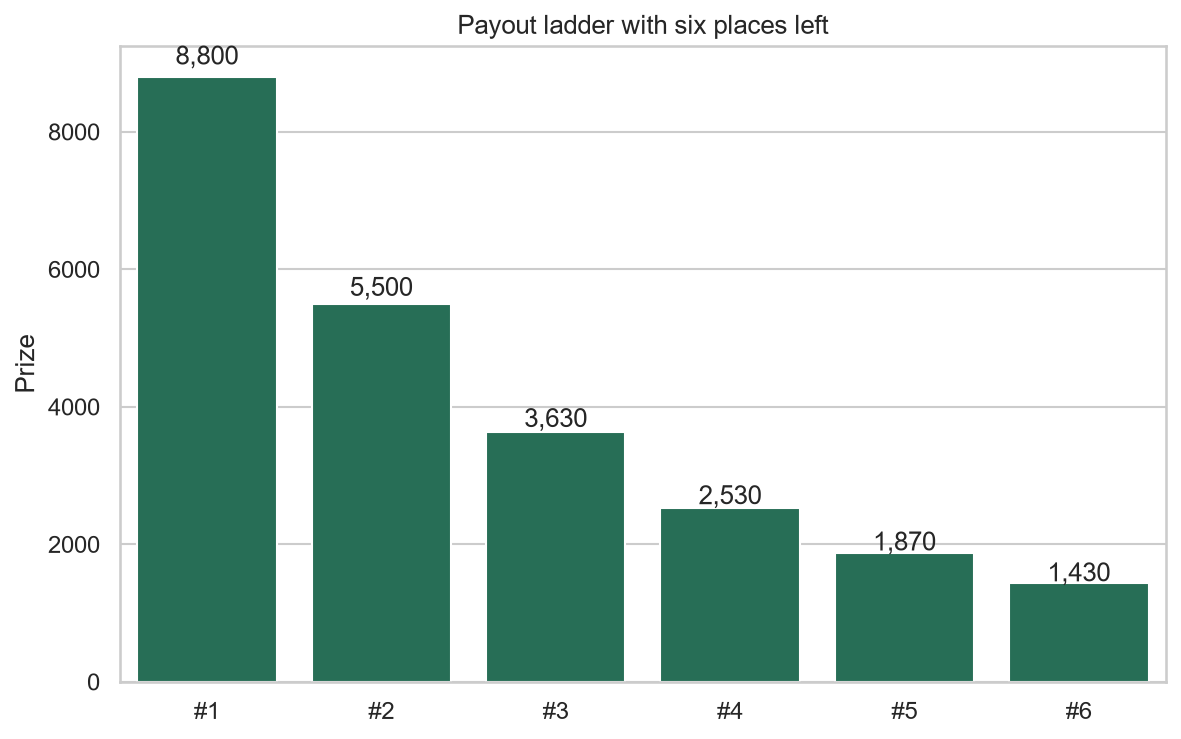
What are those stacks worth before a card comes? $3,183.20, $4,402.98, $4,486.26, $4,567.32, $3,477.66 and $3,642.58. The hero holds 21.28% of the chips in play and 18.88% of the money.
Now the hand. Dead money in the middle totals 125,000: the small blind’s 25,000, the big blind’s 50,000, and the 50,000 big blind ante that the big blind also posts. The under-the-gun player jams his whole 600,000. It folds to the hero, who calls 600,000, and the pot ends at 1,325,000.
The three outcomes in dollars
Fold and the hero keeps $4,433.51. Call and win and his stack is worth $5,577.46. Call and lose and he drops to $3,270.07.
A win adds $1,143.95. A loss takes away $1,163.44. The losing side is the larger one, and that is the decision in two numbers.
Divide the loss by the sum of both to get the price. 1,163.44 divided by 2,307.39 is 50.4%. Below that equity the call costs money. Above it the call makes money.
The fold is the baseline. Folding leaves the hero on $4,433.51, and every dollar figure above is measured against that number.
In chips he risks 600,000 to win 725,000. In dollars he risks $1,163.44 to win $1,143.95. The reward starts bigger than the risk and ends smaller than it, and that inversion is the price of the ladder. You can see it without a calculator.
Those dollar figures come from ICM, a model that assumes equal skill, so the stacks alone set each player’s chance of finishing in each place (Wikipedia). Change the assumption and the numbers move. The direction does not.
Which hands flip against the same shove
Aces do not become folds. The bottom of the range does, and a few hands in the middle turn into close calls.
Here is the jam range in standard shorthand, where “s” means suited and ”+” means that hand and everything better: 22+, A2s+, K8s+, Q9s+, J9s+, suited connectors from 98s down to 54s, and A9o+, KTo+, QTo+, JTo. The last two columns price each hand against the two lines above, 45.3% in chips and 50.4% in dollars.
| Hand | Equity against the shove | In chips (45.3%) | In dollars (50.4%) |
|---|---|---|---|
| Q♠Q♥ | 72.0% | Call | Call |
| A♠K♠ | 62.6% | Call | Call |
| 9♠9♦ | 58.4% | Call | Call |
| A♣J♣ | 57.3% | Call | Call |
| 8♣8♦ | 55.6% | Call | Call |
| 7♠7♦ | 53.3% | Call | Call |
| A♠T♦ | 52.3% | Call | Call |
| K♥Q♥ | 52.0% | Call | Call |
| 6♠6♦ | 50.9% | Call | Call |
| A♦9♦ | 50.6% | Call | Call |
| 5♣5♦ | 48.9% | Call | Fold |
| A♣5♣ | 47.1% | Call | Fold |
| K♣J♦ | 46.9% | Call | Fold |
| Q♣J♣ | 46.3% | Call | Fold |
The top of the table is easy. Q♠Q♥ wins 72.0% of the time, and a call clears both lines by a wide margin.
6♠6♦ is the last hand that clears the dollar line comfortably, at 50.9%. A♦9♦ clears it at 50.6%, by less than a quarter of a point, so it is a call that almost pays for itself.
Then look at 5♣5♦. The chip price is 45.3%, and 48.9% beats it by 3.6 points. The dollar price is 50.4%, and the same hand misses it by 1.5 points.
Every hand that lands between 45.3% and 50.4% is a call in chips and a fold in dollars.
A♣5♣ at 47.1%, K♣J♦ at 46.9% and Q♣J♣ at 46.3% fill the rest of that band. It is narrow, and it is where most of your marginal spots live.
Why the ladder charges a tax
The pay jumps do the work. In this sample ladder, going from 6th to 5th pays $440 more. Then $660, $1,100, $1,870, and $3,300 for the last step up to first. The bottom two jumps are small. The top two are the size of a buy-in.
Chips you win are worth less than chips you lose, because each stack’s share of the money grows slower than its share of the chips. The hero starts with 21.28% of the chips and 18.88% of the money.
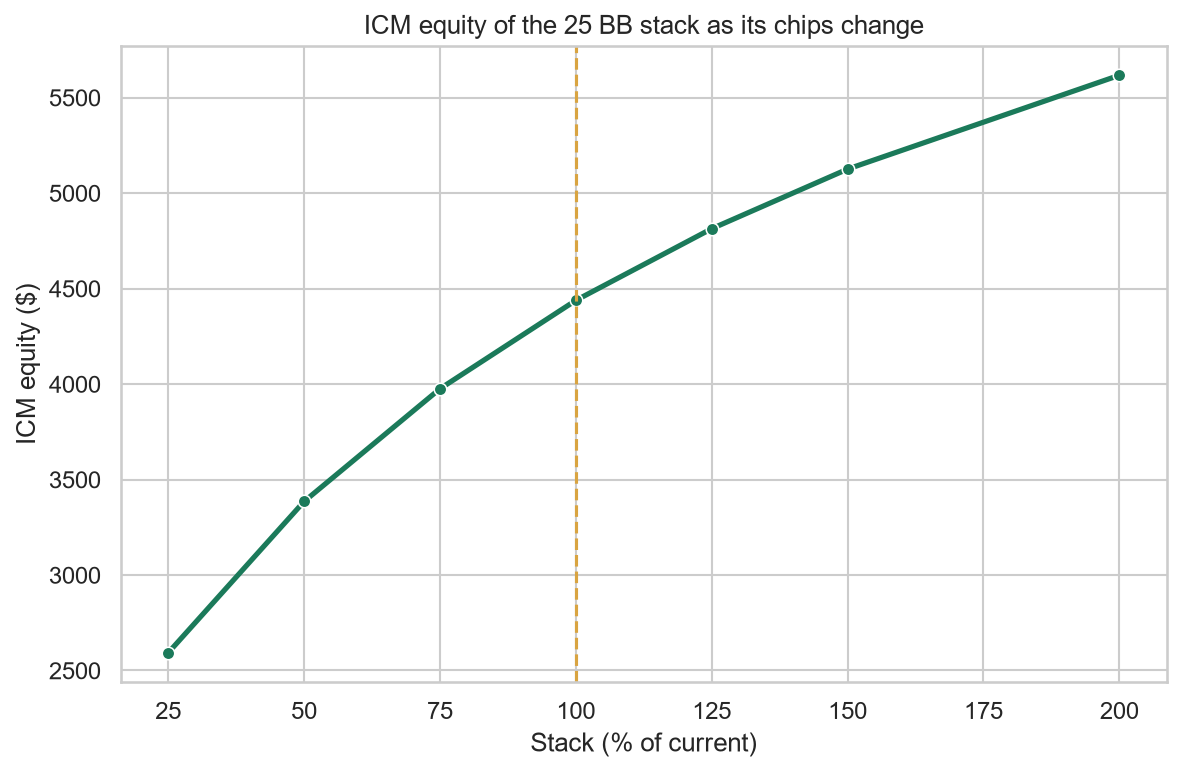
The curve bends. The same 25 big blinds cost more prize money on the way down than they pay on the way up. That gap is what the call has to overcome, and the bigger the gap, the tighter the call.
The bubble factor is the name for that ratio (Poker Skill). It compares what a chip costs you in prize money when you lose it with what a chip pays when you win it. GTO Wizard’s explainer walks through how the number is built (GTO Wizard). Run the same model on this hand, transferring 600,000 chips, and the factor comes out at 1.21.
A factor above 1 means survival is worth more than chips. The price you need climbs with it, and the difference between that price and the chip price is the risk premium. Here it is 5.1 points. It is largest on the bubble, where the shortest stack sits one place from its next pay jump.
Stack sizes change the size of the tax
The most expensive call at a final table belongs to the medium stack facing a covering shove. The hero in this hand covers the shover, so his price is the cheaper version of the same decision.
A big stack busts and loses its shot at first, but it still has chips and the ladder still has top prizes above it. A medium stack busts and lands on a small payout after hours of work, while the short stacks move up a place for free. That is why the middle of the field pays the highest price and why big stacks lean on it.
The short stack has the opposite job. Its risk premium is small, and folding into the next pay jump hands its blinds to the field. Shoving wide costs less than waiting, which is why the 12 BB jam in this hand is fine even though it is called by a stack that covers it.
How wide you call depends on how wide they shove. The wider the shover’s range, the more of your own range clears the dollar line. Against this jam, sixes are the last call and fives are the first fold. Change the range and both hands move.
Stage matters as much as the stack. Early in an event the factor sits near 1 and chip EV runs the table. ICM takes over near the bubble and at the final table, and the payout structure changes the jumps. That is why SNG versus MTT adjustments deserve their own pass, and why turbo formats need different push and fold rules in hyper-turbo bubble play.
When ICM overstates the risk
Progressive knockout bounties add money the ladder does not count, so the price falls below the chip price.
A bounty you can win is equity outside the payout structure. Once a knockout is worth collecting, calling wider than the ICM price is often right, and the progressive knockout bubble math walks through the same conversion with the bounty included.
Satellites and flat payouts push from the other side. When every paying place is worth about the same, moving up one rung beats a double-up, so folding aces can be correct. Double or Nothing sit and goes are the pure case, and the Double or Nothing bubble guide covers the calling rules. Seat-only satellites follow the same logic, with their own quirks in satellite tournament strategy.
Winner-take-all events sit at a factor of 1, since there is only one prize to chase. Heads-up play removes the effect too. With one opponent left, chips are worth their face value and chip EV rules again.
Frequently asked questions
What is ICM in poker, and what does it do at a final table? Each stack gets a dollar value, calculated from the payout ladder and the chip counts. At a final table you price a call in prize money instead of chips. In the hand above, that meant 45.3% in chips and 50.4% in dollars.
Why fold a hand that is ahead at a final table? Because losing chips costs more prize equity than winning the same chips gains. Here a hit added $1,143.95 and a miss took away $1,163.44. When the pot price is close to even, that small gap is enough to turn a thin call into a fold.
How much does a pay jump change a call? It depends on the size of the jump and the stack you hold. In the sample ladder above the top jump is $3,300, and it pushes the required equity 5.1 points above the chip price.
Does ICM apply heads-up? No. With one opponent left there is no elimination risk to price, so chips are worth their face value and the premium drops to zero.
Which stack plays the widest range at a final table? The short stack, on both sides of the decision. It should shove wide because folding into the next pay jump gives away its blinds, and it should call off wide because it has little prize money left to protect.
When should I ignore the ICM price? In progressive knockouts when a bounty is in play, in satellites and flat-payout events, in winner-take-all formats, and once you are heads-up. Each of those changes what a win is worth.
What to do at your next final table
A player can do this before the first hand: note each pay jump, convert the stacks into dollars, and price a shove against both lines. Pot odds give one of those prices. The ladder gives the other.
The chip price is the starting point. The dollar price is what the call costs.
For the model itself, the chip EV versus ICM comparison covers the basics, and the pay jumps on your own tournament’s ladder set the rest.

Written by
Jake Rivera
Founder and No-Limit Hold'em writer
Jake Rivera founded Rivera Poker and writes about No-Limit Hold'em: preflop ranges, ICM and bubble decisions, and the postflop lines that separate tournament play from cash games. He also follows the major series and reports on results, schedules and new formats.