Hyper Turbo Sit and Go Bubble Strategy: When the Price Is Wrong
Hyper turbo sit and go bubble strategy: the stacks are short, the payout ladder adds a surcharge to every call, and the chart price is only half the story.
Six players left, five get paid, and the blinds go up again in four minutes. A 9bb stack shoves from under the gun. You look down at A♠9♠ in the cutoff with 13bb behind, so you cover him by 1,600 chips.
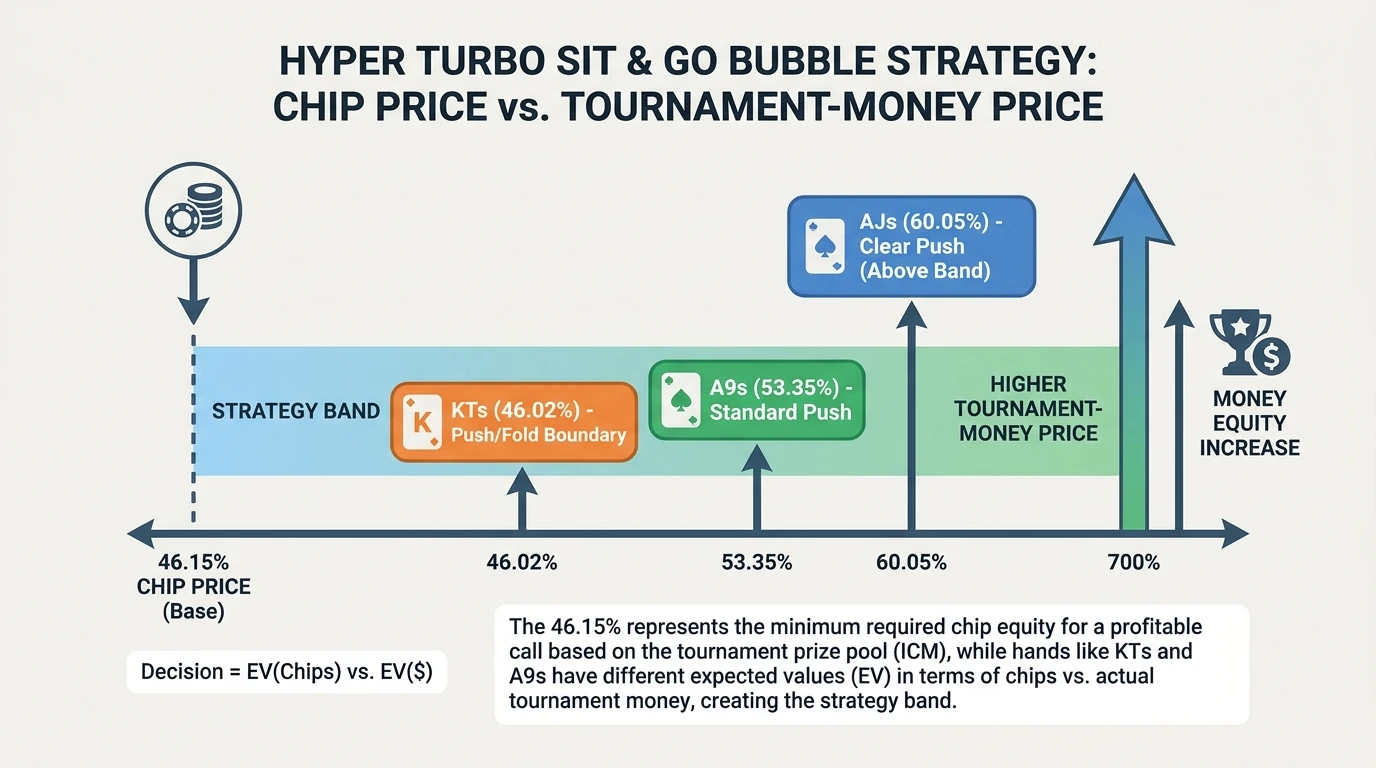
On chips, the call needs 46.15 percent: you put in 3,600 for a final pot of 7,800. Your hand wins 53.35 percent against his range, so the chips say call. The payout ladder says something else, and that gap between the chip price and the money price is what hyper turbo sit and go bubble strategy is really about.
Hyper turbo sit and go bubble strategy starts around 12bb
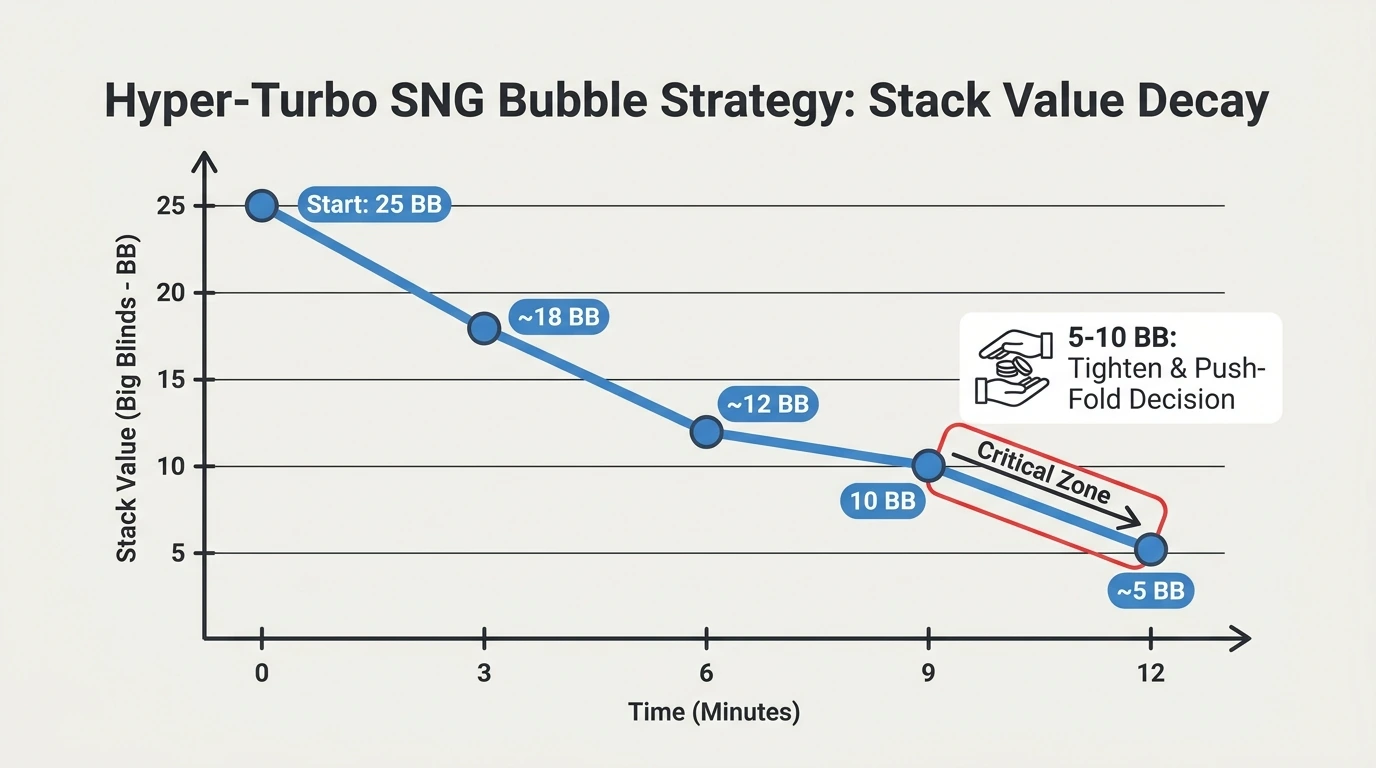
A hyper-turbo wrecks the stack before the bubble shows up. Heads-up hyper SNGs on PokerStars start with 500 chips, which is 25 big blinds, and raise the blinds every two minutes (Upswing Poker). Six minutes in, that starting stack is worth 10bb. Twelve minutes in, it is worth 5bb.
Blinds in these events can quadruple by Level 5. PokerNews notes that at the ten-minute mark almost everyone except the chip leader sits under 10bb, and some levels only see two or three hands (PokerNews).
So you arrive at the bubble short. Average stacks in single-table SNGs run from 5bb to 20bb at that point, and 12bb is the common figure (PokerProfessor).
Compare that with a sit and go push fold chart. PokerCoaching’s 15bb no-ante chart shoves 6.8 percent from under the gun and 45.7 percent from the small blind (PokerCoaching). Those charts assume 15bb, and on the bubble of a hyper you usually hold 12. The blinds climb again before the good hands arrive.
Antes add dead money to the middle too. They usually arrive after the first few levels, so the earliest chart rows have no ante in them. In a two-minute structure, “a few levels” is six minutes of real time.
A sample setup: six players, five paid
Here is the spot. Blinds are 200/400, the pool is $100, and five places pay $37, $27, $18, $10 and $8. This six-handed, five-paid ladder is an example I put together for the arithmetic. That is 28,800 chips in play and a 12bb average.
| Seat | Chips | Big blinds | ICM value |
|---|---|---|---|
| Under the gun | 3,600 | 9 | $14.73 |
| Hijack | 2,400 | 6 | $11.00 |
| Cutoff (you) | 5,200 | 13 | $18.34 |
| Button | 4,400 | 11 | $16.68 |
| Small blind | 3,600 | 9 | $14.73 |
| Big blind | 9,600 | 24 | $24.53 |
Those dollar figures are what each stack is worth right now, given the ladder and the chip counts. GTO Wizard walks the same haircut through its ICM examples (GTO Wizard). One published calculation lands a 7,500-chip leader in a 15,000-chip game at $38.39 against a $50 first prize (TournamentTerminator). They matter once the bubble is on, because chips turn into money at a bad rate for everyone at the table.
Look at the step from 5th to 4th. It pays $10 against $8, so the jump is 1.25 times. Recorded five-paid ladders on bigger fields land between 1.25 and 1.5 times on that step (PokerStrategy.com).
A small step still does damage. Your 5,200 chips are worth $18.34. The hijack’s 2,400 chips are worth $11.00, so you hold more than twice his chips and only 1.67 times his money.
The hand: A9s in the cutoff facing a 9bb shove
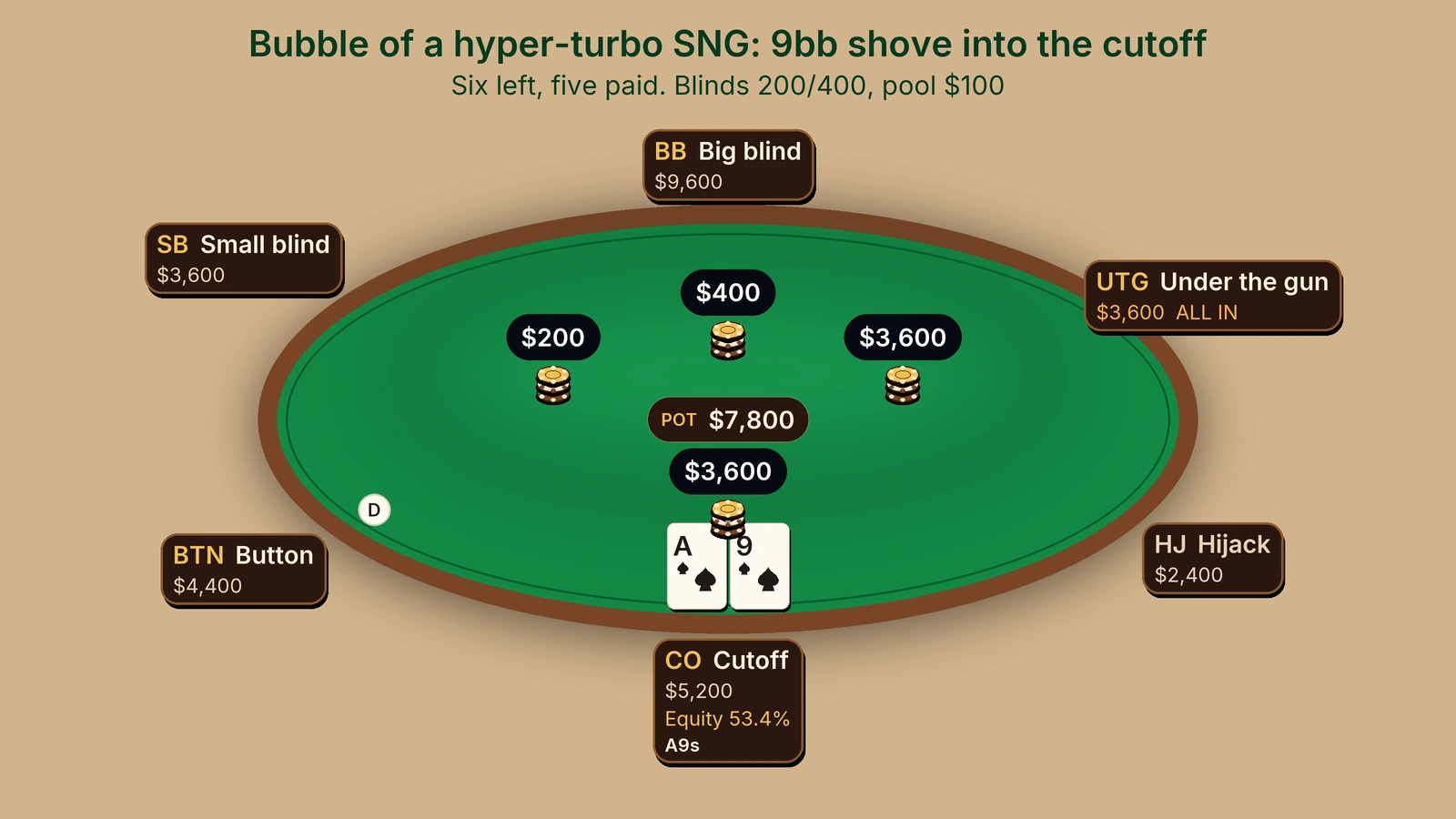
Under the gun has 9bb and 3,600 chips. He shoves. The hijack folds and the action reaches you with A♠9♠ and 5,200 behind. You cover him by 1,600 chips.
The pot is 600 before the shove: small blind 200, big blind 400. His 3,600 and your 3,600 take it to 7,800. You need 3,600 of that 7,800 to break even on chips, which is 46.15 percent.
Against a 9bb shoving range of 22+, A2s+, K8s+, Q9s+, J9s+, T9s, A2o+, KTo+, QTo+ and JTo, A9s holds 53.35 percent. On chips that is a clear call, since 53.35 beats 46.15 by more than seven points.
Then the ladder takes its cut. ICM turns chips into dollars, and a dollar you win is worth less than a dollar you lose when you have a stack to protect. So the call needs more than the 46.15 percent the pot asks for, and the extra amount is the risk premium. Against this shove on this ladder, an ICM calculator puts your break-even at 57.79 percent, which is 11.64 points above the chip price.
When the premium pushes the price past 53.35 percent, the call costs money and the fold keeps it. A fold costs you nothing beyond the blinds you already posted.
The range that clears the bar is narrow. The hijack looks down at K♠T♠, which makes 46.02 percent against the same shove, so it folds. A♠J♠ makes 60.05 percent, so a seat holding it calls.
From his side, the shove puts the last of his fold equity to work instead of paying another round of blinds. At 9bb the alternative is handing over chips every orbit until the stack is gone.
How big the risk premium gets
The risk premium is the extra equity you need on top of pot odds before a call makes money in dollars. GTO Wizard lays out the rule: a call that a chip count prices at 37.5 percent can need about 47 percent once prize money enters the picture (GTO Wizard). Think of it as a bubble surcharge the ladder adds to the chip price. The chips ask 46.15 percent. The ladder asks for more, and how much more depends on what the call does to your stack.
Here is that surcharge on this table. Your cutoff covers the 9bb shove, needs 57.79 percent, and holds only 53.35 percent, so the calculator says fold. The big blind with 9,600 chips calling that same shove needs 52.37 percent, which is 6.22 points above the chip price. Chips that cover a rival’s stack cost less to risk than chips that fight for survival every orbit.
Put it in plain dollars. Fold, and the cutoff keeps a 13bb stack that sits close to locking up 4th or better and still has a live shot at the $27 and $37 rungs.
Call and lose, and 3,600 chips leave the stack: 1,600 left and 4bb. You are last, the blinds hit you in two hands, and the stack turns into a fight for the $8.
Call and win, and you double through with one player gone. That side is real, but the ladder above you is short and the drop below you is long.
The size of the payout step matters less than the floor underneath it. A 1.25 times jump between 5th and 4th is a small step, and a lost call takes you from a stack that contests 4th to one that fights for 5th.
The same hand is a call for the chip leader
Same shove, same hand, same price. A9s in the big blind, holding 9,600 chips, needs 52.37 percent, so the calculator calls it. The risk premium there is 6.22 points, and the gain is nine cents.
The big blind holds four times the hijack’s chips and 2.23 times the hijack’s dollars. Divide it out, and each of his chips is worth less than the hijack’s first chip, because every extra chip buys a smaller slice of prize money.
Your covering cutoff pays the biggest surcharge of all, at 11.64 points, while the 9,600-chip big blind pays 6.22. The ladder taxes whoever has something to protect.
That is why the chip leader’s shoving range is wider than any chart prints. As the big stack, you can push far more hands than a push fold chart shows (Pokercode).
A nine-cent call is still thin. A chip leader can pass the true coin flips and keep the fold equity, because a shove that takes the pot down never touches the ladder.
Which seat is squeezed hardest
The squeeze is not simply a function of stack size. The players with real equity to protect sit in the middle of the counts, and the chip leader pays the least. What the shortest stack has already lost is the ability to wait.
Poker Skill says the same thing in different words: calling ranges tighten hard on the money bubble, medium stacks feel the most constraint, and the chip leader can shove wider than the chart (Poker Skill).
Apply that to the six stacks. You at 13bb are the most constrained player at the table, the button at 11bb comes next, and the 24bb big blind pays the smallest premium of anyone because a fold costs him the least.
So the instinct to protect the mid stack with tight folds runs the wrong way. Fold the 13bb stack down to 8bb and you have given up the fold equity that made shoving profitable, while the premium you were avoiding grows as the stack shrinks.
SNG vs MTT on a fast clock
The SNG vs MTT strategy question turns on time and on how many orbits the bubble lasts. In an MTT the bubble runs for orbits. You can fold 20 hands and stay alive, and the final table bubble can stretch across a long level, which is why poker final table bubble strategy leans on patience and stack watching.
A hyper SNG gives you none of that room. Blinds move every two minutes, and some levels last two or three hands (PokerNews). Waiting becomes a decision with a price tag: folding a 20bb stack down to 8bb in search of a premium spends the fold equity that made the stack useful.
That reshapes the early levels too. In an MTT, the first levels are deep and cheap, so speculative hands pay off. In a hyper, the opening stage lasts a few hands, and the plan for a single table sit and go is push-or-fold from the first level.
The clock changes how many chances you get to take a spot, and in a hyper those chances are few. Every call still has to clear the chip price plus the surcharge for that seat. What you lose is the option to wait three orbits for a better one.
A working guide at 8bb, 12bb and 20bb
The stack in front of you sets your job. These three rows are example targets for the seat roles on the bubble of a hyper SNG, built from the stack sizes and the ladder above.
| Your stack | What the bubble asks of you | The error to avoid |
|---|---|---|
| 8bb | Shove a wide range from late seats. Your stack cannot wait, so take the spots that add chips. | Folding into the blinds until you hold 3bb and have no fold equity. |
| 12bb | Keep shoving first in, and fold the 50/50 calls. You are the most constrained stack at the table. | Calling off with A9s because the pot offered 46 percent. |
| 20bb+ | Shove wider than the chart prints and aim at the mid stacks. | Treating the big stack as licence to call off. |
At 8bb the math is on your side when you are first to act. A shove that wins the blinds adds real dollars, and a 3,600-chip stack loses a sixth of itself on every go through the blinds.
At 12bb you are in the seat this article is about. Shoving stays wide, because first-in aggression collects the blinds. Calling tightens, because the surcharge lands on whoever pays it, so the tight side of your game is the calling side.
At 20bb and up, you hold the cheapest chips at the table. The short stacks behind you are folding hands they would call with in a cash game, and that gap is where the profit in the format comes from.
The chip-EV charts miss most at these depths. A 15bb chart hands under the gun a 6.8 percent shoving range, which is roughly the top of the deck. A 9bb stack faces a different problem: the blinds cost him a sixth of his 3,600 chips on every go through them, so waiting has a price the chart does not show.
Frequently asked questions
How many big blinds do you start with in a sit and go?
Regular SNGs usually start around 50 to 60 big blinds. Hyper-turbo SNGs start far shorter, and heads-up hypers on PokerStars deal 500 chips, which is 25bb.
How many big blinds before you start shoving your stack?
The push-or-fold line sits near 25bb when you face a raise, and it drops lower when you are first to act. On a hyper bubble, most of the table is already past that line.
What is a bubble factor?
It is the multiplier that raises the equity you need for a call once prize money enters the picture. It compares what one more chip adds against what one lost chip costs, both valued with the Independent Chip Model. A factor near 1.0 means chips and dollars are close to level; the higher it goes, the more a call costs beyond its pot odds.
Does ICM still matter when stacks are tiny?
Yes. The premium shrinks as the stack grows, but it never disappears. A covering call at 53.35 percent still fails here once the ladder prices it, and the 9,600-chip big blind pays 6.22 points above the chip price.
What is a push-fold strategy?
It is shove-or-fold preflop play, used once stacks fall under roughly 25bb. In hyper turbos it covers almost the whole tournament.
Do the standard push fold charts work on a hyper bubble?
They get you close, then the payout ladder raises the number you need. The charts ignore the dollars sitting in your stack, and on a bubble with a 12bb average those dollars decide the call.
Convert the price before you call
A useful study habit is to run hands through an ICM calculator with the payouts you play. Load the ladder, then check a mid stack facing a 9bb shove with A9s, the same spot with AJs, and a coin flip from the big blind. Write down the dollar break-even for each one. In a hyper you get four minutes, and the number that decides the call is the ICM price for that ladder. The chip price is just the starting point.

Written by
Jake Rivera
Founder and No-Limit Hold'em writer
Jake Rivera founded Rivera Poker and writes about No-Limit Hold'em: preflop ranges, ICM and bubble decisions, and the postflop lines that separate tournament play from cash games. He also follows the major series and reports on results, schedules and new formats.