How Do PKO Bounties Work? PKO Bounty Math Made Simple
How do PKO bounties work? Half the head pays you cash, half lands on your own head. Plus chip-value math, bounty poker strategy and PKO vs standard knockout.
Half of a knocked-out player’s bounty goes into your account, and the other half lands on your own head. That’s the whole mechanic behind how PKO bounties work. Using a bounty in a real hand takes one division and one multiplication: convert the dollar figure into chips, then compare it with the pot.
How do PKO bounties work?
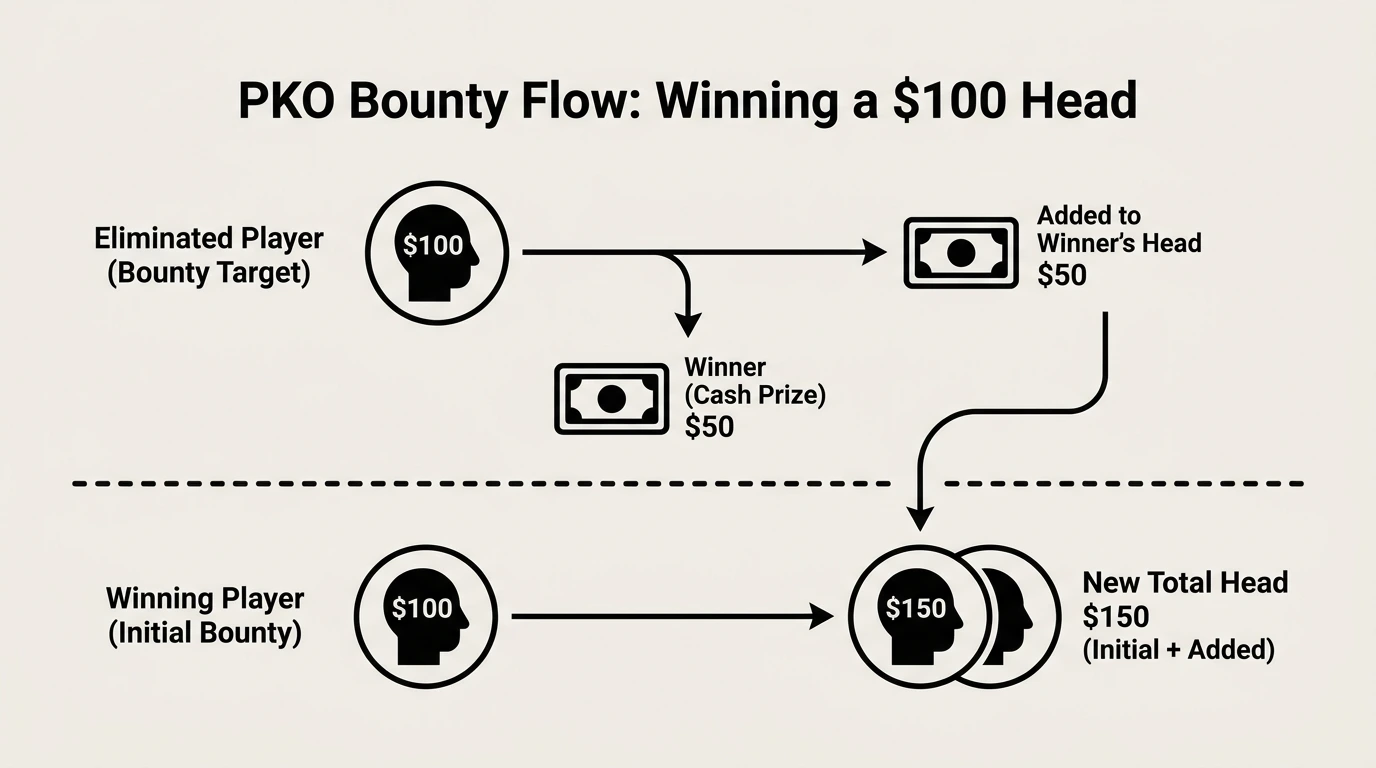
The bounty on a busted player’s head splits in two. You collect one half in cash. The other half is added to the bounty on your own head, so the next player who busts you collects more than you did.
PokerStars states the same rule on its tournament page: 50% of the bounty is progressive, so a knockout pays you half of the victim’s head and adds the other half to yours (PokerStars). The money comes out of the buy-in, never on top of it.
Under any bounty poker strategy, a good first step is to see how your site carves up the price. Here is an illustrative setup in a $200 progressive knockout with 1,000 runners and 10,000 starting chips:
| Hand | What happens | Cash you collect | Your head after |
|---|---|---|---|
| 1 | You bust a $100 head | $50 | $150 |
| 2 | You bust another $100 head | $50 | $200 |
| 3 | Someone busts you | $0 | gone |
You paid $200 and leave with $100 of bounty cash. That $100 came out of other players’ heads. The prize pool stayed untouched.
Your head is now a target. The player in hand 3 busted your $200 head and collected $100 in cash, and their own head grew by $100. The bigger your head gets, the wider the players behind you should call.
Payment timing varies by site: PokerStars credits the cash immediately, while 888poker issues bounty winnings once the tournament is completed (PokerStars Learn, 888poker).
What is the difference between a PKO, a standard knockout, and a non-bounty tournament?
A progressive knockout pays half the bounty in cash and moves the other half onto your own head, so the heads keep climbing all tournament. Standard knockouts keep each bounty fixed from the first hand. A non-bounty tournament puts no money on heads, so the prize pool pays every payout.
| Format | Where the buy-in goes | Does the head grow? | What you collect | Effect on your calling range |
|---|---|---|---|---|
| Progressive knockout (PKO) | Roughly half to the prize pool, half to bounties | Yes, every knockout adds half the victim’s head to yours | Half in cash, half onto your head, and only if you cover | Widens as the head on offer grows; the bigger the head, the wider you call |
| Standard knockout | A fixed slice to bounties, the rest to the prize pool | No | The full fixed bounty in cash | Widens by a set amount, and most of that value sits in the early levels |
| Non-bounty tournament | Everything to the prize pool | No head to collect | Nothing extra | Widens for chips and ICM only |
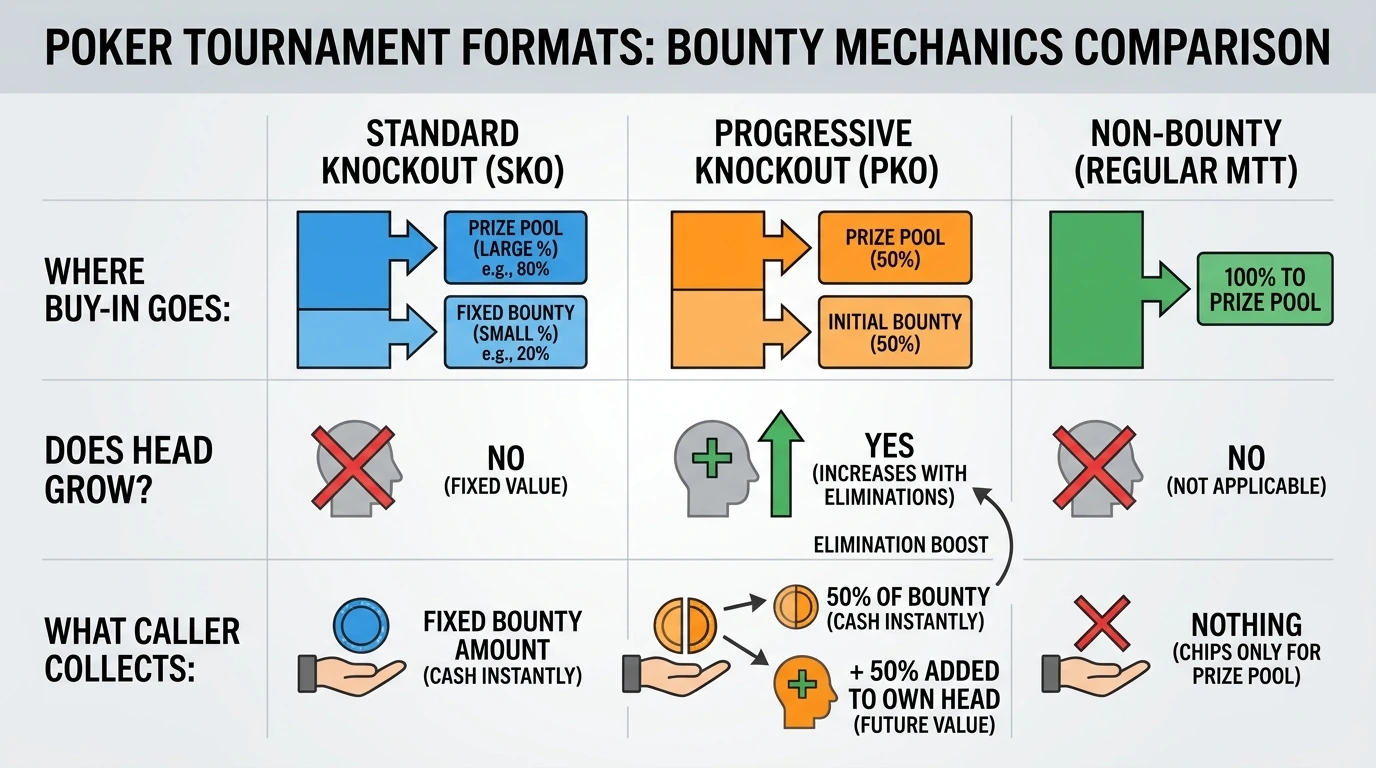
In chip terms the gap between the first two rows is large. A starting bounty in a standard knockout is worth about 750 chips from a 3,000 starting stack, while the starting bounty in a progressive knockout is worth a little over 1,500 (Upswing Poker). So half a stack in a progressive knockout against a quarter of one in a standard knockout.
The knockout payout structure has two taps: a prize pool paid by finishing position, and a bounty pool paid by eliminations. That second tap keeps moving money onto heads as the field shrinks. Some sites run two-thirds or even the whole pool to bounties (PokerStars Learn), so read the lobby split before you assume a 50/50 format.
How do you convert a bounty into chips (or big blinds)?
Divide the chips in play by the total money still in the two pools. That gives the chip value of one dollar of bounty. Multiply the head by that figure, then divide by the big blind.
The three steps:
- Add the money left in the prize pool to the money left in the bounty pool.
- Divide the chips in play by that total. The result is how many chips one dollar of bounty buys.
- Multiply that by the head, then divide by the big blind.
That conversion is the core of how to calculate bounty value in poker: chips in play divided by the money still on the table (GTO Wizard). GTO Wizard ran it on a 200-player field with 70% of players left. Chips in play were 7,018, the prize pool left was $16,836 plus $20,000 in bounties, and the factor came out at 0.191. A $50 head became 9.55bb, and the equity needed to call fell from 43.6% to 32.4%.
Here is the same arithmetic on the $200 setup, with every input shown. Pick a stage, take the money still in the two pools, and divide the chips in play by that total.
| Stage | Prize pool left | Bounty pool left | Chips in play | Chips per $1 | $100 head in chips | Big blind | A $100 head is worth |
|---|---|---|---|---|---|---|---|
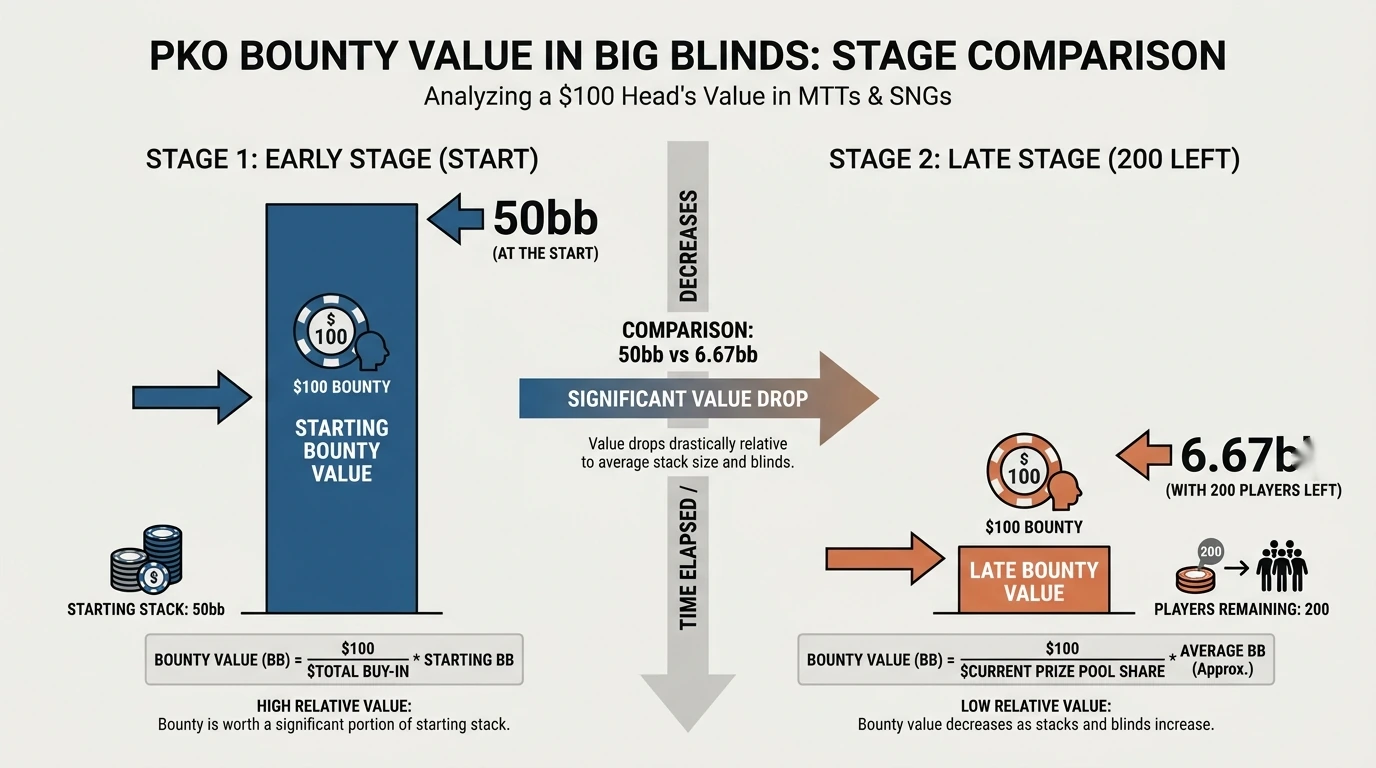
| Start, 1,000 left | $100,000 | $100,000 | 10,000,000 | 50 | 5,000 | 100 | 50bb |
| 200 left | $100,000 | $50,000 | 10,000,000 | 66.67 | 6,667 | 1,000 | 6.67bb |
The 200-left row assumes the bounty pool has fallen to $50,000 after 800 busts. The exact figure depends on how the heads cascade, but the conversion is the same once the pool is known. The setup is illustrative; the split and formula are GTO Wizard’s, and every input is shown so the arithmetic can be checked. The prize pool stays at $100,000 because both stages are before the money.
The same $100 head buys far fewer big blinds late than early, because the blinds climb faster than the head grows in chip terms. In other words, a bounty loses value relative to the big blind as the tournament goes on, even though average heads get bigger.
For calls, use the big-blind method. The big-blind figure fits straight into a pot-odds equation.
Does the bounty change your calling range in a PKO?
Yes, and you can size the change. The bounty widens your calling range whenever you cover an all-in. However, shorter stacks collect nothing extra, so with a short stack the optimal calling range doesn’t change.
An example:
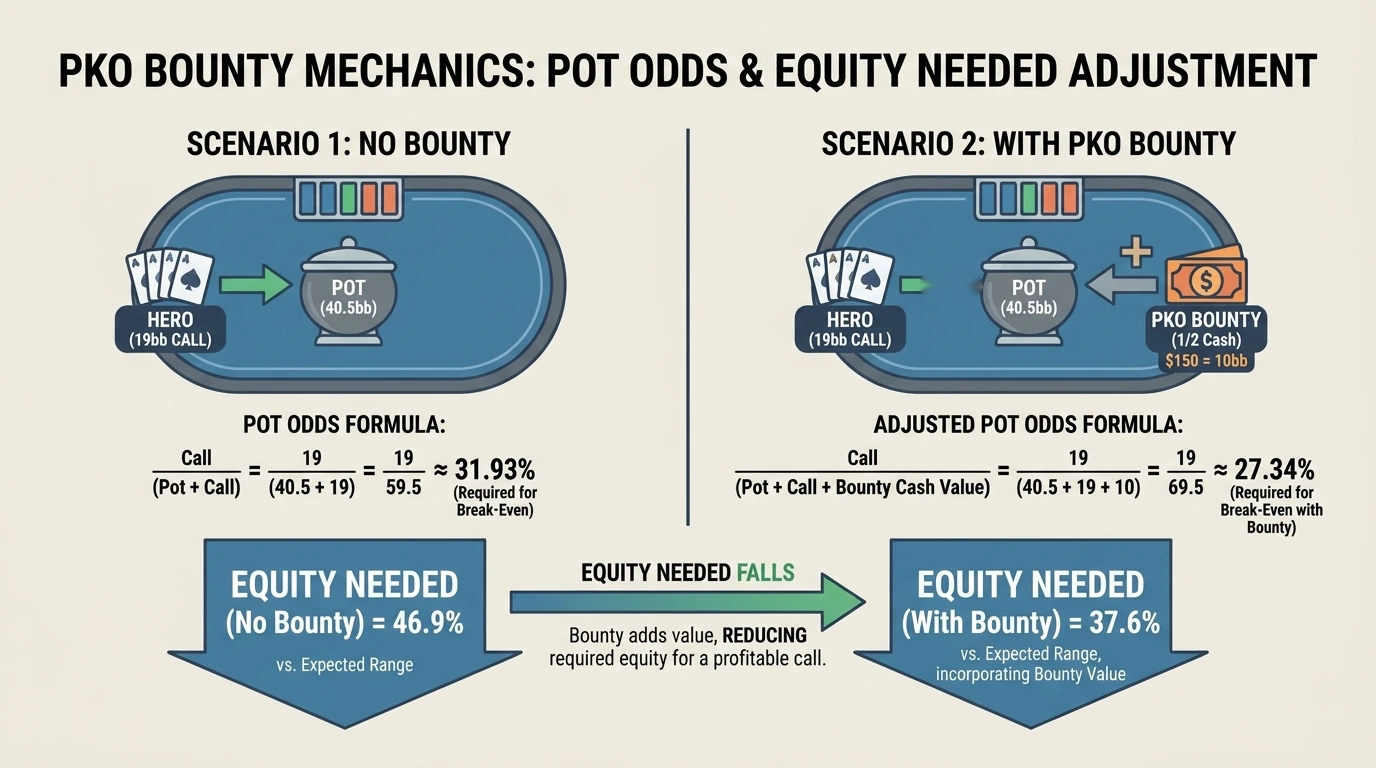
Blinds are 500/1,000 and 200 players are left. You hold A♠J♦ in the big blind with 60bb. The button shoves 20bb with a head that has grown to $300 on top. The small blind folds. Your big blind is already in the middle, so the pot before your call is 21.5bb: the button’s 20bb, the small blind’s 0.5bb and your 1bb blind. You have 19bb left to call. Short answer: fold, until the head enters the equation.
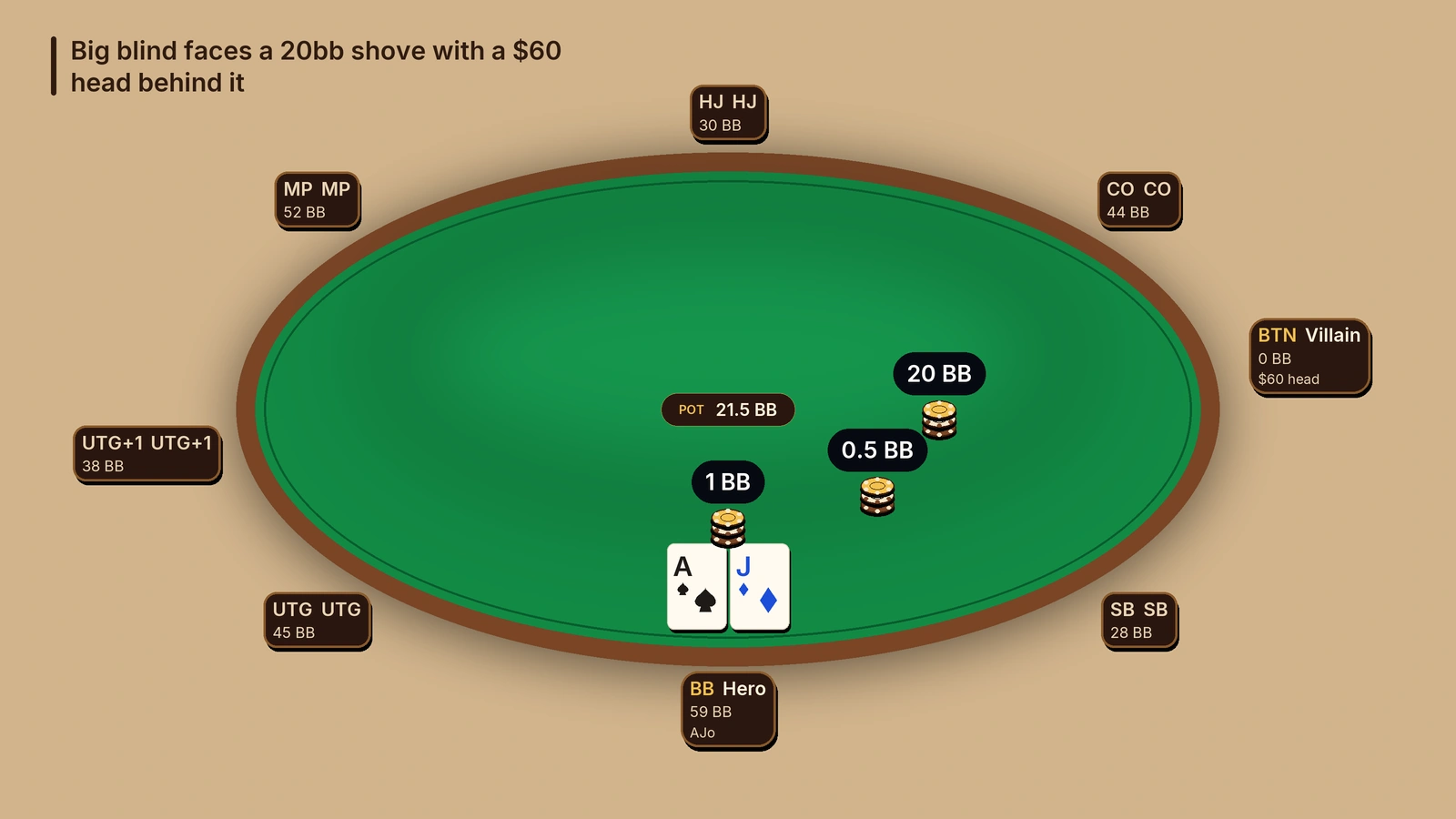
Without the bounty, the pot after your call is 21.5bb + 19bb = 40.5bb. You need 19 ÷ 40.5 = 46.9% equity. Against a tight 20bb shove range (66+, A9s+, A5s, KTs+, QJs, ATo+, KQo), A♠J♦ wins 45.94%. That is a fold by a hair.
Now add the head. At this stage the conversion gives 66.67 chips per dollar of bounty, and 66.67 × $300 = 20,000 chips, or 20bb at a 1,000 big blind. You can collect half of that, so the cash half is 10bb. Add the cash half to the pot before your call: 21.5bb + 19bb + 10bb = 50.5bb. You risk 19bb to win 50.5bb, so you need 19 ÷ 50.5 = 37.6% equity. A♠J♦ at 45.94% is now a clear call. The collectable half joins the pot; the half left on the shover’s head does not.
When to ignore the bounty entirely
Four cases where the head should not move your decision.
- You do not cover. No cover, no bounty. A short stack calling off against a bigger stack gets chips and a prize-pool share, nothing more.
- The pot is multiway. When two or more covering players win, the head is divided equally between them (888poker). Two callers means half the bounty for the same price.
- The head is small against the call. A $100 head converts to 6,667 chips, or 6.67bb. It still matters, but it cannot rescue a hand that is far behind the range.
- Your own head is the big one. The larger your head, the more the players covering you will call. Thin value bets and bluffs into covering stacks cost more than the bounty you were chasing.
How does bounty pressure change before the money, on the bubble, and at the final table?
Bounty pressure peaks in the middle of the tournament and fades at the final table. Early on, heads are worth a big chunk of a stack but stacks are deep. On the bubble the prize pool is still full while the bounty pool has shrunk. At the final table the prize jumps outgrow the heads.
Before the money
At the start the same $100 head was worth 50bb, a large share of a 100bb stack. Early stacks are deep, which keeps most pots small; the bounty decides close spots more often than it decides stack-offs. Run the conversion when you cover a short shover: when the cash half of the head converts to more chips than the call costs, the bounty alone can justify a call that chip odds reject. Avoid paying off covering stacks with medium hands, because your own growing head is the price they are chasing.
On the bubble
Chips per dollar of bounty are at their highest here. The prize pool has paid nothing yet while the bounty pool has been shrinking for hours, so every head on the table buys more chips than it did at the start.
In a regular tournament, you play extra careful to stay alive. But in a PKO, if the player shoving has a huge bounty, the cash reward is so massive that the gamble becomes completely worth it. You actually want to take the risk, allowing you to call with way weaker hands than normal (GTO Wizard). Covering stacks can call wider than ICM alone suggests on the bubble.
Short stacks face the opposite trade. They do not cover the shover and collect no bounty, so their calls stay tied to prize money and survival. Being short in a PKO leaves no extra reward to collect.
At the final table
Prize jumps get large and heads get small relative to stacks, so bounty-driven calls shrink. The exception is a covering stack facing a huge head, where the extra money on the table can still widen a call.
Fixed-bounty events behave differently here. Their bounties fade to nothing at the final table. Progressive heads, meanwhile, have been growing all day, so they stay a live part of the maths to the last few tables.
The same conversion works in both games. PKOs run in Hold’em and in Pot-Limit Omaha. The Omaha game uses four-card hands and a pot-limit betting cap, so the same conversion needs the Omaha pot size, but the bounty maths is unchanged. Definitions for each structure sit in the tournament formats hub, and the chip EV versus ICM explainer covers why a call that is right for chips can be wrong for dollars.
Frequently asked questions
How do PKO bounties work?
The elimination pays out in two halves. Winners get half the busted player’s head in cash and carry the other half on their own head. 888poker’s $11 example shows the split on a small scale: a $5 head pays $2.50 to the winner’s balance and lifts the winner’s own head from $5 to $7.50 (888poker).
Do you get the bounty if you don’t cover the opponent?
No. A knockout bounty is paid only to a winner who has the losing player covered. A short stack that wins a pot against a bigger stack gets the chips and the prize money, and the head stays in play.
Can you profit in a PKO without cashing?
Yes, in principle. Bounty cash is separate from the prize pool, and the prize pool pays out on finishing position regardless of who collected the bounties (888poker). A player who wins several heads and busts before the money can end up ahead.
How many big blinds should you call off for a bounty?
There is no single number, because the answer depends on the head, the pot and the stacks. Two methods are worth keeping. Card Player’s version cuts the required equity by about 5 percentage points per bounty, reaching 12 points with three bounties, so a spot that needs 40% normally needs 35% with one bounty on offer (Card Player). The chip conversion above gives a number tied to the pot. The conversion is the precise route when there is time; the 5% shortcut is the fast route when the clock is running down.
Does a bounty’s chip value change as the field shrinks?
Yes. Heads buy more chips as players bust, and they buy fewer big blinds as the blinds climb. In the illustrative table a $100 head was worth about 50bb at the start and about 6.67bb with 200 players left, even though plenty of money was still on heads.
Is a PKO the same as a knockout?
No. Standard knockouts keep every head at its original size from the first hand to the last. The knockout tournament payout structure differs under the progressive format: the winner banks half the head and carries the other half, so bounties keep growing and stay relevant deep.

Written by
Jake Rivera
Founder and No-Limit Hold'em writer
Jake Rivera founded Rivera Poker and writes about No-Limit Hold'em: preflop ranges, ICM and bubble decisions, and the postflop lines that separate tournament play from cash games. He also follows the major series and reports on results, schedules and new formats.