Double or Nothing Poker: How to Survive the Bubble and Cash
Double or nothing poker explained: how the flat payout works, why ace-jack folds on the bubble, the ICM numbers, shove ranges and the leaks that cost micro players.
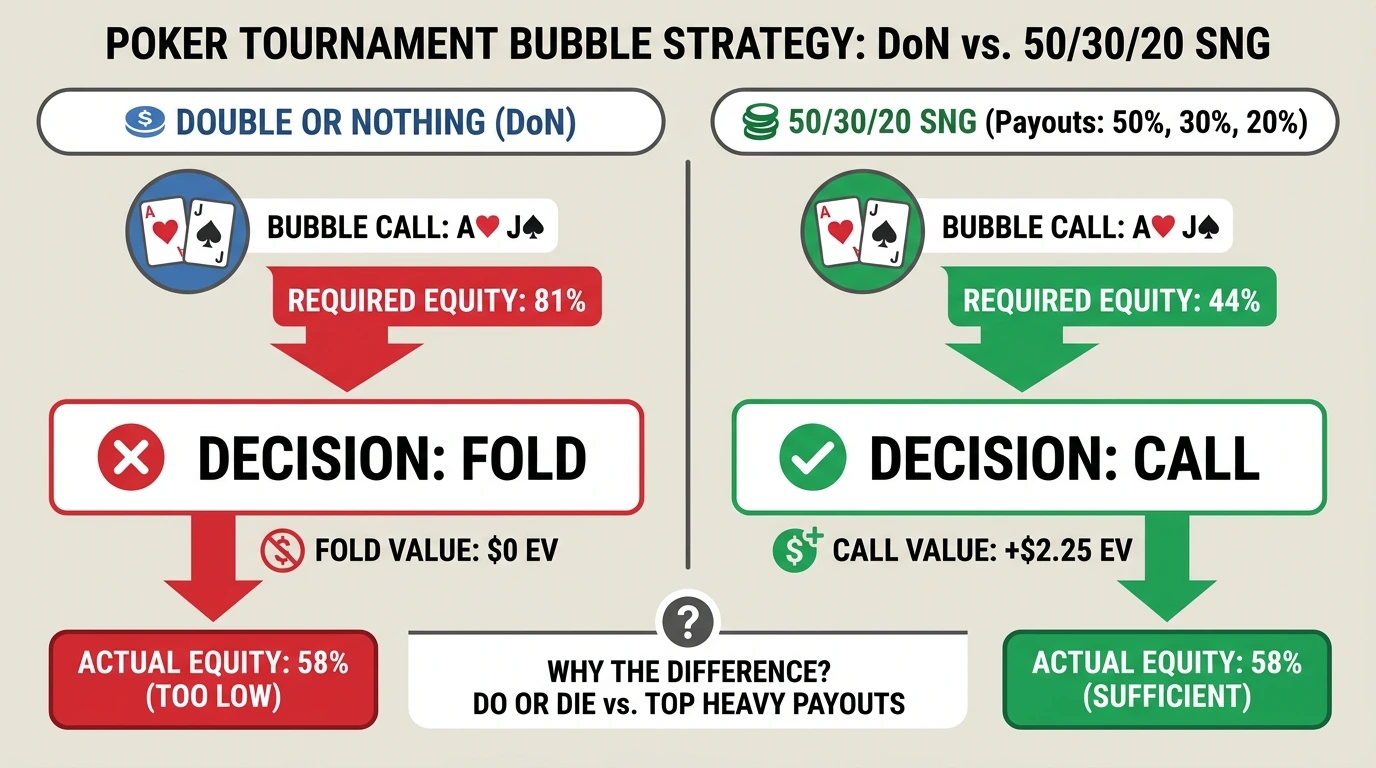
Six players are left in a ten-player double or nothing, five seats get paid, and you hold ace-jack in the big blind. The small blind shoves 12.5 big blinds. Calling is worth $5.82 of a $10 seat. Folding is worth $8.09. You need about 81% equity to call, and ace-jack against a wide shoving range sits at 58%.
That gap between the pot-odds number and the payout number runs the whole format. Double or nothing poker is a No-Limit Hold’em single-table sit-and-go (SNG), and it rewards patience more than aggression. This guide covers how the money works, how it changes every street, and the leaks that cost micro-stakes players the most.
How double or nothing poker sit-and-gos work
Half the field gets paid, half gets nothing, and play stops the moment half the players are gone. PokerListings describes it as a sit-and-go where half of the entrants double their buy-in upon surviving, while the other half wins nothing (PokerListings). The game ends when 50% of players are knocked out (CoinPoker).
Ten seats is the common size, so five seats pay. Eight-seat games pay four. There is no final table and no heads-up battle, because the game is over before that.
The “double” in the name is approximate. Published payouts land under a literal double of the headline buy-in, because the fee comes off the top. PartyPoker’s $20 game pays $39.16, 888poker’s $10 game pays $18.86, and Winamax pays €94 at the €50 level (Cardmates). Some rooms spread regular and turbo versions of the same game, and the turbo runs to the push-or-fold stage much faster.
Why survival beats chip building
Chips turn into dollars at a heavy discount in this format, and the last chips you win are worth almost nothing.
Here is a representative setup. A ten-player double or nothing with a $5.50 buy-in, $5 of it going to the prize pool and 50¢ to the room. That makes a $50 pool, and the top five seats take $10 each. Everyone starts with 1,500 chips.
Every player begins holding $5.00 of that pool. Double up on the first hand and you sit on 3,000 of the 15,000 chips in play, which is 20% of the chips but only $7.78 of the prize pool. The eight players behind you each still hold $5.28. So the double-up added $2.78 to your equity while busting would have cost the full $5.00.
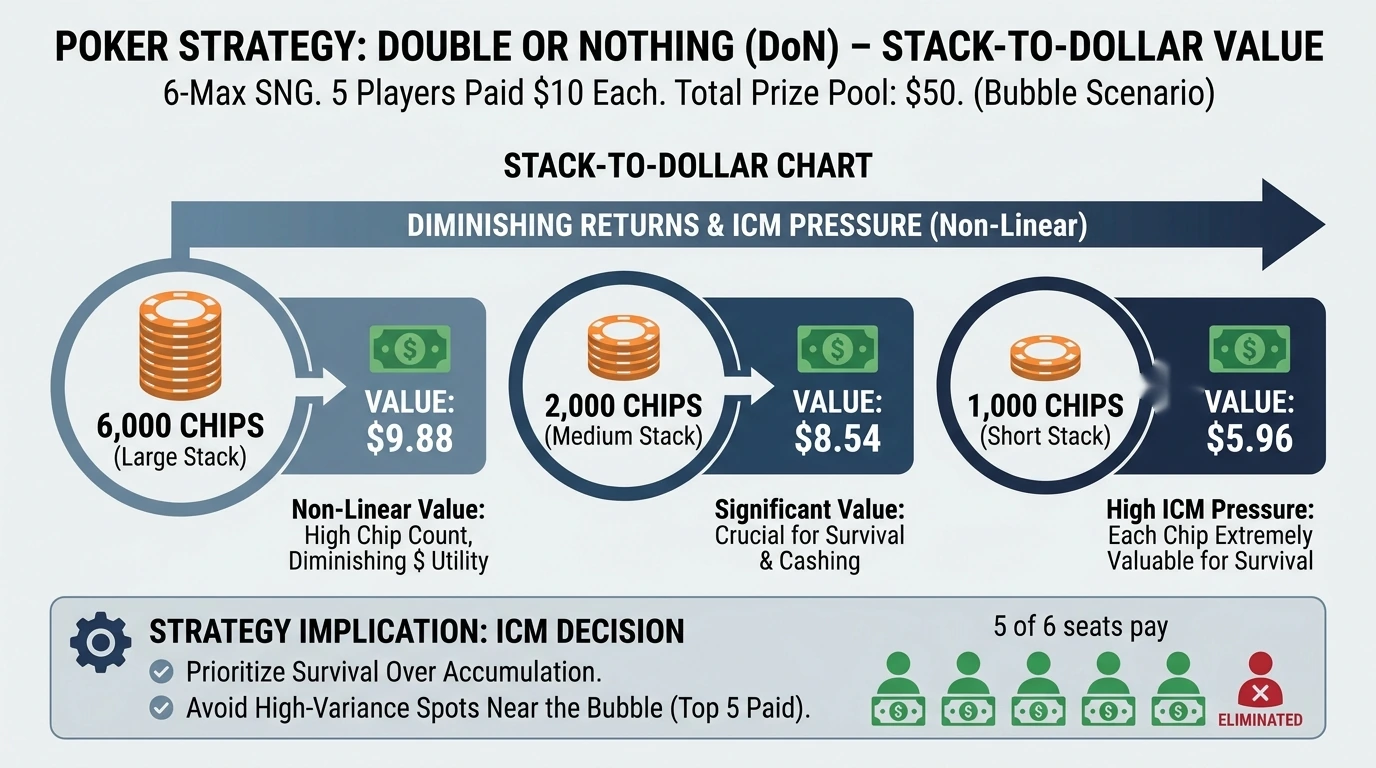
The compression gets stronger as the field shrinks. Picture six players left with five seats paid: one stack of 6,000 chips, four stacks of 2,000 and one stack of 1,000. The 6,000 stack is 40% of all the chips and is worth $9.88. Each 2,000 stack holds $8.54. A stack three times the size holds about 16% more money.
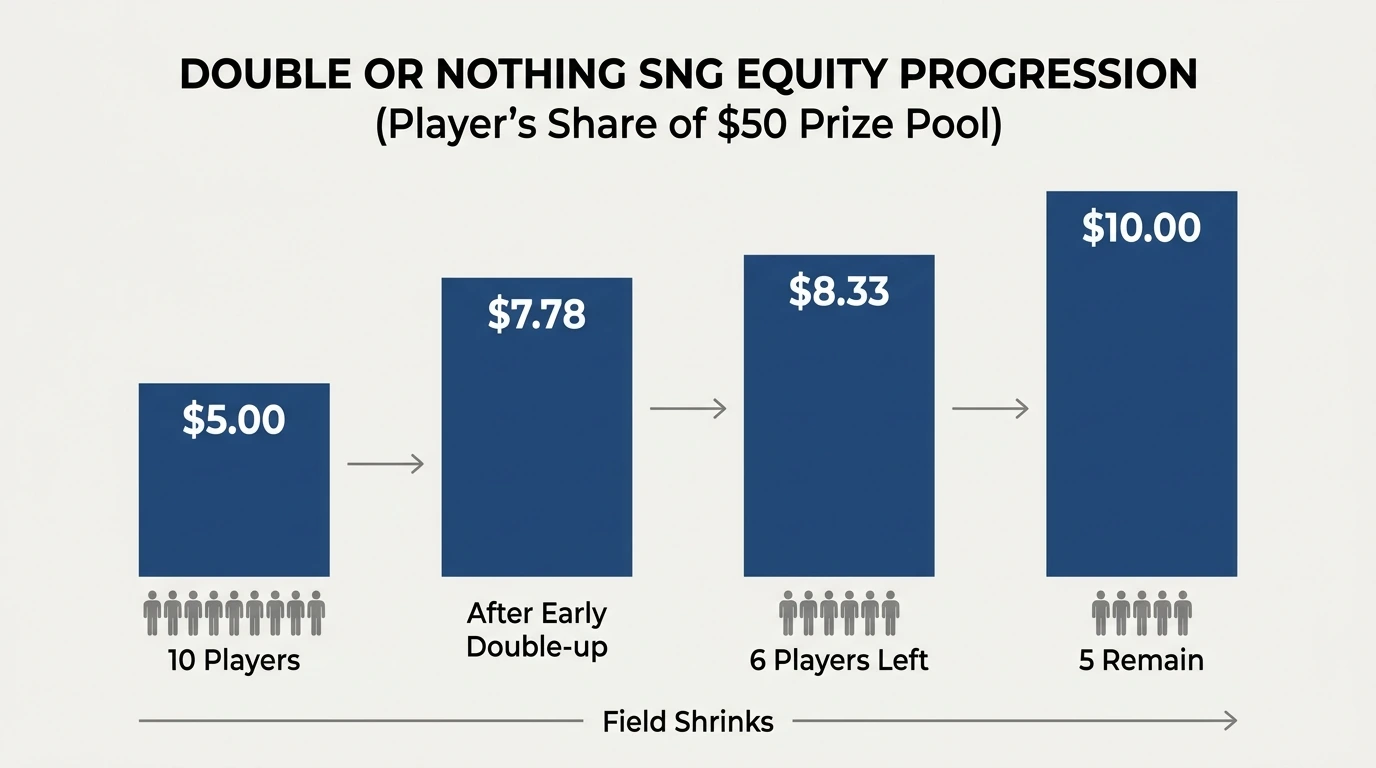
Short stacks stay alive in this format for the same reason. A 1,000-chip stack with six players left and five seats paid still holds $5.96. Nobody is drawing dead while the bubble is open.
PokerStrategy states the conclusion directly: “5th place is as good as 1st in a 10 player DoN” (PokerStrategy).
How ICM reshapes every decision
ICM stands for the Independent Chip Model. It turns chip stacks into each player’s share of the prize pool, on the idea that equal stacks deserve equal shares and a big stack earns less per chip than a short stack does. The maths is the Malmuth–Harville method, worked out by David Harville for horse racing in 1973 and rediscovered for poker by Mason Malmuth in 1987 (Wikipedia).
Run it on the bubble. Six players hold 2,500 chips each and five seats pay $10. Every player’s share is 16.67% of the pool, or $8.33. Win a full all-in and you sit on 5,000 chips with five players left, all of them paid, so your share becomes $10.00. The gain is $1.67 and the risk is $8.33.
Now the ace-jack hand from the top. Blinds are 100/200. You have 2,500 in the big blind, so 2,300 behind. The small blind covers you and shoves 2,500. The pot is 2,700 and a call means putting in 2,300 to win 5,000. Raw pot odds ask for 46% equity.
Ace-jack against a wide small-blind shoving range (any pair, most suited aces, suited kings and queens, suited connectors, and the offsuit broadways) wins 58.21% of the time. That clears the 46% pot-odds bar easily. Under the payout structure it does not come close.
| Decision | Dollar equity |
|---|---|
| Fold, keeping 2,300 chips | $8.09 |
| Call at 58.21% equity | $5.82 |
| Equity needed to call | 80.87% |
Folding is better by about $2.27. The equity you need above the pot-odds number is the risk premium, and here it is about 35 percentage points.
That number looks absurd until you remember what the call risks. Losing ends your tournament with nothing, while winning adds $1.67 to a seat that was already nearly yours.
Compare the same hand in a standard SNG with the usual 50% for 1st, 30% for 2nd and 20% for 3rd (ThePokerBank). On a $50 pool that is $25, $15 and $10. Folding the ace-jack leaves you with $7.43. Calling at 58.21% is worth $9.81. You need only 44% equity, so the call is clearly right.
Same cards, same chips, same opponent. The payout structure flips the answer.
Early stage: tight, small pots, no thin edges
Play tight and keep the pots small. At 1,500 starting chips with 10/20 and 15/30 blinds you are 75 to 150 big blinds deep, and an early double-up is worth $2.78 out of a $10 seat. That pays for a lot of folding.
Raise your good hands and fold the junk. Speculative hands in position for cheap work well at micro stakes, because the field limps and pays off with top pair. Suited connectors and small pairs that flop a monster can win a big pot against a player who cannot fold. Avoid coin flips and avoid chasing thin value with one pair.
The one early adjustment: do not three-bet light or bluff-raise into a field that calls too much. These games punish fancy play and reward straightforward value.
Middle stage: chip up without coin flips
Keep building the stack, but do it with raises rather than calls for your whole stack. With eight players left and five seats paid, an even field of 1,875 chips each is worth $6.25 per player.
Blind stealing becomes the cheapest source of chips on the table. Raise to about 2.2x to 2.5x from late position and take the blinds when everyone folds. Target the players who are waiting for the bubble, since they fold too often. Refuse the big pots against players who cover you, because there is no prize for arriving at the bubble as the chip leader.
The bubble: the tightest spot in the format
With six players left and five seats paid, one bust ends the game and everyone still seated gets paid. That is the whole bubble, and it lasts until a single player is eliminated.
The calling rules are simple. A full-stack shove needs about 81% equity when folding leaves you with a playable stack, which means aces, kings and little else. A small shove needs much less, because you only lose what the shover had: if a 600-chip stack shoves into your 2,500, the risk is 600 and the required equity drops sharply.
Shoving is where the pressure sits. A big stack can push almost any two cards into players who would rather wait for someone else to bust. Two exceptions. Do not shove into the other big stack, and do not shove into a short stack so small that the call is trivial for them.
Short stacks: push first, call second
Shove early rather than drifting down. A 1,000-chip stack with six players left and five seats paid holds $5.96, and with blinds at 100/200 that is 5 big blinds. Folding into the money rarely happens from there, because the blinds and antes take 300 chips a round.
From 10 big blinds and below, pick a spot and move in. Late position, first in, with a wide range. The value of your stack falls faster than the value of the seat you are protecting.
Blinds, stack depth and how shove ranges change
Three depth bands cover almost every decision in this format.
Above 24 big blinds, make small raises and play small pots. You have room to see flops and no reason to risk a stack.
From 14 to 24 big blinds, raise and fold from late position. Shove only when a raise would commit you anyway, such as a min-raise from the small blind into a short stack.
Below 14 big blinds, push or fold. Limping and min-raising with a fold behind cost chips and hand you decisions you did not need to have.
Published no-ante charts shove the small blind 58.4% of the time at 10 big blinds and under the gun only 9.4%; the button at 15 big blinds is 28.2% (PokerCoaching). Those charts price chips at face value for a standard tournament, and a double or nothing needs two edits. Shove wider from late position, because the players behind you must fold more often than the charts assume. And call much tighter, because that 81% figure from the bubble example applies to every full-stack call you make near the money.
Double or nothing vs Fifty50 vs satellites
A Fifty50 pays half the field as well, with a bonus on top for the chips you finish with. PokerStars runs eight-player Fifty50s that pay four, and a $2 entry pays $1.85 plus $0.06 per 100 chips, so a 1,500-chip stack collects $2.75 (PokerStars Learn). The room’s own description of the format appears on its tournament types page (PokerStars). A Fifty50 is a double or nothing that also pays for the chips you finish with.
The stack bonus changes the strategy a little. Chips still convert poorly to dollars, but every chip you finish with has a price tag, so winning a big pot early is worth more than it is in a DoN and there is less reason to fold into the money.
Satellites pay seats rather than cash. A ticket to a bigger event has a fixed value, so a satellite paying one seat per ten players has the same flat payout shape as a DoN: half the field or a tenth of the field, all getting the same thing. The differences sit outside the payout. A satellite ticket cannot be spent, and the target tournament may have different stacks and blind levels from the satellite you won.
Rake, micro buy-ins and whether the edge is there
Micro-stakes rake eats a large slice of a small edge. The 888poker example is the clearest case: a $10 game pays $18.86 rather than a clean $20, and the shortfall goes to the fee. Rake can make you a long-term loser even when you break even in play.
Your edge has to come from the other players’ bubble mistakes, and at micro stakes those mistakes are frequent and large. The rooms that still spread these games include PartyPoker, 888poker and Winamax.
PokerStars stopped offering double or nothing sit-and-gos from 28 February 2011 (TwoPlusTwo). Its Fifty50 is the direct replacement still running there.
Common leaks
Calling too wide on the bubble
This is the most expensive mistake in the format. A strong hand like ace-jack beats the shover’s range and loses money, because the payout is already close to yours. Players call because the hand looks good, because they are tired of folding, or because they want the game to end.
Set the bar at the number the structure gives you. With a playable stack and a full shove in front of you, that bar is around 81%. Against a short stack’s shove, it drops to the normal pot-odds figure plus a smaller premium.
Playing a double or nothing like a normal SNG
In a standard SNG, first pays 2.5x third, so stacking off with a strong hand protects your chance at the top prize. In a DoN there is no top prize. The same call that prints money at 50/30/20 payouts loses $2.27 here.
The same mistake shows up in isolation. Raising a limper with a medium pair, calling a shove with tens because “it is a flip”, or getting 60 big blinds in preflop all belong to a different game.
Ignoring the stack sizes around you
The player who covers you can end your tournament, and the player who does not cover you cannot. Before every decision, check three things: who covers you, who is short enough to bust, and how many big blinds you have left.
If two other players are about to collide, folding costs nothing. If you are the shortest stack with 5 big blinds, that same fold costs you the seat. The format rewards patience, and patience with 5 big blinds is a slow exit.
Frequently asked questions
What is a double or nothing in poker?
A single-table sit-and-go where the top half of finishers each receive roughly double the buy-in and the rest get nothing. Play ends once half the field is eliminated, so a ten-player game finishes with five players still holding chips.
Is double or nothing poker profitable?
Marginally, and rake decides it. A $10 game that pays $18.86 leaves little room, so the edge has to come from opponents who call too wide on the bubble. Losing players outnumber winners in these games, and the fee takes the rest.
How many players get paid in a double or nothing?
Half the field. A ten-player table pays five and an eight-player table pays four, which matches the payout structure of PokerStars’ eight-player Fifty50.
What is the difference between a double or nothing and a 50/50?
A 50/50 pays the same half-field flat share plus a bonus per chip you finish with. A $2 entry pays $1.85 plus $0.06 per 100 chips, so a 1,500-chip stack collects $2.75. That makes chip accumulation worth more in a 50/50 than in a straight double or nothing.
Why did double or nothing SNGs disappear?
PokerStars removed them from 28 February 2011, and other rooms followed. The format still runs at several rooms, mostly at micro and low buy-ins, and turbo versions are common.
Where can I play double or nothing tournaments?
PartyPoker, 888poker and Winamax are the rooms most often listed, across buy-ins from about 40 cents to €50. Check the lobby before you plan a session, and compare the fee at your level, because the payout you get back sets your break-even point.

Written by
Jake Rivera
Founder and No-Limit Hold'em writer
Jake Rivera founded Rivera Poker and writes about No-Limit Hold'em: preflop ranges, ICM and bubble decisions, and the postflop lines that separate tournament play from cash games. He also follows the major series and reports on results, schedules and new formats.